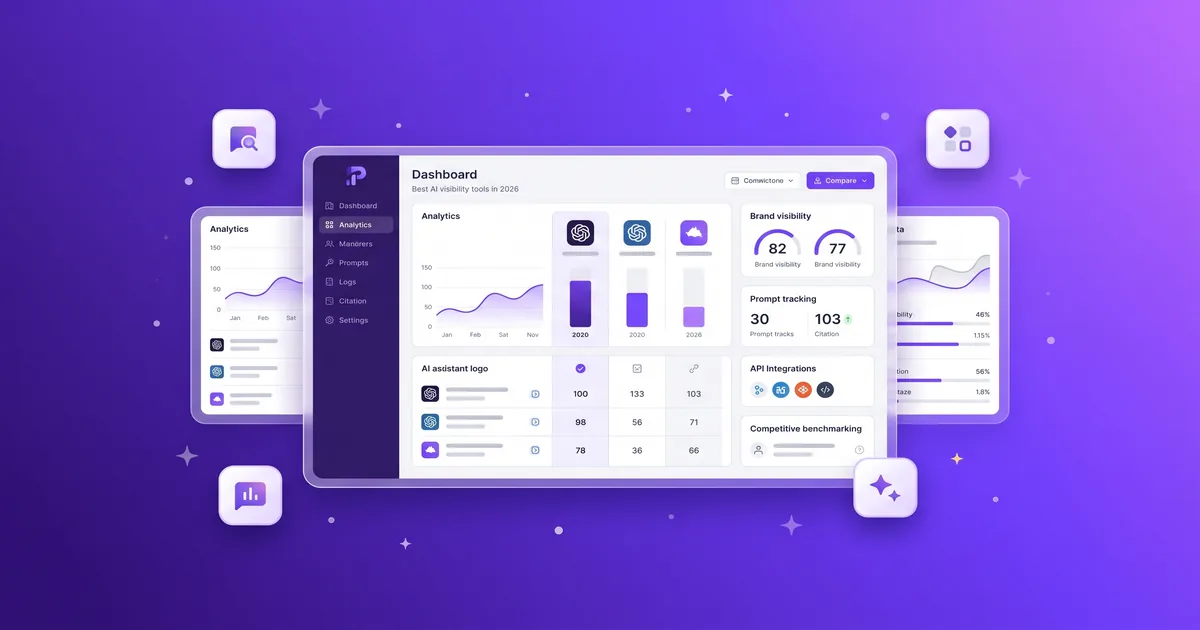

Quick Answer
The best AI visibility tools in 2026 are Rank Prompt (best overall, six engines and an API from $49/mo), Profound (best enterprise answer-engine analytics), Peec AI (best multi-client benchmarking), Rankscale (most AI responses per dollar), Otterly.ai (cheapest entry at $29/mo) and Scrunch (best for how AI agents read your site).
An AI visibility tool is software that runs a fixed set of buyer questions against AI answer engines on a schedule, then records whether your brand was mentioned, which URLs were cited, and who was recommended instead of you.
All prices below were checked on each vendor’s own pricing page in July 2026. Prices in this category change often, so re-check before you buy.
Key Takeaways
- Nothing in this category is a spot check. Repeated sampling is the product; a one-off lookup is noise.
- Engine coverage is gated, and that is the hidden cost. Profound’s $99 tier tracks ChatGPT only. Knowatoa’s $59 tier covers three of its seven services.
- Compare cost per AI response, not per “prompt.” Vendors count in prompts, credits and responses, and those units are not interchangeable.
- API access is the sharpest dividing line. Profound, Peec and Scrunch gate it behind Enterprise. Rank Prompt ships it on the $49 plan.
- Measurement alone changes nothing. Only a few tools in this list also generate content, run outreach or fix crawler access.
- We build Rank Prompt. It ranks first here on breadth and access, and it is the most expensive option per AI response sampled. Both things are true.
What an AI Visibility Tool Actually Does
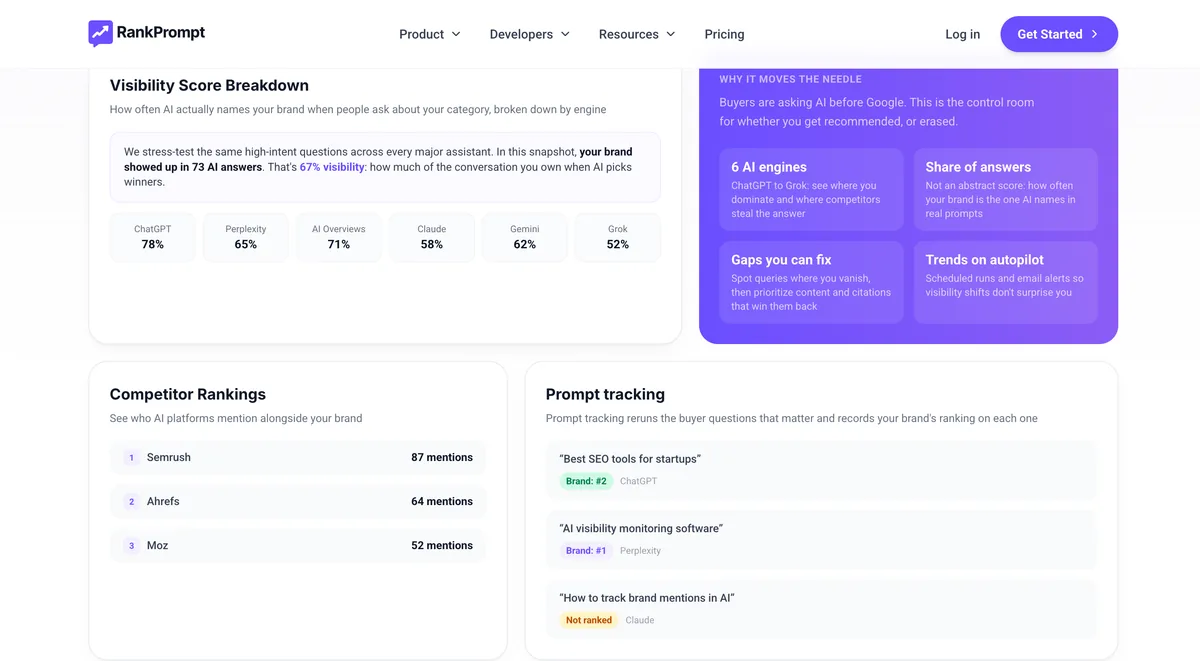
What the category actually produces: a per-engine score, a competitor ranking and a per-prompt result. Sample data shown on Rank Prompt’s own product page.
An AI visibility tool is software that repeatedly queries AI answer engines with a defined prompt set and reports how often a brand is mentioned, cited or recommended in the resulting answers.
That word “repeatedly” carries the whole category. Answer engines are non-deterministic, so the same question asked twice can return different text and different sources.
A 2026 statistical study of Perplexity, OpenAI’s search and Gemini put numbers on it. Sampling the same queries every ten minutes, the authors found that “citation rankings are unstable across samples”.
Many apparent differences between domains sat inside the noise floor of the measurement itself. We see the same thing in client accounts: a score moves four points, everyone gets excited, and the next run puts it back.
Their conclusion is the real sales pitch for this whole product category. Single-run visibility metrics give “a misleadingly precise picture.”
A separate SIGIR 2026 study got there from another direction, finding that AI Overviews are “less consistent when processing two runs of the same query”.
So what you are buying is sample size and consistency. Everything else on a feature list is secondary to that.
What this means for you
- A free one-shot checker is a demo, not a measurement. Useful for a baseline conversation, useless for a trend line.
- Ask every vendor how many AI responses your plan buys per month. That is the real unit.
- Treat any single week’s movement with suspicion unless the tool reports variance alongside the score.
Comparison Table: 10 AI Visibility Tools
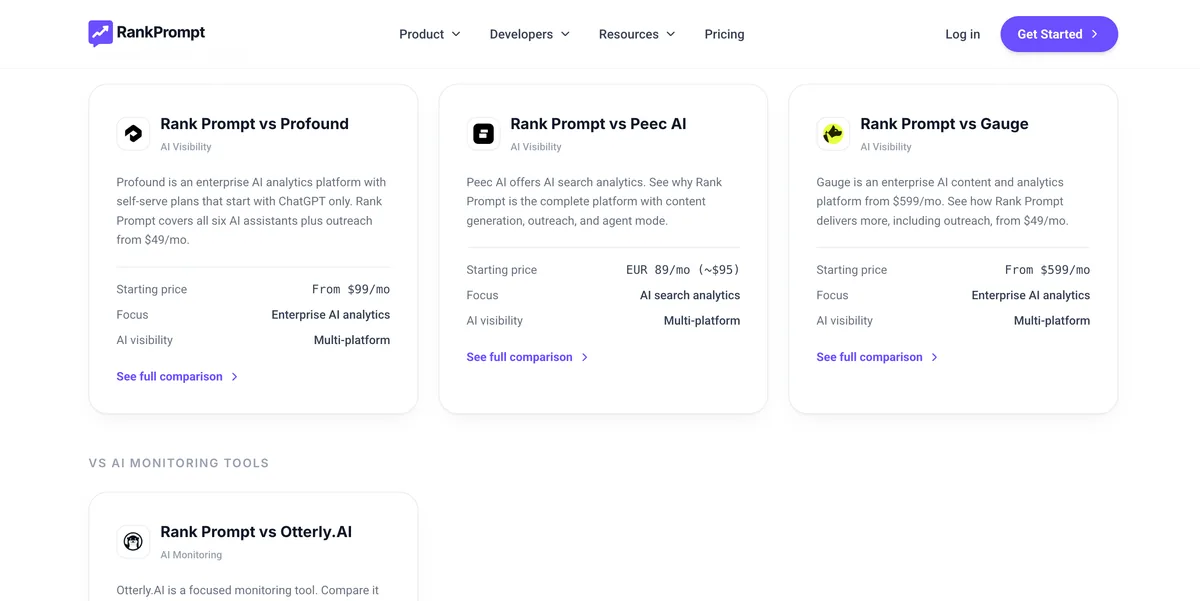
Entry prices differ by an order of magnitude across the category, and so does what the entry tier covers.
Entry price is the cheapest published self-serve plan, verified on each vendor’s own pricing page in July 2026. “Engines at entry” is what the entry tier covers, not what the top tier covers.
| Tool | Entry price | Engines at entry | API access from | Free option | Best for |
|---|---|---|---|---|---|
 Rank Prompt Rank Prompt | $49/mo | All 6 | $49/mo Starter | 7-day trial, 50 prompts | Measuring and then acting in one place |
 Profound Profound | $99/mo | ChatGPT only | Enterprise | Free AEO report | Enterprise analytics and AI crawler traffic |
 Peec AI Peec AI | $95/mo | Any 3 of 6 | Enterprise | Free trial | Multi-client benchmarking and reporting |
 Rankscale Rankscale | $20/mo | Not published | $385/mo Growth | ”Try Pro for Free” | Most AI responses per dollar |
 Otterly.ai Otterly.ai | $29/mo | 4 | $189/mo Standard | 7-day trial, no card | The cheapest serious starting point |
 Scrunch Scrunch | $250/mo | 4 LLMs | Enterprise | 7-day trial | How AI agents consume your site |
 Athena HQ Athena HQ | Free tier, then $295/mo | 9 models | Paid add-on | Free Essential plan | Trying a full toolkit at zero cost |
 Knowatoa Knowatoa | $59/mo | 3 of 7 services | $199/mo Growth | Free audit | Small teams who want recommendations |
 Semrush AI Visibility Semrush AI Visibility | $99/mo per domain | 4 | Not published | None for this toolkit | Teams already living in Semrush |
 Ahrefs Brand Radar Ahrefs Brand Radar | $199/mo per platform | 1 per index | Not published | Free checker, no signup | Search-demand context around prompts |
How We Scored These Tools
Six criteria, in the order they change a buying decision. We weight the first two heaviest because they determine whether the data is trustworthy at all.
- Sampling depth. How many AI responses per month, and how often the prompt set re-runs.
- Engine coverage at the tier you will actually buy. Not the enterprise tier in the marketing copy.
- Citation-level detail. Whether the tool shows the source URLs behind an answer, or only a score.
- Action, not just measurement. Content generation, outreach, schema and crawler fixes.
- Cost per AI response. The only price comparison that survives across different billing models.
- Access and portability. API, MCP, exports, white-label, seats.
What this means for you
- Score the tier you can afford, because engine gating at entry level is where most disappointment starts.
- Weight citations heavily if your plan involves earning placements rather than publishing more.
- Skip criterion 4 entirely if you already have an agency or an in-house team doing the work.
The 10 Best AI Visibility Tools in 2026
1. Rank Prompt
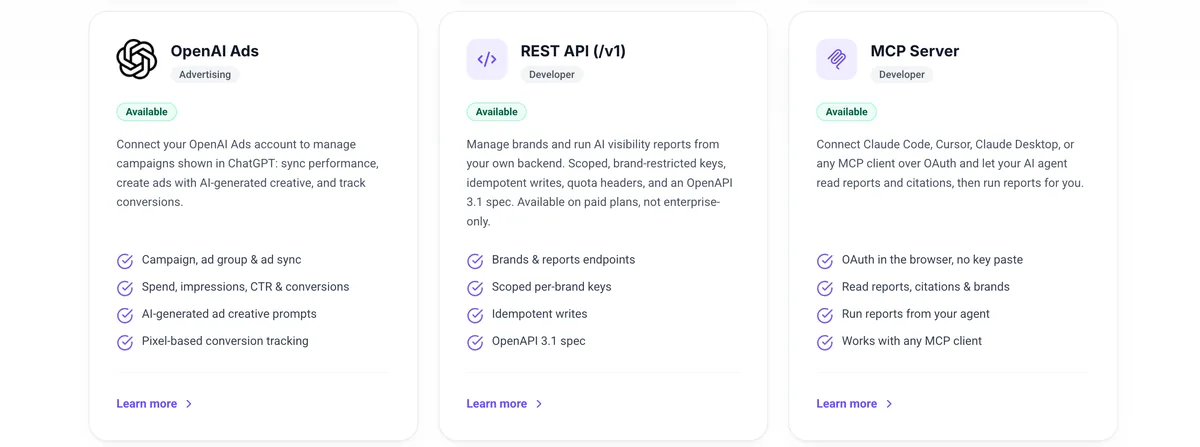
The REST API and MCP server are available on paid plans rather than reserved for Enterprise, which is the main structural difference from Profound, Peec and Scrunch.
The tool we build, and the one we rank first because it covers all six engines at every tier and opens its API on the entry plan. Both of those are unusual in this category.
- Best for: Marketing teams and agencies that need to measure AI visibility and then act on it without buying a second tool.
- Pricing (July 2026): Starter $49/mo (150 tracked prompts a month), Pro $89/mo (500), Agency $149/mo (1,000), Agency Plus $299/mo (2,000). Annual billing takes 20% off. Your first full AI visibility report is free and needs no card; the 7-day trial of a paid plan does.
Pros
- All six assistants on every plan. ChatGPT, Perplexity, Google AI Mode, Claude, Gemini and Grok, with no engine gating at the entry tier.
- REST API and an MCP server from $49/mo, where most rivals reserve both for Enterprise.
- Acts, not only measures. Content generation, author discovery from citations and email outreach campaigns sit alongside the tracking.
- Citation-level source data, so you see which URLs an answer was built from, not just a mention count.
- White-label reporting at $149/mo, plus a client portal and cross-brand agency dashboard higher up.
Cons
- The most expensive option per AI response in this list. 150 tracked prompts at $49 buys 150 sampled responses a month. Profound’s $99 plan buys 1,500.
- One allowance covers everything. The same monthly budget pays for tracked prompts, AI-written articles or Lighthouse audits, so heavy content use eats your tracking budget.
- No published SOC 2 attestation or SAML SSO. If your security review requires either, Profound, Scrunch and Athena HQ are further along.
- No free forever tier. The first report is free, but staying on after that means paying, and the trial needs a card.
2. Profound
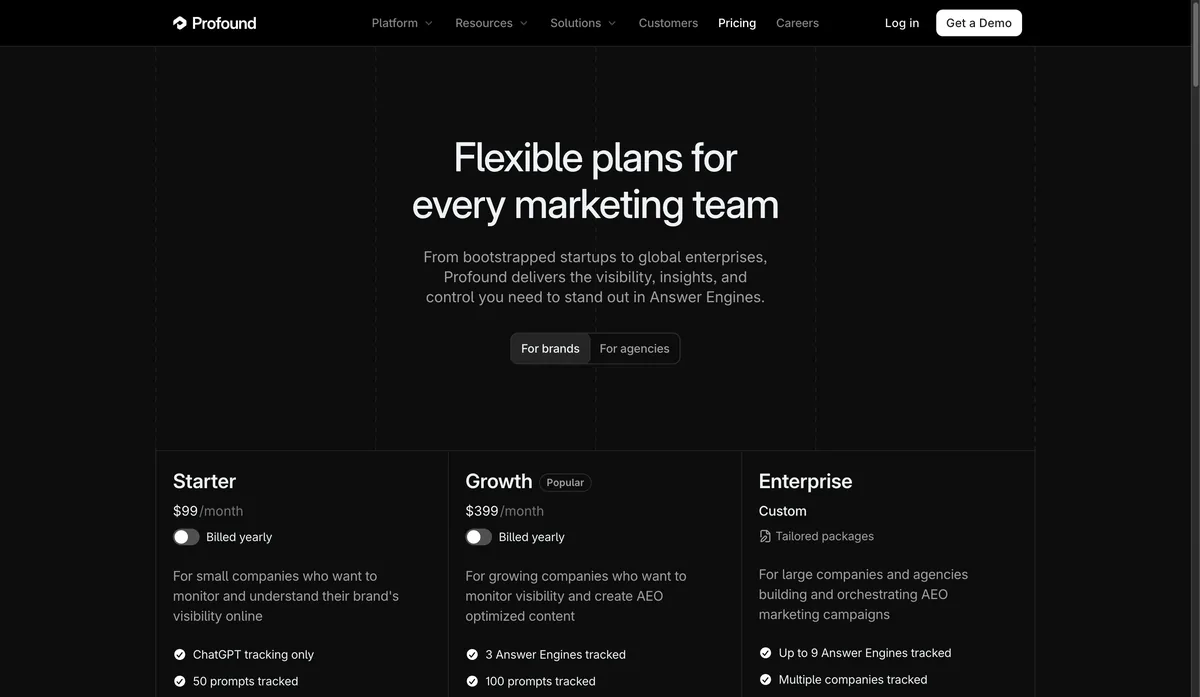
Profound’s public tiers on 31 July 2026: Starter at $99 a month is ChatGPT tracking only, with 50 prompts. Three answer engines start at Growth.
The most established enterprise player, and the only tool here that pairs answer-engine tracking with server-side AI crawler analytics.
- Best for: Enterprise teams that need answer-engine analytics plus data on how AI bots and agents hit their site.
- Pricing (July 2026): Starter $99/mo, Growth $399/mo, Enterprise custom. Agency Growth starts at $99/mo with full client workspaces as a $399/mo add-on. Yearly billing gives two months free.
Pros
- Deepest sampling at the entry price. Starter includes “1,500 responses monthly” against 50 tracked prompts.
- Agent Analytics has no real equivalent here. It reports AI crawler and agent traffic to your own site rather than only what the engines say.
- Enterprise apparatus is real. SSO/SAML and SOC 2 are listed on the Enterprise tier.
- Up to nine answer engines at Enterprise, including Claude, Grok, DeepSeek and Copilot.
Cons
- Starter is ChatGPT only. You reach three engines at $399/mo, which makes the honest entry price four times the sticker.
- API is Enterprise only. No self-serve programmatic access at any published tier.
- Agency pricing compounds fast. Client workspaces are an add-on rather than an inclusion.
If price is your reason for leaving Profound, the cheaper multi-engine options are ranked in our affordable AI visibility tools guide.
3. Peec AI
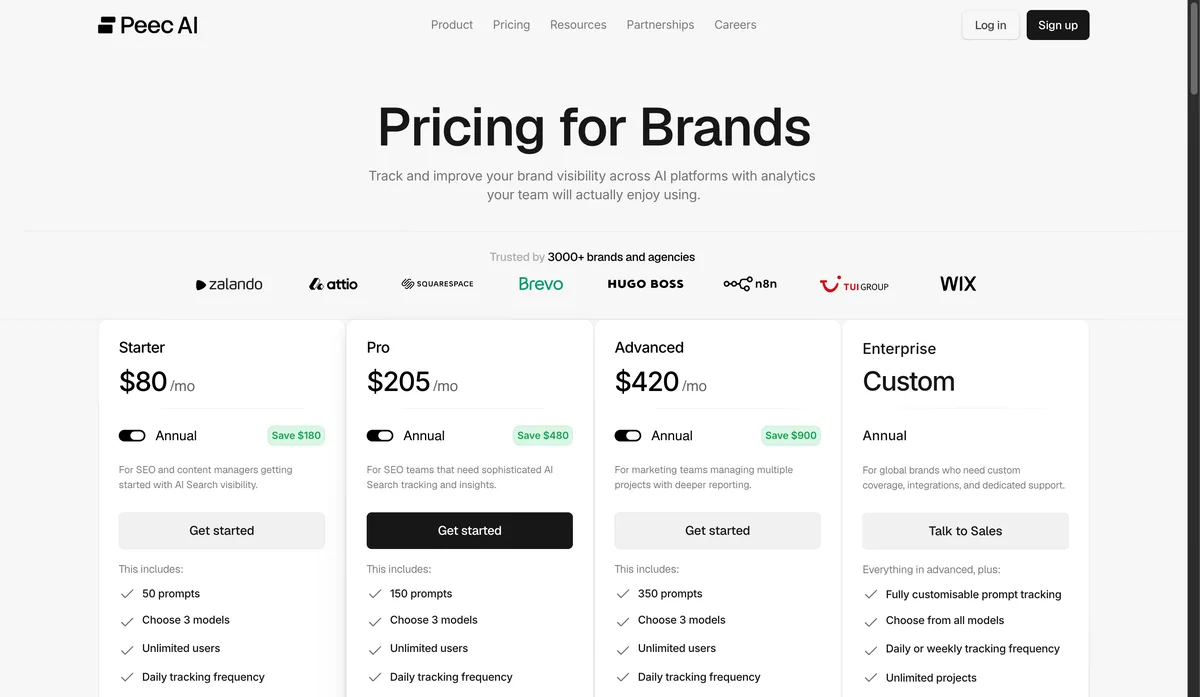
Peec AI’s brand plans on 31 July 2026, captured with the annual toggle on. Monthly billing is higher than the figures shown here, at $95 Starter and $245 Pro.
A clean, well-built analytics product for marketing teams, with the most coherent agency packaging in the category.
- Best for: In-house teams and agencies that want competitor benchmarking and client-ready reporting without an enterprise contract.
- Pricing (July 2026): Starter $95/mo, Pro $245/mo, Advanced $495/mo, billed monthly. Annual billing drops those to $80, $205 and $420 per month. Agency bundles run $205 to $675/mo.
Pros
- Daily tracking on every tier, including the $95 Starter.
- Unlimited users on all plans, which is rare here and matters for larger teams.
- Looker Studio integration from the Advanced tier, plus pitch projects on agency bundles for prospecting.
- No per-country surcharge. Peec states pricing is “based on the number of tracked prompts and models analyzed” rather than regions.
Cons
- Countries are tier-gated even though regions carry no surcharge. The plan matrix allows 1 country per project on Starter and 3 on Pro and Advanced, so a three-market team’s real entry point is Pro, not the $95 Starter. Peec’s own page is inconsistent here: “Multi country” is listed as an Advanced inclusion while the matrix grants 3 countries on Pro.
- Three models only on Starter, Pro and Advanced. Additional models are a $30 to $140 per month add-on.
- API and MCP are Enterprise or the $675 agency tier.
- Measurement only. No content generation or outreach, so you will pair it with something else.
4. Rankscale
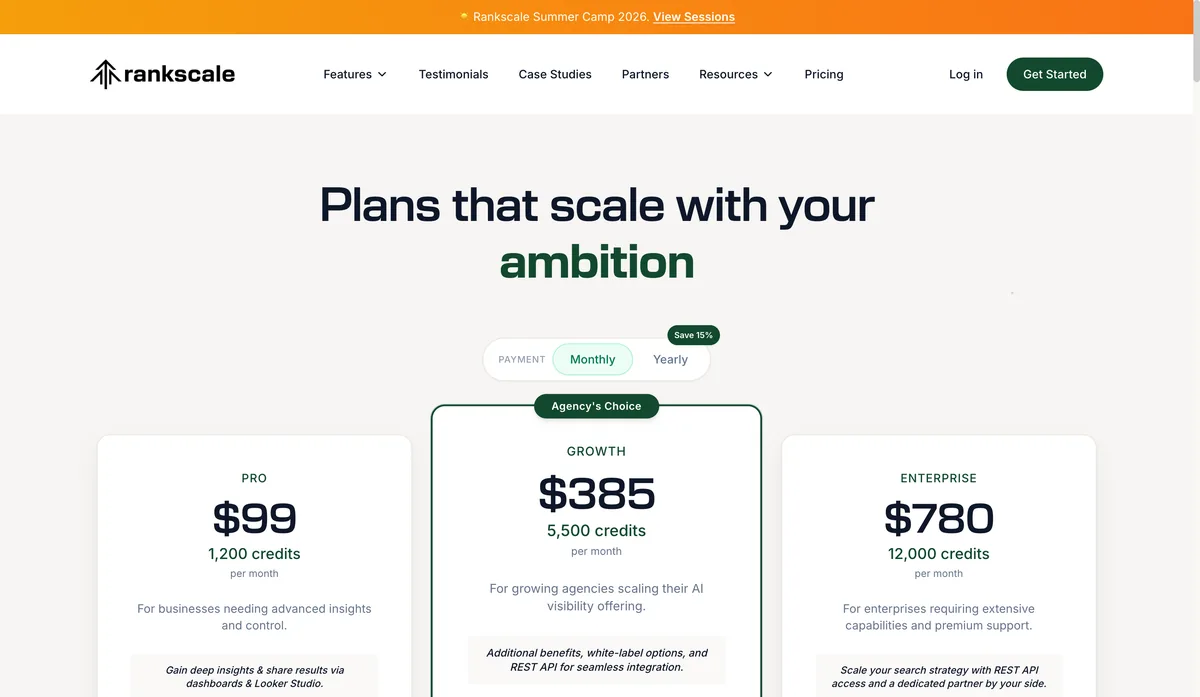
Rankscale’s monthly plans on 31 July 2026. Note the REST API arrives at Growth, and the $20 Essentials tier sits below this crop, publishing no prompt or engine limits at all.
The value pick if raw sampling volume is what you are buying. Nothing else in this list publishes response counts this generous at this price.
- Best for: Teams that want the largest number of AI responses per dollar and will do the acting themselves.
- Pricing (July 2026): Essentials from $20/mo, Pro $99/mo (1,200 credits, up to 4,800 AI responses), Growth $385/mo (5,500 credits, 22,000 responses), Enterprise $780/mo (12,000 credits, 48,000 responses). Yearly billing saves 15%.
Pros
- Roughly $21 per 1,000 AI responses on Pro, the cheapest sampling in this comparison by a wide margin.
- Published Enterprise pricing. At $780/mo it is the only tool here that does not hide its top tier behind a sales call.
- White-labeled dashboard links on Growth and above, with Rankscale branding removed.
- REST API on Growth, below the usual Enterprise gate.
- Unlimited search terms and all regions on Pro.
Cons
- Engine coverage at the $20 Essentials tier is not published. You are buying on faith at the bottom.
- The “17+ engines” headline is a claim, not a list. Around ten are actually named on the site.
- Yearly prices are not published in dollars, only as a 15% discount.
- Smaller company, thinner public track record than Profound or the SEO suites.
5. Otterly.ai
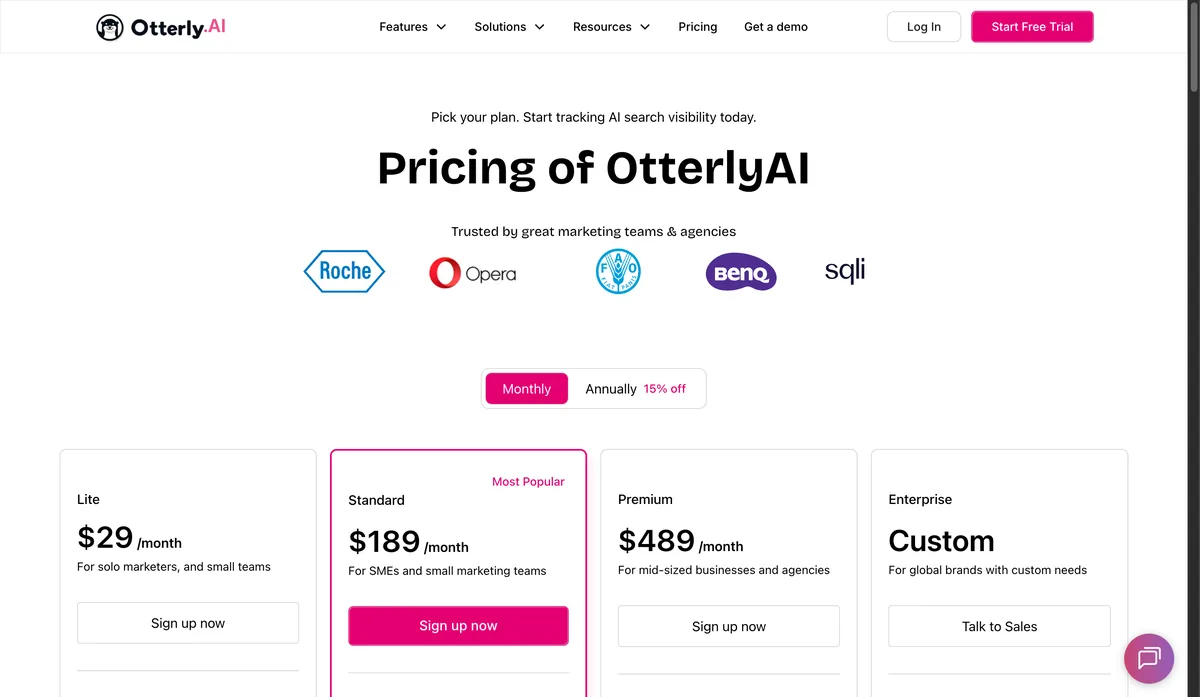
Otterly.ai’s tiers on 31 July 2026, the cheapest serious entry point in the comparison table at $29 a month.
The cheapest serious entry point in the category, and the lowest-priced route to a public API among the pure trackers.
- Best for: Solo marketers and small teams who need a real trend line for under $50 a month.
- Pricing (July 2026): Lite $29/mo (15 prompts), Standard $189/mo (100), Premium $489/mo (400), Enterprise custom. Annual billing takes 15% off. Prices are stated in US dollars excluding tax.
Pros
- $29/mo with daily tracking and four engines included: ChatGPT, Google AI Overviews, Perplexity and Copilot.
- API and MCP access at $189/mo, far below where Profound, Peec and Scrunch open theirs.
- 7-day free trial with no credit card, stated plainly on the homepage rather than buried in a CTA.
- Agency Partner programme adds pitch workspaces and Looker Studio reports under your own branding.
- Unlimited team members on every plan.
Cons
- 15 prompts on Lite is a very small sample. Enough for a baseline, thin for a category.
- Claude, Gemini and Google AI Mode are paid add-ons, from $9 to $439 per month each depending on tier.
- The jump from $29 to $189 is steep with nothing in between.
- Agency status is apply-only. You subscribe first, then apply.
6. Scrunch
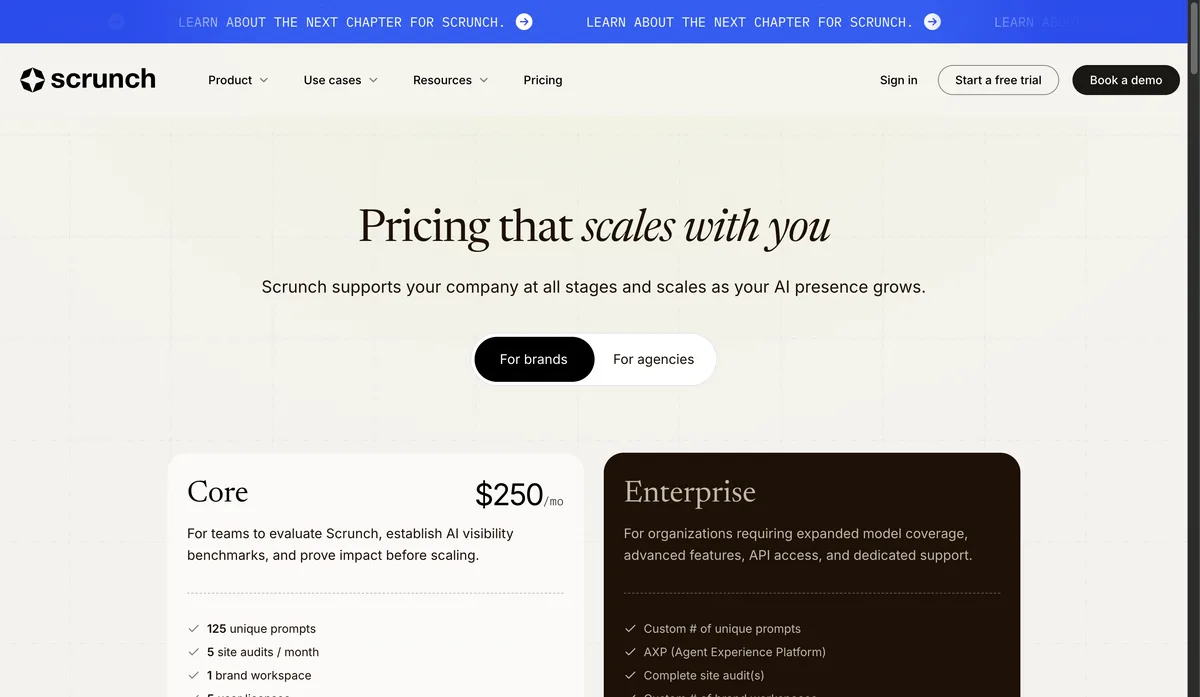
Scrunch publishes exactly two tiers. Core is $250 a month for 125 unique prompts, and everything beyond that is a sales conversation.
Repositioned around how AI agents experience your site, which is a different bet from pure answer tracking. Note the domain moved from scrunchai.com to scrunch.com.
- Best for: Enterprises whose priority is making the site itself legible to AI agents, not only monitoring answers.
- Pricing (July 2026): Core $250/mo (125 prompts, 4 LLMs), Agency Core $500/mo (250 prompts, 3 brand workspaces, 3 pitch workspaces), Enterprise custom with 9 LLMs.
Pros
- Describes its Agent Experience Platform as a way to “deliver an optimized experience to AI agents,” which is a distinct angle from answer monitoring.
- Pitch workspaces on the agency tier, built for winning new business.
- Nine LLMs at Enterprise, among the widest published coverage here.
- 7-day free trial, advertised with no credit card required.
Cons
- $250/mo is the highest entry price of any dedicated tool in this list.
- API, MCP, CLI and Looker access are all Enterprise-only.
- Four LLMs at Core despite the entry price.
- Annual pricing is not published. Their FAQ raises the question without answering it in readable page copy.
7. Athena HQ
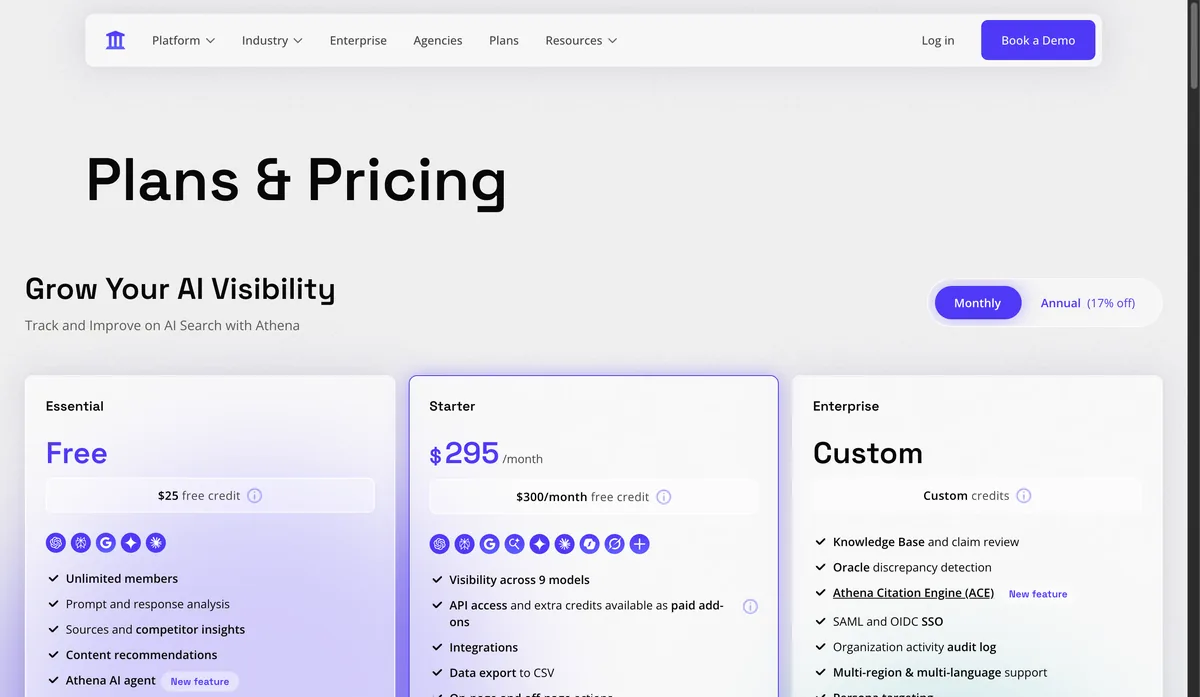
Athena HQ is the only tool here with a genuinely free tier. Essential is free with $25 of credit, and the first paid step is $295 a month.
The only tool here with a real free tier, which makes it the cheapest way to find out whether you like using this kind of software. We describe it only from its own public site.
- Best for: Teams that want to evaluate a full AI-search toolkit before spending anything.
- Pricing (July 2026): Essential free with $25 of credit (300 credits), Starter $295/mo with $300 of monthly credit (3,600 credits), Enterprise custom. Annual billing is advertised at 17% off. Athena states that “1 credit = 1 AI response”.
Pros
- A real free plan, not a trial. Essential carries 300 credits.
- Nine models named on the pricing page, with more “available upon request.”
- About $82 per 1,000 AI responses on Starter, cheaper sampling than Profound Growth.
- The site states SOC II Type 2 certification and GDPR compliance, which matters in enterprise procurement.
Cons
- $295/mo is a hard jump from a 300-credit free tier.
- API access is a paid add-on billed on top of Starter, not included.
- No white-label claim. The Enterprise language is “white-glove setup,” which is a different thing.
- Nothing between free and $295.
8. Knowatoa
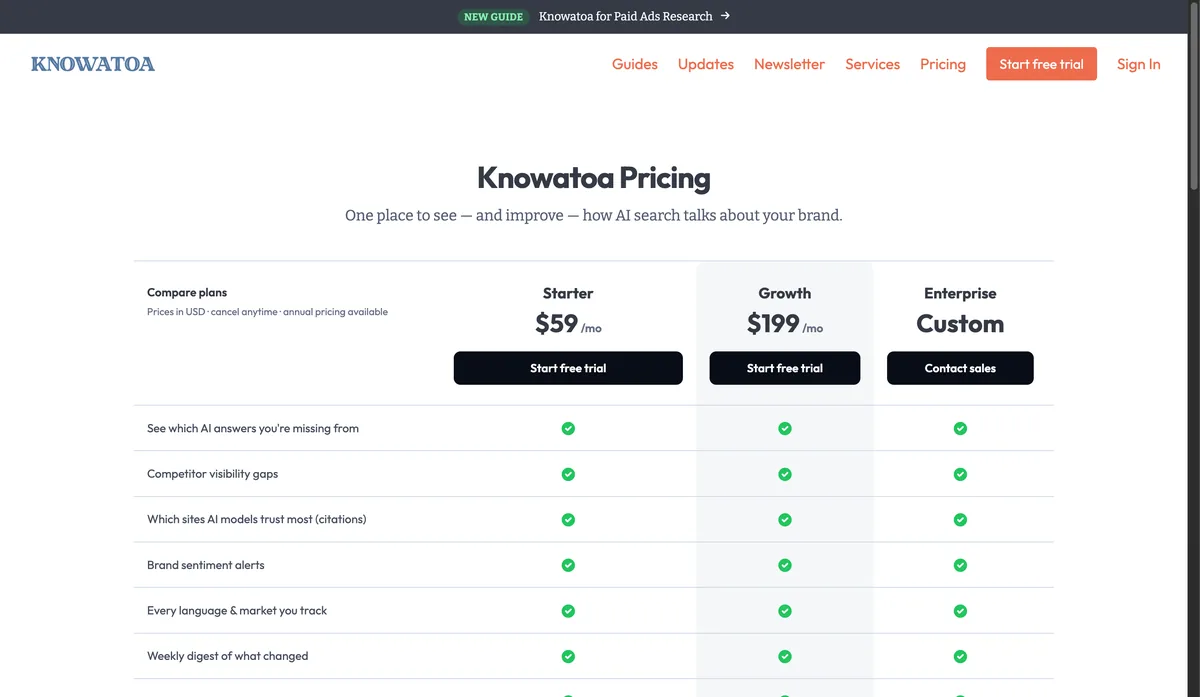
Knowatoa’s published tiers on 31 July 2026, aimed at small teams that want recommendations rather than raw dashboards.
Positioned as recommendations rather than dashboards, which suits teams with no dedicated GEO person.
- Best for: Small teams who want to be told what to fix, not handed another chart.
- Pricing (July 2026): Starter $59/mo, Growth $199/mo, Enterprise custom. Prices are stated in USD, cancel anytime, with annual pricing available but no published annual figure.
Pros
- Frames itself as “an AI Search Marketer” for your team, leading with personalized recommendations.
- API, MCP, Looker Studio and NinjaCat on Growth, a broad reporting stack at $199.
- Every language and market included on both paid tiers.
- Free audit with no credit card, advertised at 60 seconds.
Cons
- Starter covers three services only: ChatGPT, AI Overviews and AI Mode. All seven require the $199 Growth plan.
- No prompt or response counts published, so you cannot compare sampling cost against anyone else.
- Trial length is not stated.
- Smallest published feature surface of the dedicated tools here.
9. Semrush AI Visibility Toolkit
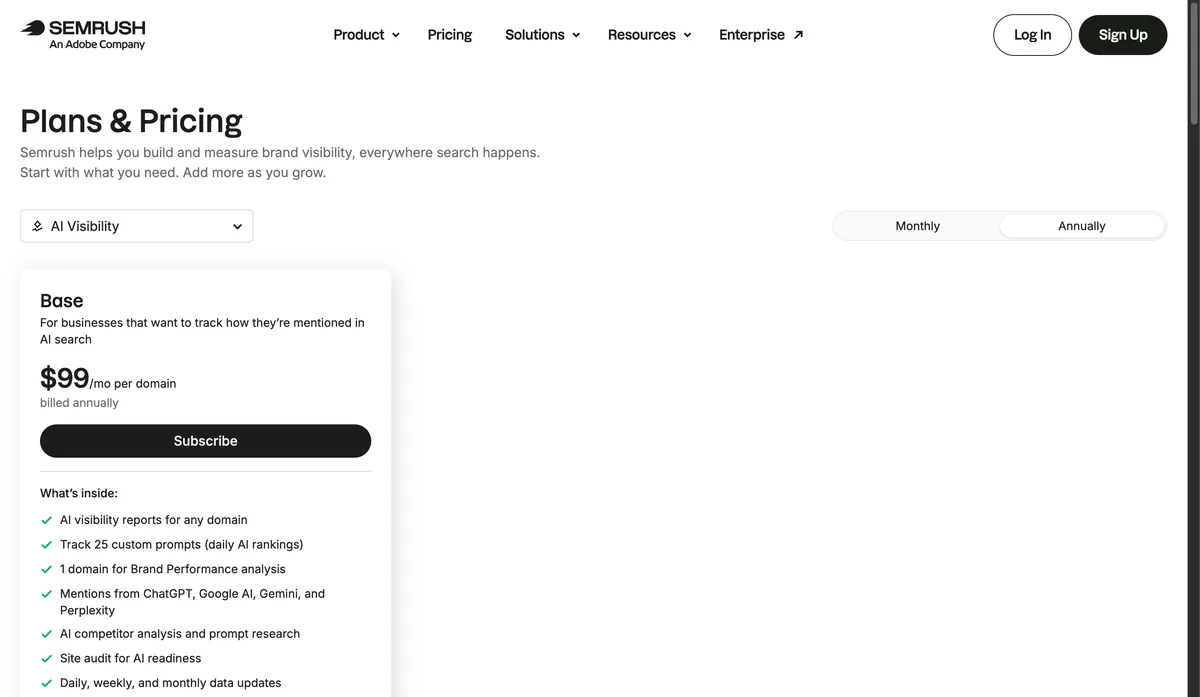
Semrush prices the AI Visibility Toolkit per domain rather than per seat, which is what makes multi-brand tracking expensive here.
The pragmatic choice when your team already runs on Semrush and switching costs outweigh a better point solution.
- Best for: SEO teams with an existing Semrush subscription and a reporting workflow built around it.
- Pricing (July 2026): $99/mo per domain, described on the pricing page as billed annually. Extra domains are $99 each; 50 additional prompts cost $60/mo. Semrush One bundles it with the SEO Toolkit from $199/mo monthly.
Pros
- One login, one invoice, one reporting stack alongside your existing keyword and backlink data.
- Prompt Research and AI Search Site Audit connect AI visibility to the technical work in the same tool.
- Four engines included: ChatGPT, Google AI, Gemini and Perplexity.
- Semrush One is a reasonable bundle if you were renewing the SEO Toolkit anyway.
Cons
- No free trial for this toolkit. Semrush’s own help centre states plainly that “a paid subscription is required”, despite the site-wide 7-day trial banner.
- 25 prompts at the base price works out near $4 per tracked prompt, level with Profound’s Growth tier and roughly double Peec or Otterly.
- Priced per domain, which multiplies quickly for agencies.
- The monthly, non-annual price is not clearly published.
10. Ahrefs Brand Radar
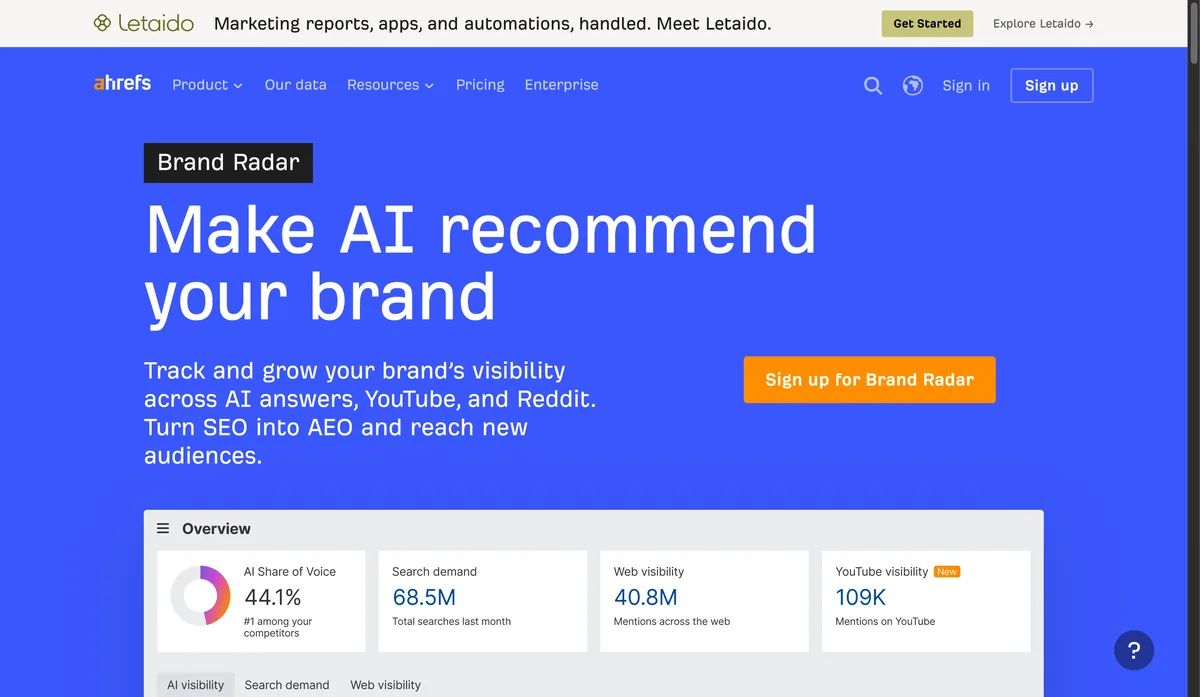
Brand Radar’s reason to exist: AI share of voice sitting next to traditional search demand in one view. Pricing is quoted elsewhere on the page, at $199 a month per platform index.
Strong at connecting AI prompts back to search demand, and the only vendor here with a free checker that needs no signup.
- Best for: Teams that want prompt volume context and already own an Ahrefs plan.
- Pricing (July 2026): $199/mo per AI platform index, $699/mo for all platforms including 2,500 custom prompt checks. Base Ahrefs plans run Starter $29/mo through Enterprise $1,499/mo. The help centre states that “Lite and higher Ahrefs plans come included with Custom prompts to track in AI.”
Pros
- A genuinely free AI visibility checker, with “no signup, no credit card, no limit on how many brands you can check.”
- Search-demand grounding. Brand Radar is described as tracking AI visibility across a large prompt corpus rather than only your own prompt list.
- Covers surfaces others skip, including YouTube, Reddit and TikTok in beta.
- Useful if you already pay for Ahrefs, since some AI tracking is bundled into Lite and above.
Cons
- $199/mo per platform index makes multi-engine coverage expensive fast. All platforms is $699/mo.
- Two different prompt-corpus figures appear across Ahrefs pages, 458M+ on the product and pricing pages and 405M+ in the help centre, so quote whichever page you cite.
- The advertised $398/mo is two platform indexes, not one. The platform selector on the Brand Radar page ships with two already ticked, so the headline price you first see is double the $199 entry.
- Whether the index can be bought without a base plan is not documented.
- Claude checks consume eight checks each, which quietly multiplies the price of the engine many buyers most want.
What Sampling Really Costs
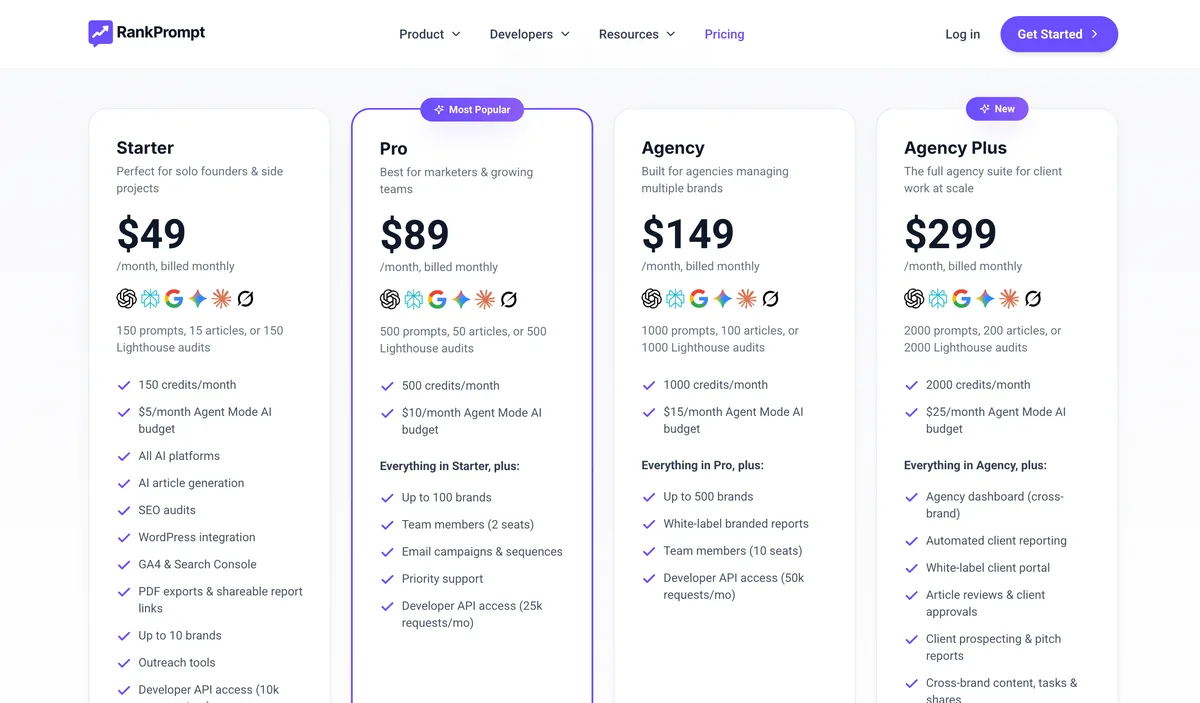
Rank Prompt’s four self-serve tiers, monthly billing. One monthly allowance covers tracked prompts, articles and audits alike, which is the trade-off behind the cost-per-response figures below.
Four vendors publish enough detail to compute a like-for-like number. The rest count in “prompts” without saying how often those prompts re-run, which makes their pricing incomparable by design.
| Plan | Price/mo | AI responses/mo | Cost per 1,000 responses |
|---|---|---|---|
| Rankscale Pro | $99 | up to 4,800 | ~$21 |
| Rankscale Growth | $385 | 22,000 | ~$18 |
| Profound Growth | $399 | 9,000 | ~$44 |
| Profound Starter | $99 | 1,500 | ~$66 |
| Athena HQ Starter | $295 | 3,600 | ~$82 |
| Rank Prompt Agency | $149 | 1,000 | ~$149 |
| Rank Prompt Starter | $49 | 150 | ~$327 |
That table does not flatter us. On sampling volume alone Rank Prompt is the most expensive option here, and Rankscale is roughly fifteen times cheaper per response.
What the table leaves out is what those responses buy. The same Rank Prompt allowance also produces articles, audits and outreach campaigns, and every tier covers all six engines rather than one.
What this means for you
- Buying pure measurement? Rankscale or Profound Growth will sample far more for the money.
- Buying measurement plus execution? Compare against the cost of a separate content tool, not against a tracker.
- Ask for the response count in writing before you sign anything. Most vendors will not volunteer it.
What We Excluded, and Why
Two things get counted as AI visibility tools that we would not put in a ranking.
- TrackerAI. We checked trackerai.com, trackerai.ai, trackerai.io and tracker-ai.com in July 2026. None of them is an AI visibility product. One is a parked page, one is veterinary clinical software, one is an unlaunched SEO toolkit. The name people usually mean is Trackerly.ai, which is a real product in this space but which we have not tested.
- Free one-shot checkers presented as tools. Several exist, including our own and Ahrefs’. They are useful for a baseline. They are not measurement, for the reasons in the sampling section above.
We also left out done-for-you agencies. Those follow a different buying process and get their own ranking in best AI visibility agencies.
How to Choose the Right Tool for Your Situation
Pick by constraint, not by feature count. Five constraints cover almost everyone.
- Budget under $50/mo: Otterly.ai Lite at $29 or Rank Prompt Starter at $49. The trade is sample size against engine coverage. Our full affordable AI visibility tools guide runs that cut in detail.
- You need volume, not help: Rankscale Pro at $99. Nothing else comes close per response.
- You need to act on what you find: Rank Prompt, or a tracker plus a separate GEO stack. Measurement and optimization are different purchases, and most trackers here only do the first.
- You are an agency with client reporting: Rank Prompt Agency at $149 for white-label reports (Agency Plus at $299 adds the client portal), Peec AI’s agency bundles, or Rankscale Growth for white-labeled dashboards.
- You have a security review: Profound, Scrunch or Athena HQ, which publish SSO and compliance claims. This is where we lose deals and it is fair that we do.
Two more cases worth naming. If you sell products rather than services, product-level visibility changes the maths, and we handle that in AI visibility tools for ecommerce.
And if you already pay for Semrush or Ahrefs, price their add-on before you add a tenth login. Tool sprawl kills more GEO programmes than budget does.
What this means for you
- Trial two tools on the same prompt set, not one tool for twice as long.
- Expect the numbers to disagree. Different prompt sets and sampling schedules produce different scores from the same reality.
- Buy the tier with the engines you need, because upgrading for engine access is the most common regret in this category.
What No AI Visibility Tool Can Do
Four limits apply to every tool on this list, and the marketing in this category rarely mentions any of them.
- None of them can see inside a ranking system. Google states directly: “No third-party tool has access to our internal ranking or AI systems.” Treat any claim of internal metrics as a red flag.
- None of them fixes retrievability for you. The SIGIR 2026 study found that sites blocking Google’s AI crawler “are significantly less likely to be retrieved by AIOs”, even when the content is otherwise accessible. That is a robots.txt problem, not a dashboard problem.
- None of them makes the engines accurate. The Tow Center tested eight AI search tools against 1,600 queries and found they “provided incorrect answers to more than 60 percent of queries.” A 2023 Stanford audit of four generative search engines found only 51.5% of generated sentences were fully supported by their citations, a baseline worth remembering before you trust any answer. Monitoring surfaces the errors. Correcting them is outreach work.
- None of them replaces the underlying content. The original GEO research from KDD 2024 found that adding quotations, statistics and cited sources “can boost visibility by up to 40%”, while keyword stuffing produced “little to no performance improvement.”
The stakes are still real. Pew found that users who saw an AI summary clicked a traditional result in 8% of visits, against 15% when no summary appeared. Google says AI Overviews now reach over 2.5 billion monthly active users.
Cloudflare’s network data shows 80% of AI crawling over twelve months was for training, against 18% for search and 2% for user actions.
So most bot traffic hitting your site is not the traffic that puts you in an answer. That is why crawler-level detail beats a raw hit count, and it is the first thing we check when a client’s logs look busy but their visibility is flat.
What this means for you
- Fix crawler access before you buy anything. Check that OAI-SearchBot, PerplexityBot and Claude-SearchBot are permitted.
- Budget for the work, not only the dashboard. The tool is maybe a quarter of the cost of moving the number.
- Expect to correct errors by hand. No vendor edits what a model says about you.
Where This Fits
This is the hub of our AI visibility cluster. The dedicated guides go deeper on the cuts we deliberately kept short here: agencies and done-for-you services, ecommerce and budget tiers.
For the concepts underneath the tooling, and for AI search optimization as a discipline rather than a purchase, start with what is AI visibility, then answer engine optimization and GEO vs SEO.
Our longer inventory of AI search visibility tracking tools covers a wider set of smaller vendors, including several we did not rank here.
Check your AI visibility free → See which engines mention your brand today, and which ones don’t.
Sources
All vendor pricing was verified on the vendor’s own pricing page in July 2026.
 Google: Search Central: AI features and your website (primary, updated July 2026)
- Google: New opportunities, control and insights for website owners (primary)
 OpenAI: Bots and crawlers (primary)
 Perplexity: Crawler documentation (primary)
 Anthropic: Does Anthropic crawl data from the web? (primary)
- Sielinski, R. (2026). Quantifying Uncertainty in AI Visibility. arXiv:2603.08924 (academic, preprint)
- Grossman, R., Liu, S., Chen, M. K. (2026). How Generative AI Disrupts Search. arXiv:2604.27790, accepted to ACM SIGIR 2026 (academic, peer-reviewed)
- Aggarwal, P. et al. (2023). GEO: Generative Engine Optimization. arXiv:2311.09735, KDD 2024 (academic, peer-reviewed)
- Liu, N. F., Zhang, T., Liang, P. (2023). Evaluating Verifiability in Generative Search Engines. arXiv:2304.09848, Findings of EMNLP 2023 (academic, peer-reviewed)
- Pew Research Center: Google users are less likely to click on links when an AI summary appears (independent)
- Cloudflare: The crawl-to-click gap (independent)
- Tow Center / CJR: AI Search Has a Citation Problem (independent)
- Vendor pricing pages: Rank Prompt, Profound, Peec AI, Rankscale, Otterly.ai, Scrunch, Athena HQ, Knowatoa, Semrush, Ahrefs
 Grok
Grok