Quick Answer
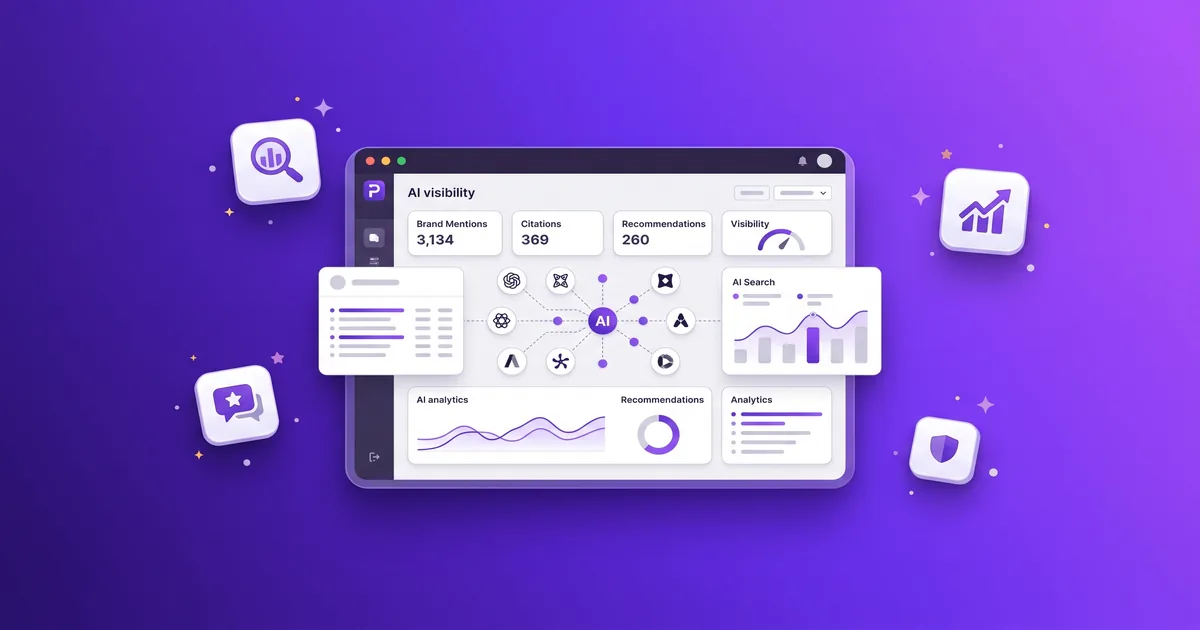
AI visibility is how often, how prominently, and how accurately your brand appears inside answers generated by AI systems such as ChatGPT, Google AI Overviews, Perplexity, Gemini, Claude, and Grok. It covers three distinct outcomes: being mentioned by name, being cited as a linked source, and being actively recommended.
Those three come apart in practice. You can be named without being cited, or cited without being recommended, and each gap has a different fix. Collapsing them into one number is the most common measurement mistake we see.
Key Takeaways
- AI visibility is an outcome, not a tactic. GEO and AEO are the work; AI visibility is what you measure afterwards.
- It is platform-specific, far more than most teams assume. In our own citation corpus, 85.2% of cited URLs were cited by exactly one of eight AI platforms. One engine tells you little about the other seven.
- There is no “position 7.” An AI answer either includes you or it doesn’t, so visibility is a coverage rate, not a rank.
- Retrieval decides everything. If your content isn’t retrievable at answer time, no amount of on-page work will surface it.
- Structure and sourcing are the levers with real evidence. Quotations, statistics and cited sources lift visibility by up to ~40%; keyword stuffing does nothing.
What Is AI Visibility?
AI visibility is the degree to which a brand appears inside AI-generated answers, measured by how often it is mentioned, whether it is cited as a source, and whether it is recommended.
An AI answer engine is any system that answers a question with synthesized prose instead of a ranked list of links. Google AI Overviews and AI Mode, ChatGPT, Perplexity, Gemini, Claude and Grok all qualify.
Here is why that changes your job. A results page has ten slots and you optimize your way up them. An AI answer has no slots. The model reads a handful of retrieved sources and writes a paragraph, and you are either in that paragraph or you are not. There is no second page to climb from.
Picture a buyer asking an assistant to shortlist vendors in your category. It returns four names, a line each. If you aren’t one of them, nothing about that moment surfaces anywhere: no impression, no bounce, no lost-deal reason. The shortlist was drawn without you.
In AI search you don’t lose on page two. You lose inside a paragraph the buyer never audits.
So stop asking “where do I rank in ChatGPT.” There is no rank. There is a coverage rate across a set of buyer questions, and it differs on every platform.
Why AI Visibility Matters When Clicks Disappear
The click you used to win is disappearing, and the mention you win instead doesn’t show up in any report you currently run.
Pew Research tracked 900 U.S. adults’ browsing in March 2025. When an AI summary appeared, people clicked a normal search result on 8% of visits versus 15% without one, and clicked a link inside the summary just 1% of the time. Google disputes the methodology, worth noting, but it matches what publishers see.
What that means for you is a reporting change before a tactics change. If AI visibility is judged on sessions, it will always look like failure, because the click was never the thing being won. Move it next to brand tracking, not next to organic traffic, or you will spend quarter two defending a metric the work was never going to move.
The same story shows up in your server logs. Cloudflare’s crawler analysis found AI platforms requesting pages at thousands-to-one ratios against the referrals they send back. The trap is reading that volume as demand. It isn’t. Heavy crawling with no referrals means your content is feeding answers you cannot see, which argues for measuring the answers directly rather than inferring health from traffic.
Then the risk nobody budgets for. The Tow Center ran 200 tests across eight AI search engines and got incorrect citations in more than 60% of cases, from 37% on Perplexity to 67% on ChatGPT Search. A confidently wrong description of your pricing or your category is worse than silence, and it splits your remediation in two: absence is a content and coverage problem, while a wrong description means correcting whichever source the engine is leaning on, usually someone else’s page. Track presence alone and you’ll never see the second one.
How AI Visibility Actually Works
You need one mental model: retrieve, ground, generate. Everything actionable hangs off the first step.
When someone asks a question, the system turns it into one or more searches, pulls a small set of candidate passages, and hands only those to the model. The model then writes an answer constrained to what it was handed. This is retrieval-augmented generation, the technique behind every cited AI answer, and the passage-matching methods underneath it decide which chunks of your page are even eligible.
The consequence is blunt. If your page isn’t in the retrieved set, nothing else about it matters. Being well written doesn’t help. Having the best answer doesn’t help. Retrieval is a gate, not a ranking: you either make the shortlist of passages or you were never in the running. That’s why the first thing we check in an audit is access, not copy. Rewriting a page no AI crawler may fetch is the most common wasted month in this work.
Access runs through named crawlers, and each vendor now splits them by purpose. That split is what matters. OpenAI separates OAI-SearchBot, “used to surface websites in search results in ChatGPT’s search features,” from GPTBot for training and ChatGPT-User for user-initiated fetches, in its crawler documentation. Anthropic does the same, warning in its support docs that disabling Claude-SearchBot or Claude-User “may reduce your site’s visibility.” Perplexity states that PerplexityBot is “designed to surface and link websites in search results” and “is not used to crawl content for AI foundation models,” in its crawler docs. Google runs AI Overviews and AI Mode on the core Search index.
Blocking a training crawler and a search crawler are different decisions with different consequences, and the misconfiguration we hit most often isn’t deliberate. It’s a robots.txt written when “AI bot” meant “scraper,” quietly catching the search crawlers too. Fixing that one line is routinely worth more than a quarter of content production.
The good news is there’s nothing exotic to build. Google is explicit: “There are no additional requirements to appear in AI Overviews or AI Mode, nor other special optimizations necessary… You don’t need to create new machine readable files, AI text files, or markup,” per its AI features documentation.
AI Visibility vs SEO, GEO and AEO
If these terms keep derailing your planning meetings, here’s the distinction that resolves it: three are work, one is a result.
| Term | What it is | What it optimizes for | Measured by |
|---|---|---|---|
| SEO | Practice | Ranking links on a search results page | Position, impressions, clicks |
| GEO | Practice (academic term) | Being surfaced inside generative-engine responses | Visibility share (arXiv:2311.09735) |
| AEO | Practice (trade term) | Being the cited source in a direct answer | Citation share |
| AI visibility | Outcome | n/a | Mention rate, citation rate, recommendation rate, by platform |
GEO and AEO describe the same activity from two angles, and no agreed definition separates them. Arguing about which goes on the slide is wasted time. AI visibility sits a level up: it’s what you measure to find out whether that work paid off. You don’t “do” AI visibility any more than you “do” revenue.
Google’s own line is that the practice layer collapses back into SEO entirely: “optimizing for generative AI search is optimizing for the search experience, and thus still SEO,” per its AI optimization guide, because its AI features run on the core Search ranking systems.
Take that seriously when you plan headcount. It argues against standing up a separate GEO team. The optimization work belongs with whoever already owns crawlability and content quality; what’s new is the measurement, and that’s where we consistently see teams under-resourced. For the practice side, see our guides on answer engine optimization and GEO vs SEO.
Citations, Mentions and Recommendations Are Not the Same Win
Most tools report these as one figure. Don’t let yours: each is worth a different amount and earned a different way.
A mention is your brand named in the answer text with no link, pulled from the model’s trained knowledge or from a retrieved passage. A citation is your URL attached as a source, which requires being retrieved at answer time. A recommendation is your brand named as the preferred option, and it usually rests on what other sites say about you.
The asymmetry is the useful part. A citation without a mention sends a trickle of traffic and builds no memory. A mention without a citation builds memory and sends nobody. A recommendation is the only one that reliably moves a deal, and it’s the hardest to buy your way into.
That points your budget somewhere specific. Ahrefs’ study of 75,000 brands found brand web mentions correlated with AI Overview citation about three times more strongly than backlinks (0.664 versus 0.218). It’s correlation, not proof, but it lines up with our own data: presence beats link count. In practice: move spend from link acquisition toward presence where buyers and models both read, such as review sites, communities and roundups. Slower and harder to attribute, which is why it stays under-funded.
What 2,504 AI Citations Reveal
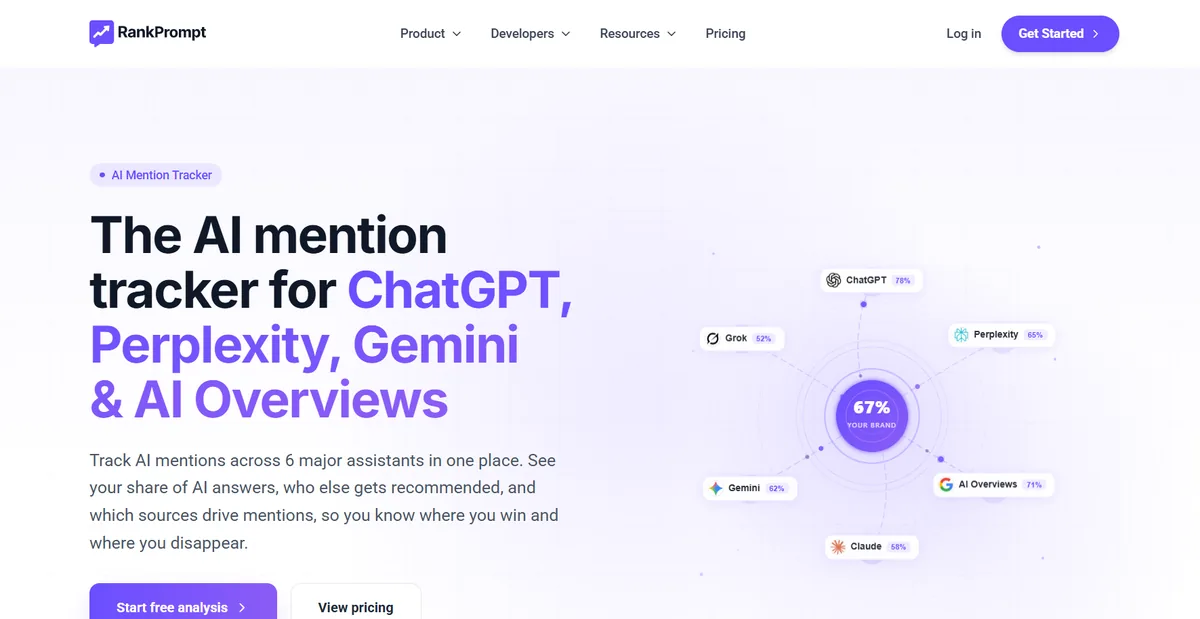
Visibility is measured per engine, not as one blended number.
We analyzed the full citation corpus for one tracked brand: every source URL any monitored platform attached to an answer across six reports run June 2025 to June 2026, English-language, U.S. region, B2B SaaS and marketing technology, across eight platform surfaces. That’s 1,696 unique URLs across 870 domains, carrying 2,504 citation events.
The platforms barely agree. Of the 1,526 URLs with per-platform attribution, 1,300 (85.2%) were cited by exactly one of the eight platforms. Only 147 appeared on two, 48 on three, 20 on four, 11 on five. None appeared on more than five.
Six of every seven sources that earned a citation earned it in exactly one place. A single-engine report isn’t a rough proxy for the rest; it’s a different question. If you take one thing from this guide into your next reporting cycle, make it this: split your visibility number into per-engine coverage, because the remedies diverge the moment you do.
Volume is wildly uneven. Grok produced 957 citation events across 666 URLs and Google AI Overviews 561 across 500, while Perplexity, Claude Search, Gemini, ChatGPT and ChatGPT Search each sat between 104 and 291. Claude without web search returned zero, which is the mode, not a bug: answering from trained knowledge alone it cites nothing, though it can still mention you. Precisely why mention and citation have to stay separate metrics.
Watch for flattering totals. A corpus weighted toward whichever engine cites most freely lifts your aggregate score without a single buyer seeing it, so weight engines by where your audience actually asks questions.
There’s no gatekeeper list to win. Across 2,504 events and 1,696 URLs, the average URL was cited about 1.5 times; in the June 2026 report alone, 1,061 citations spread across 723 URLs. The most-cited domain in the whole corpus was  reddit.com with 94 events, then
  youtube.com with 73, both ahead of every vendor blog and every publisher.
That reshapes outreach. A plan built on landing ten authoritative placements does not fit a citation graph this diffuse. It’s also the least popular finding we present, because community and video presence is harder to schedule than a guest post.
How far you can push these numbers. One brand’s prompt set in one category, so consumer retail, healthcare or local services may behave differently. English-language and U.S.-only. The reports span a year in which platforms changed their retrieval stacks repeatedly, so treat it as a composite, not a snapshot. 170 of the 1,696 records lacked per-platform attribution and sit outside the 85.2% figure. Reports run on different dates used different prompt sets, so their scores aren’t comparable over time, which is why we haven’t shown ours as a trend.
What Is an AI Visibility Score?
An AI visibility score is a single 0 to 100 figure summarizing what share of relevant AI answers include your brand, usually weighted by where you appear and how positively you’re described, typically combining frequency, position (being named first beats a final-sentence mention) and sentiment.
Use it to track your own direction, not to compare yourself to anyone else. The number depends entirely on the prompt set behind it and no two vendors use the same one, so a score of 40 against fifteen easy prompts is not better than 12 against a hard, commercially relevant set. Be sceptical of any pitch built on one. For scoring bands, see AI Visibility Benchmarks: Where Do You Stand?.
How to Measure AI Visibility
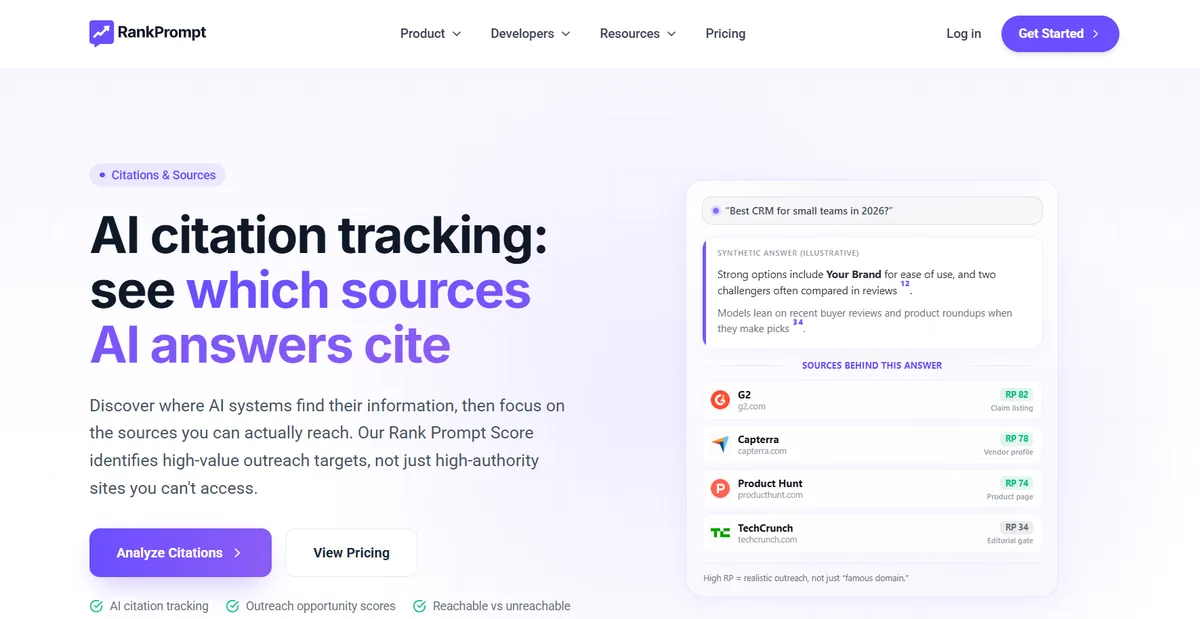
The sources behind one AI answer. Citation tracking is what produced the 1,696-URL corpus in this guide.
Four decisions determine whether your numbers mean anything.
Pick prompts your buyers would actually type. Not your brand name. An assistant asked about your company by name will describe it, which tells you nothing about whether you win the category question. Thirty to fifty prompts is a workable start.
Keep every platform separate. A single-engine report misrepresents your position, and averaging destroys the signal.
Fix your run conditions. Region, language and date all change the answer, and swapping your prompt set mid-stream breaks the series. If you change it, restart the baseline.
Record mention, citation and recommendation separately. Three outcomes, three different fixes.
Here’s what separation buys you. A B2B software company tracks 40 category prompts across eight platforms (320 cells), and the first run returns a mention in 24 of them: 7.5% overall. Broken out, 19 come from two engines and four engines return nothing at all. “Low visibility” was the wrong diagnosis; this is a coverage problem sitting on four specific platforms.
From there you triage by layer. Prompts failing everywhere usually mean the answer cites third-party roundups you’re absent from, which no on-page editing fixes. Prompts failing on only some platforms point at retrieval. Two diagnoses, two owners, and a blended score hides both.
Pair this with Search Console’s Generative AI performance report, which Google describes as the way “to measure how your content is performing in generative AI features on Google Search and Discover.” It covers only Google surfaces, so it answers part of the question, but it’s free and it’s real click and impression data.
Two things to set expectations on internally. AI answers are non-deterministic, so the same prompt can return different sources on consecutive runs, so sample repeatedly and don’t let anyone treat a single result as fact. And no major platform offers a public API for answer monitoring, so non-Google engines can only be measured by structured, repeated querying. For the hands-on workflow, see how to track brand mentions in AI search.
Key AI Visibility Metrics (And the Two Everyone Ignores)
| Metric | What it answers | How it’s calculated |
|---|---|---|
| Mention rate | How often are we named at all? | Answers naming the brand ÷ total answers |
| Citation rate | How often are we the linked source? | Answers citing our URL ÷ total answers |
| Share of voice | How do we compare to competitors? | Our mentions ÷ all brand mentions in the same answers |
| Platform coverage | Are we visible everywhere, or in one place? | Platforms citing us ÷ platforms monitored |
| Prompt coverage | Which questions do we lose? | Prompts where we appear ÷ prompts tracked |
| Sentiment | Is the description favorable? | Classified per mention |
| Accuracy | Is what it says about us correct? | Manual review, critical given a >60% miscitation rate |
If you only add two of these to your dashboard, add platform coverage and prompt coverage. They’re the most neglected and the most decision-useful. A brand at 60% mention rate on one platform and 0% on the other seven has a coverage problem, not a content problem, and sending that to the content team wastes a quarter.
What Actually Drives AI Visibility
Here’s where to actually spend your time.
Three things are worth real investment. Retrievability first: if crawlers can’t fetch and parse your content, nothing else applies. Then structure and sourcing: the one controlled study in this space tested tactics across roughly 10,000 queries and found quotations, statistics and cited sources raised visibility by up to around 40%, while keyword stuffing did nothing. Third, write passages that stand alone, because anything needing surrounding context to make sense is harder to retrieve and quote.
What that means at the desk is narrow: put a direct answer in the opening paragraph, attach a named source to every claim worth verifying, and cut the throat-clearing that pushes the answer below the fold.
Two are worth some. Third-party mentions look important in both the Ahrefs data and our corpus, though only as correlation. Freshness helps, since Google says its systems retrieve up-to-date pages, but won’t carry a programme.
Two are oversold, and we spend real time talking teams down from both. Schema markup earns its place for classic rich results, but Google explicitly says no markup is required for AI features, so keep it as hygiene, not strategy. And llms.txt has no commitment from any major platform. Harmless to publish, but if it’s on your roadmap as a visibility play, take it off.
AI Visibility Best Practices
Start with crawler access: confirm OAI-SearchBot, Claude-SearchBot, PerplexityBot and Googlebot are permitted, and separate search from training crawlers before you block anything. The cheapest AI visibility win is almost never a piece of content. It’s a line in robots.txt.
Then lead every page with a self-contained answer that could be lifted verbatim and still make sense, backed by named, linkable sources. Serve it in the initial HTML rather than client-side, since AI crawlers handle rendering unreliably.
Build presence where the engines actually read, which our corpus says means Reddit and YouTube more than most content plans assume. Measure per platform every time. And audit accuracy, not just presence. With miscitation above 60%, being described wrongly is a live risk your presence metrics will never surface.
Common AI Visibility Mistakes
Tracking one engine and calling it AI visibility. Measuring one engine and reporting it as AI visibility is like polling one city and publishing it as a national result. The 85.2% figure above is the direct rebuttal.
Measuring with brand-name prompts. Reliably produces flattering numbers that say nothing about whether you win the question buyers actually ask.
Comparing scores across vendors. Different prompt sets, different numbers, no shared method. Reading a score movement as progress when the prompt set changed is the same error pointed inward.
Blocking training crawlers and losing search visibility with them. GPTBot and OAI-SearchBot carry separate consequences.
Chasing a handful of high-authority placements when the citation graph averages about 1.5 citations per URL, far too diffuse to pay off.
Reporting a mention as preference. Being listed ninth of ten is visibility; presenting it as a win sets expectations the pipeline won’t meet.
How Rank Prompt Measures and Improves AI Visibility
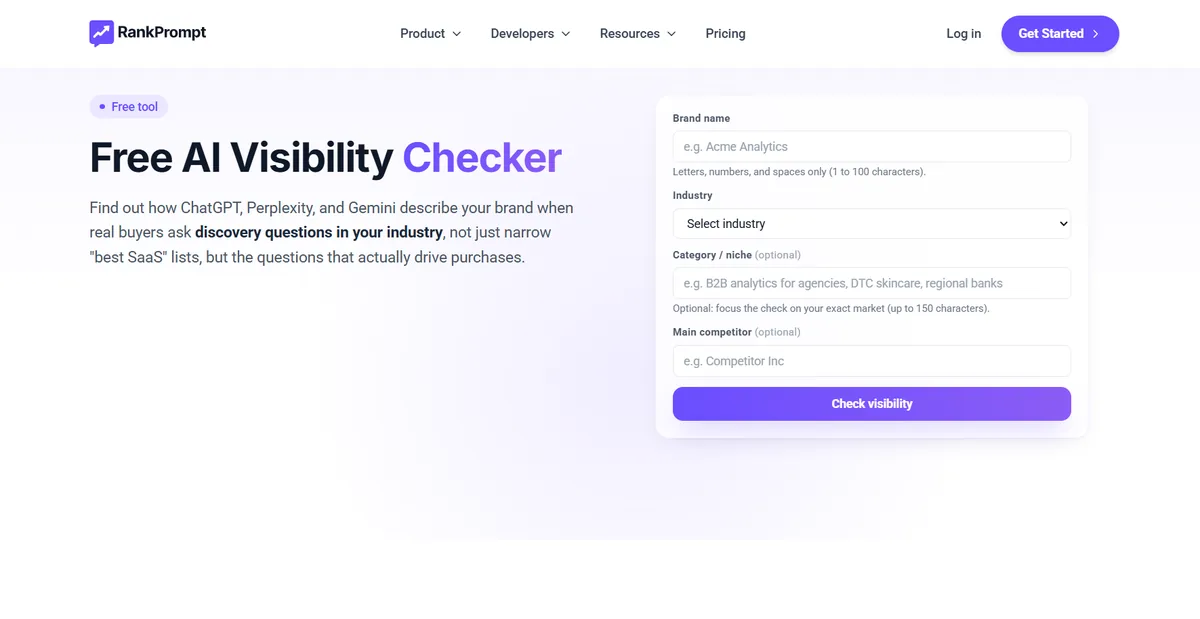
The free checker runs discovery questions rather than brand-name lookups.
Doing this by hand doesn’t survive many reporting cycles, which is why Rank Prompt exists. It monitors brand presence across ChatGPT, Perplexity, Google AI Overviews and AI Mode, Claude, Gemini and Grok from one prompt set, keeping the per-platform view intact rather than averaging it away.
AI visibility monitoring runs the scheduled checks. Citation tracking surfaces the source URLs behind each answer, where this guide’s 1,696-URL corpus came from. Content opportunities turns it into a gap list: prompts where you’re absent and a named competitor is cited instead. The SEO audit and free robots.txt AI checker cover the retrievability precondition everything else depends on.
None of this requires a new discipline. It requires knowing which questions your buyers ask, which engines answer them, and whether your name appears when they do. Most teams cannot answer the third part today, and that gap is the whole problem.
So start with a baseline rather than a strategy. Find out where you actually stand on each engine, and the priorities tend to name themselves.
Check your AI visibility free → See which engines mention your brand today, and which ones don’t.

 ChatGPT
  AI Mode
  Claude
  Grok
Grok  Perplexity