Quick Answer
The best AI visibility agencies in 2026 are Rank Prompt Services (best overall done-for-you GEO, published pricing from $1,500/mo), iPullRank (best for enterprise and technical GEO programmes), NoGood (best for growth-stage brands that want AEO inside a growth retainer), Amsive (best for large multi-location brands), Single Grain (best for B2B and ecommerce teams already buying paid media) and Anderson Collaborative (best for franchise and local-services groups).
An AI visibility agency is a service provider that runs the audit, content, citation and community work needed to get a brand recommended by AI answer engines, then reports the change over time.
This page ranks agencies you hire. If you are looking for software you operate yourself, you want our AI visibility tools ranking, or the white-label tools built for agencies to resell.
Every provider below was checked on its own live site in July 2026. Only one publishes prices.
Key Takeaways
- Agencies to hire, not tools to buy. Two different purchases, two different pages, and mixing them up wastes a quarter.
- Almost nobody publishes a price. Five of the six providers here quote on a call, so the honest cost signal is thin.
- The work is content plus citations plus community, not a dashboard. If a proposal is mostly reporting, you are buying the cheap half.
- A GEO retainer is roughly a fifth of one marketing manager. US median pay for marketing managers was $161,030 in May 2024, about $13,400 a month before benefits.
- We run Rank Prompt Services. It ranks first here on scope and published pricing, and it is also the narrowest provider on this list. Both are true.
- No agency controls what a model says. Anyone promising a guaranteed ChatGPT ranking is selling something they cannot deliver.
Agencies to Hire vs Tools to Buy
Search “best AI visibility for agencies” and you get two completely different pages. Knowing which one you are on saves a month.
- This page ranks providers you pay to do the work. Audit, content, outreach, community, reporting, delivered by someone else’s team.
- Best AI visibility tools ranks software you run yourself. Ten platforms, verified pricing, no service attached.
- Best AI visibility tools for agencies ranks white-label software for agencies who already sell GEO and need a reporting layer to put their own logo on.
- GEO for agencies is the training side, for agency owners adding the service to their own menu.
An AI visibility agency is a done-for-you service provider. An AI visibility tool is software you operate. The first sells outcomes and hours, the second sells measurement and access.
What this means for you
- Buying outcomes? Stay here.
- Buying software? Start at the tools pillar instead.
- You are an agency, not a brand? The agency solutions page is the right door.
What an AI Visibility Agency Actually Does
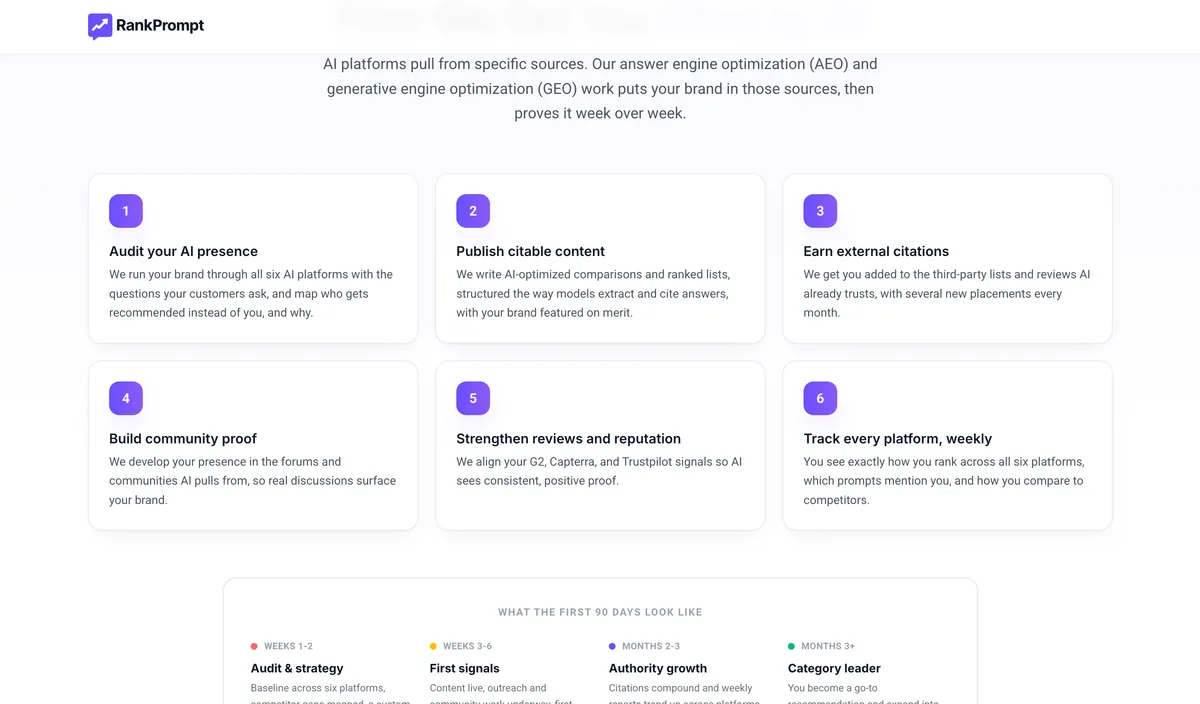
The five workstreams as one agency states them publicly. Rank Prompt Services numbers six steps: audit, publish citable content, earn external citations, build community proof, strengthen reviews, and track every platform weekly.
Five workstreams sit behind every credible AI visibility retainer. A proposal missing three of them is a reporting subscription with a person attached.
- Baseline audit. Run your buyer questions across the answer engines and record who gets recommended instead of you.
- Citable content. Publish comparisons, rankings and definitions structured the way models extract answers.
- External citations. Get added to the third-party lists and reviews the engines already pull from.
- Community presence. Build real participation in the forums and threads that surface in answers.
- Weekly measurement. Track mention rate, citation share and competitor position across engines, not just one.
That order matters. The KDD 2024 research behind the term GEO found that adding quotations, statistics and cited sources “can boost visibility by up to 40%”, while keyword stuffing produced “little to no performance improvement.”
So the content half is where the movement comes from. The dashboard just tells you whether it worked.
What this means for you
- Ask which of the five a proposal covers. Most cover two.
- Weight content and citations heaviest. They are the slow, expensive, effective part.
- Treat weekly reporting as table stakes, not a differentiator.
Comparison Table: 6 AI Visibility Agencies
Everything below was read off each provider’s own live site in July 2026. “Published pricing” means a number appears on a public page without a sales call.
| Provider | Published pricing | Model | Named GEO/AEO service page | Best for |
|---|---|---|---|---|
| Rank Prompt Services | $1,500/mo and from $2,500/mo | Done-for-you, two tiers | Yes, done-for-you AEO and GEO | Brands that want the whole programme run |
| iPullRank | None published | Consulting plus execution, three stages | Yes, GEO services | Enterprise and technical programmes |
| NoGood | None published | Growth retainer with AEO practice | Yes, AEO services | Startups through Fortune 100 growth teams |
| Amsive | None published | Enterprise performance agency | Yes, SEO plus AEO and LLM optimization | Multi-location and regulated enterprise |
| Single Grain | None published | Growth retainer, GEO by vertical | Yes, GEO for B2B and GEO for ecommerce | B2B and ecommerce paid-media buyers |
| Anderson Collaborative | None published | Full-service growth and advertising | Yes, AI-powered LLM SEO services | Franchise, multi-location, local services |
How We Evaluated These Providers
Five criteria, in the order they change a buying decision.
- A real, current, public offering. A named GEO, AEO or LLM optimization service page on the provider’s own site, live in July 2026.
- Scope of execution. Whether they publish and place, or hand you a strategy and a spreadsheet.
- Pricing transparency. Whether a buyer can size the engagement without a call.
- Measurement discipline. Multi-engine reporting, a stated baseline, and a competitor comparison.
- Fit signal. The specific kind of client the provider’s own site says it serves.
We deliberately did not score on awards, follower counts or directory badges. Those are marketing, and this category is too young for them to mean much.
What this means for you
- Verify the service page yourself before the first call. It takes two minutes and filters half the market.
- Score scope over polish. A plain page describing real deliverables beats a beautiful page describing outcomes.
- Discount anything a provider will not put in writing.
The 6 Best AI Visibility Agencies in 2026
1. Rank Prompt Services
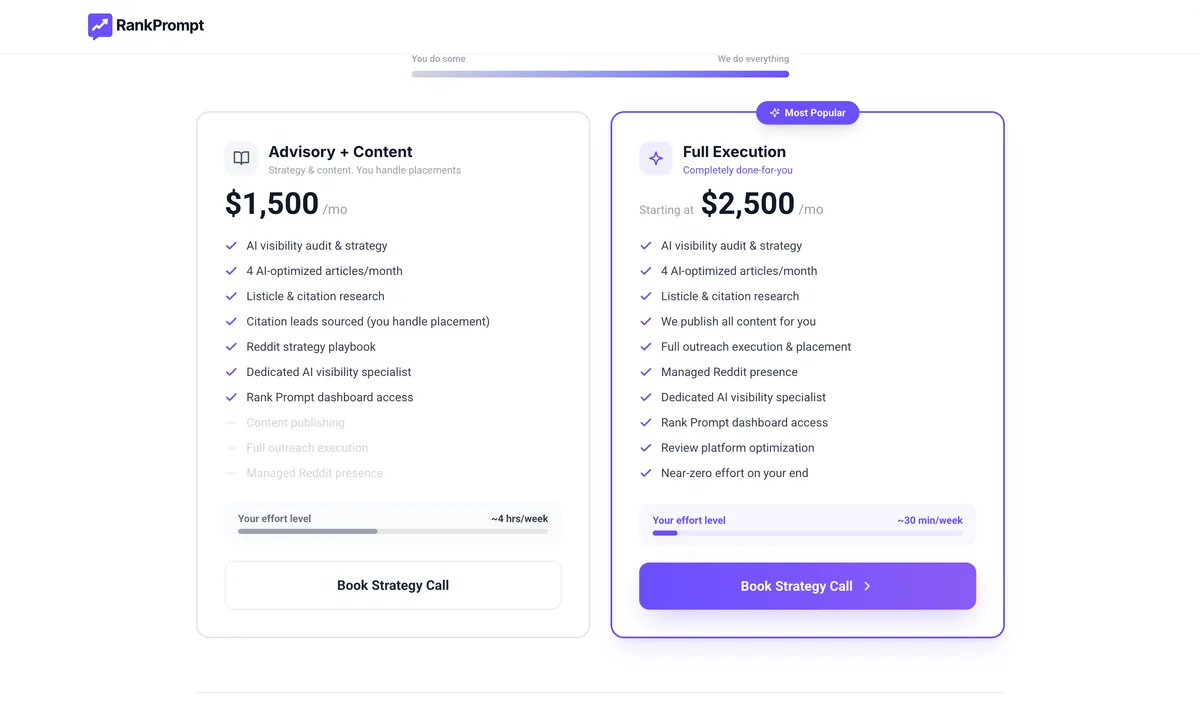
The only published price in this ranking. Advisory + Content at $1,500 a month leaves publishing and placement with you; Full Execution starts at $2,500 and states client effort of about 30 minutes a week.
This is our own done-for-you offering, run by the team that builds the Rank Prompt platform, and it ranks first here on two things we can point at: it publishes its prices, and it covers all five workstreams rather than two.
- Best for: Brands that want the audit, content, outreach, community work and reporting handled by one team, with a number they can budget against before the first call.
- Pricing (July 2026): Advisory + Content $1,500/mo, Full Execution from $2,500/mo, both published on the service page. No setup fees, no long-term contract, cancel with 30 days notice.
Pros
- Published pricing in a category that hides it. Five of the six providers here quote only on a call.
- Both tiers include the same core: AI visibility audit and strategy, four AI-optimized articles a month, listicle and citation research, and a dedicated specialist.
- Full Execution actually executes. Content is published for you, outreach and placement are run for you, and Reddit presence is managed, with client effort stated as about 30 minutes a week.
- Platform access is bundled at no extra cost, so reporting comes from the same Rank Prompt dashboard rather than a slide deck.
- Weekly reporting across six engines: ChatGPT, Perplexity, Google AI Mode and AI Overviews, Claude, Gemini and Grok.
- Free audit before the strategy call, so the baseline exists before any money moves.
Cons
- It is the narrowest provider on this list. No paid media, no brand or creative, no web development. If you want one agency for everything, Amsive or Anderson Collaborative fits better structurally.
- Reporting is tied to one platform. If you already pay for Profound or Peec AI and want the agency to work inside it, that is not the model.
- Four articles a month is fixed at both tiers. For an enterprise with many product lines or hundreds of locations, that is thin without a custom scope.
- The published case studies are anonymised by industry, not named brands. Useful as pattern evidence, weaker than a logo and a reference call.
- We are a small team. There is no procurement apparatus here of the kind a Fortune 500 vendor review expects.
2. iPullRank
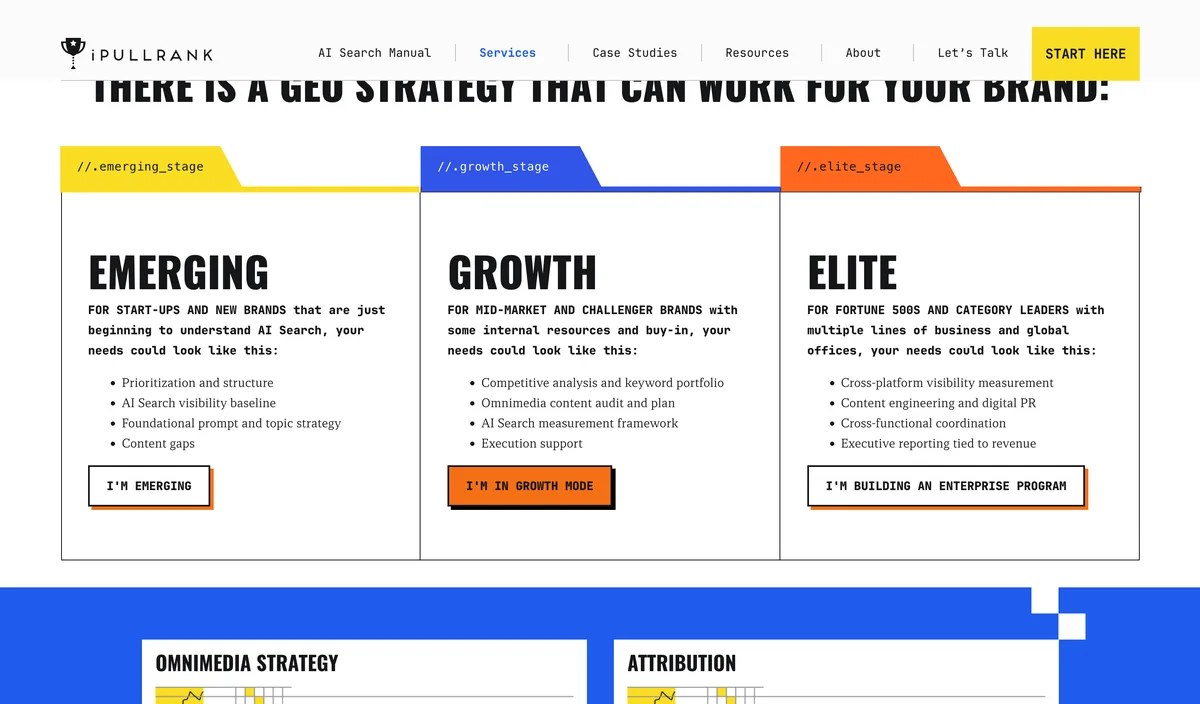
iPullRank splits its GEO offer by company stage rather than by deliverable count. Emerging covers a visibility baseline and content gaps; Elite covers cross-platform measurement and executive reporting tied to revenue.
The most rigorous framing of the problem we found on any agency site, and the one that treats AI visibility as an engineering discipline rather than a content package.
- Best for: Enterprise and mid-market teams that need a measurement framework, content engineering and cross-functional coordination, not just articles.
- Pricing (July 2026): Not published. Engagements are scoped through a call.
Pros
- Three named engagement stages on the GEO services page: Emerging for startups, Growth for mid-market challengers, Elite for Fortune 500s and category leaders.
- Explains the mechanism, not just the outcome. Their page breaks AI search into retrieval, chunking and citation selection, which is the clearest public agency explanation we have read.
- Attribution is scoped from day one, tying citations and AI referral traffic back to leads and revenue.
- Says plainly that GEO and AEO are the same thing, which cuts through a lot of category noise.
- Publishes an AI Search Manual, so you can evaluate the thinking before you evaluate the invoice.
Cons
- No published pricing at any stage. Sizing requires a call.
- Enterprise posture throughout. The Elite tier language assumes multiple business lines and global offices, which is a poor fit for a ten-person company.
- Consulting-weighted. Much of the value is roadmap and framework, so you still need people to execute it.
3. NoGood
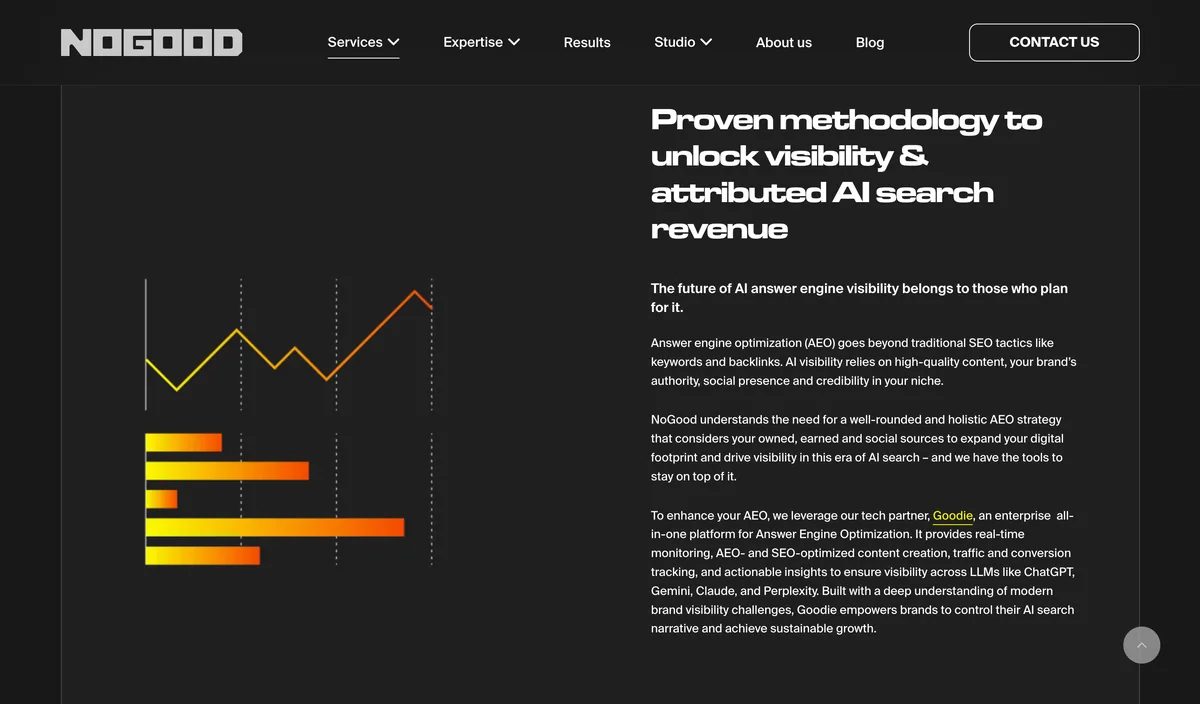
NoGood states plainly that its AEO work runs on a partner platform. The page names Goodie as the tech partner behind monitoring and content, which is a question worth asking before you sign.
A growth-marketing agency with a real AEO practice attached, and the clearest example on this list of an agency that pairs its service with a partner platform.
- Best for: Startups and scaleups that want AEO run alongside paid, lifecycle and creative by one growth team.
- Pricing (July 2026): Not published.
Pros
- A dedicated AEO services page, not a paragraph bolted onto an SEO page.
- Technical AEO is in scope, including indexing, site speed, mobile and structured data, which many content-led shops skip.
- Owned, earned and social sources are treated as one footprint, which matches how engines actually assemble answers.
- Bundles a partner platform, Goodie, for real-time monitoring and content work, so measurement is not an afterthought.
- Also runs a public AEO course, a reasonable way to sample the methodology cheaply.
Cons
- No published pricing, and growth-agency retainers in this bracket are usually well above the numbers on this page.
- AEO sits inside a wider growth offer. If you only want AI visibility, you may be buying capacity you do not use.
- Measurement runs through a partner tool, so ask what happens to your data and dashboards if that partnership changes.
4. Amsive
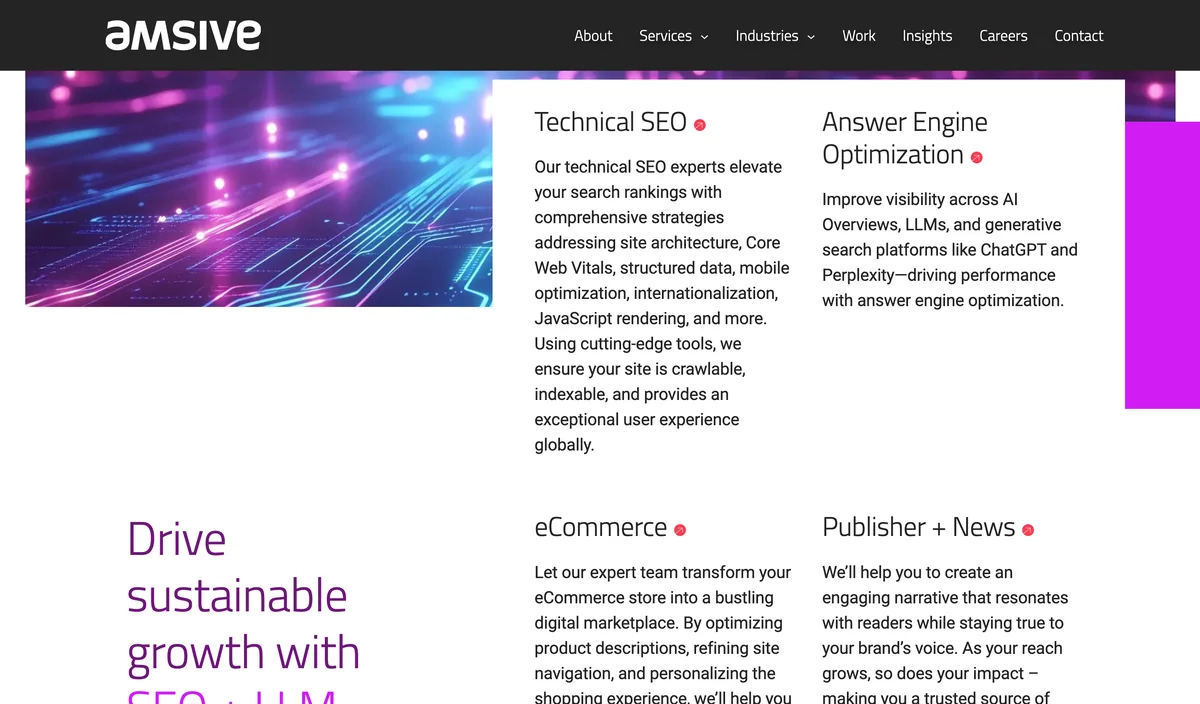
Amsive presents answer engine optimization as one card inside a wider SEO practice, alongside technical SEO, ecommerce and publisher work. That breadth is the appeal and the caveat at the same time.
The enterprise option. A large performance agency that folded answer engine optimization into an existing SEO practice rather than starting a new one.
- Best for: Multi-location, publisher and regulated enterprise brands that need AEO inside a bigger media and analytics relationship.
- Pricing (July 2026): Not published.
Pros
- Positions the offer as SEO plus AEO and LLM optimization across ChatGPT, Gemini, Perplexity and Copilot.
- Deep adjacent coverage including technical SEO, ecommerce, publisher and news, local SEO and Google Discover.
- Third-party validation exists, with a Forrester Total Economic Impact study of Amsive promoted on their own site.
- Enterprise delivery apparatus, which matters when procurement and legal are in the room.
Cons
- AEO is a line item inside a large SEO practice, so ask who specifically owns it on your account.
- No published pricing, and enterprise agencies are rarely cheap. Expect a floor well above a specialist retainer.
- Breadth cuts both ways. A brand that only wants AI visibility will be the smallest engagement in the room.
5. Single Grain
The pragmatic pick if you already buy paid media and content from one growth agency and want GEO added without a new vendor.
- Best for: B2B and ecommerce marketing teams that want GEO attached to an existing performance retainer.
- Pricing (July 2026): Not published.
Pros
- Vertical-specific GEO pages, GEO for B2B and GEO for ecommerce, rather than one generic offer.
- A clear four-step method on the page: audit current AI visibility, build the strategy, optimize content for AI discovery, then monitor and adjust.
- Named client testimonials on the service page, including Amazon Alexa, Nextiva and Lever.co.
- Broad adjacent AI offer, including ChatGPT ads, if your AI plan is not only organic.
Cons
- The GEO pages sit inside a very large programmatic services library. Scope varies by who you talk to, so get the deliverables in writing.
- No published pricing.
- Paid-media DNA. Strong if you want both, less focused if organic AI visibility is the entire brief.
6. Anderson Collaborative
A full-service growth and advertising agency, listed as a partner in Rank Prompt’s own directory, with AEO delivered as one capability among many.
- Best for: Franchise, multi-location and local-services groups that want AEO alongside paid media and web work from one team.
- Pricing (July 2026): Not published.
Pros
- A named AI-powered LLM SEO service covering AEO, conversational content structuring, entity optimization and technical work for LLM indexing.
- Scale claims are specific and on-page: 550+ clients served, 100+ industries, and more than $500M in ad dollars managed.
- Genuinely full-service, spanning paid media, SEO, content, branding and web development.
- Listed in the Rank Prompt agency directory, so they work inside the same measurement stack we do.
Cons
- AEO is one capability among many, not the core practice. Ask who runs it day to day.
- The service page copy is heavily padded with location phrases, which is a reason to ask for a plain deliverables list rather than marketing copy.
- No published pricing and no AI-visibility-specific case study on the page we read.
Four Types of Provider, and Who Each One Fits
Six named agencies is not the whole market. Most buyers are really choosing between four models, and the right answer is often not an agency at all.
| Model | Typical monthly cost | Speed to first result | Best when |
|---|---|---|---|
| Specialist GEO service | $1,500 to $5,000 | Fastest | AI visibility is the goal, not a side project |
| Full-service agency adding GEO | Bundled into a larger retainer | Medium | You already buy media or SEO from them |
| In-house team plus tooling | Salary plus $29 to $399 tooling | Slowest to start, cheapest at scale | You publish a lot already and have writers |
| Freelancer or fractional consultant | $1,000 to $4,000 | Fast for strategy, slow for execution | You need a plan and can execute it yourself |
- Specialist GEO shops live and die on this one problem, so the methodology is usually sharper and the reporting is usually multi-engine by default.
- Full-service agencies adding GEO win on coordination. If the same team runs your paid, your site and your content, AI visibility work stops fighting the rest of the plan.
- In-house plus tooling is the cheapest path at volume, and the only one where the knowledge stays with you. It needs a writer, an SEO and someone who will actually do outreach.
- Freelancers and fractional consultants are excellent for the audit and the roadmap. They are a poor fit for sustained outreach and community work, which is grinding, weekly labour.
What this means for you
- Publish four or more pieces a month already? In-house plus a tool is probably cheaper than any retainer here.
- Publish nothing? A retainer buys the machine, not just the advice.
- Need a plan, not a partner? Buy an audit from a consultant first and decide afterwards.
What This Actually Costs
Only one provider on this list publishes a price, so the market has no public floor to quote. The comparable numbers are below.
| Option | Monthly cost | What you get |
|---|---|---|
| Rank Prompt Services, Advisory + Content | $1,500 | Strategy, audit, 4 articles, citation research, you publish and place |
| Rank Prompt Services, Full Execution | From $2,500 | The above plus publishing, outreach, placement, managed Reddit, review platform work |
| Every other agency here | Quote on a call | Scope varies from consulting to full execution |
| In-house marketing manager | About $13,400 | One person, before benefits and payroll tax |
| AI visibility software only | $29 to $399 | Measurement, no execution |
The in-house figure is not a guess. The US Bureau of Labor Statistics puts the median annual wage for marketing managers at $161,030 in May 2024, which is roughly $13,400 a month before you add benefits, payroll tax or software.
So a full-execution GEO retainer costs about a fifth of one manager. In our experience that one comparison ends the make-or-buy debate faster than any deck.
A retainer does not remove the internal cost entirely, though. Someone on your side still approves content, opens doors for outreach and answers subject-matter questions.
What this means for you
- Budget the internal hours too. Even the lightest tier assumes about half an hour a week from you.
- Compare retainer against tool plus headcount, not retainer against tool.
- Refuse to sign without a written deliverables list. Absent published pricing, that list is your only contract.
Eight Questions to Ask Before You Sign
Copy these into the first call. The answers separate the five-workstream providers from the reporting subscriptions.
- Which engines do you report on, and how often? One engine is not coverage.
- What is my baseline today, and how did you measure it? No baseline means no proof later.
- How many prompts do you track, and who chooses them? Prompt selection is where most of the strategy actually lives.
- Do you publish content, or hand it to us? This is the single biggest scope difference between tiers.
- How many external placements per month, and on what kind of domain? Ask for last month’s real examples.
- Who writes, and does a human edit? Google’s spam policies treat scaled content abuse as a violation, whether the content is AI-generated or not.
- What happens to the dashboards and data if we leave? Especially when reporting runs through a partner tool.
- What have you failed at? A provider with no failure story has either not been doing this long or is not being straight with you.
What this means for you
- Score the answers, not the deck. Write them down and compare across two providers.
- Ask question six of every provider. It is the one that most often produces an uncomfortable pause.
- Insist on the baseline in writing before work starts.
Red Flags
Five claims that should end the conversation.
- “We guarantee a #1 ranking in ChatGPT.” Nobody can. Google states directly that “no third-party tool has access to our internal ranking or AI systems.”
- “We publish 40 AI articles a month.” Volume without review runs straight into Google’s scaled content abuse policy.
- “We place reviews for you.” Incentivised or fabricated endorsements sit squarely inside the FTC’s endorsement guides, and the liability lands on the brand.
- “Your score went up four points this week.” A 2026 statistical study of Perplexity, OpenAI’s search and Gemini found that “citation rankings are unstable across samples”, and that single-run metrics give “a misleadingly precise picture.”
- “We handle everything, you do nothing.” Nobody can answer your product questions or approve your positioning except you.
What this means for you
- Treat guarantees as disqualifying, not as confidence.
- Ask for variance, not just the score. A weekly number with no error bar is decoration.
- Read the content before it ships, at least for the first two months.
What No Agency Can Do for You
Four limits apply to every provider on this list, and almost none of them appear in a pitch deck.
- None of them can see inside a ranking system. They observe outputs and infer, exactly as you would.
- None of them can make the engines accurate. The Tow Center tested eight AI search tools against 1,600 queries and found they “provided incorrect answers to more than 60 percent of queries.” A Stanford audit of four generative search engines found only 51.5% of generated sentences were fully supported by their citations.
- None of them can fix crawler access without your dev team. A SIGIR 2026 study found sites blocking Google’s AI crawler “are significantly less likely to be retrieved by AIOs”. That is a robots.txt change, and it is on your side of the wall.
- None of them can make the results deterministic. Answer engines are probabilistic, so month-to-month movement includes real noise.
The stakes are still worth the retainer. Pew found users who saw an AI summary clicked a traditional result in 8% of visits, against 15% when no summary appeared, and Google says AI Overviews now reach over 2.5 billion monthly active users.
Cloudflare’s network data adds a useful caution. It found 80% of AI crawling over twelve months was for training, against 18% for search and 2% for user actions.
So a busy crawl log is not evidence the programme is working. Ask your agency to report retrieval and citation, not bot hits.
What this means for you
- Confirm crawler access first. Check that OAI-SearchBot, PerplexityBot and Claude-SearchBot are permitted before anyone bills you.
- Judge on a quarter, not a week. Noise dominates at short horizons.
- Expect to correct model errors by hand. No provider edits what a model says about you.
Who We Left Out, and Why
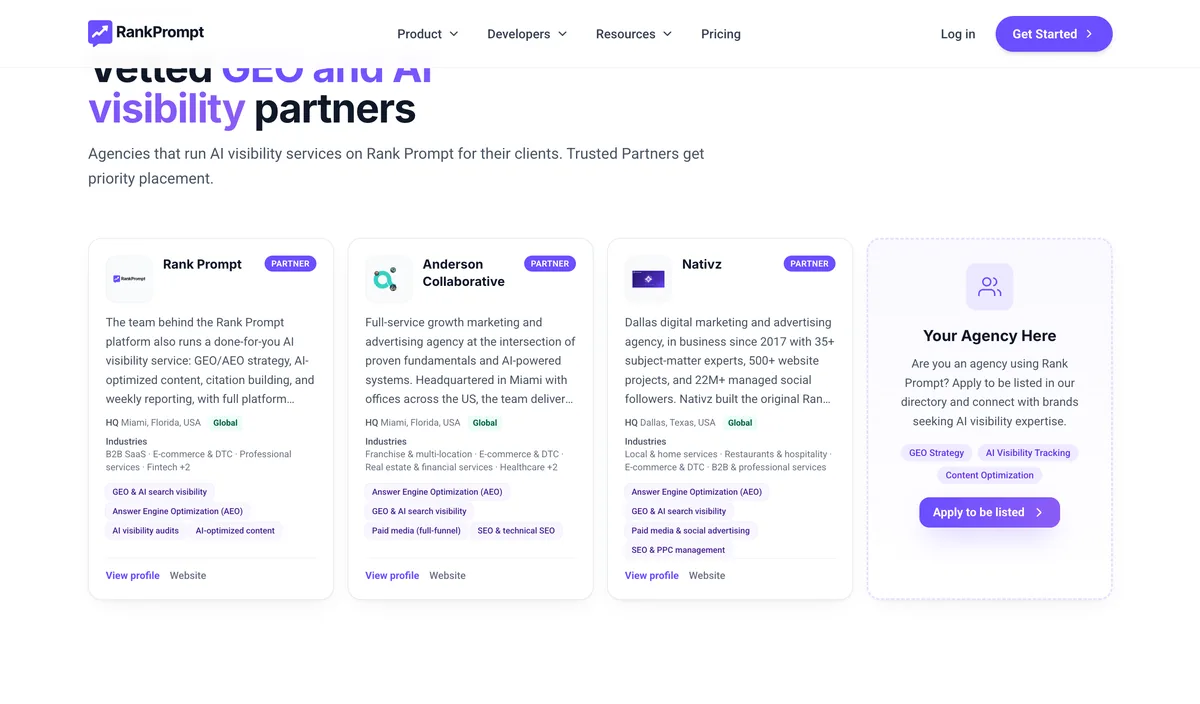
The Rank Prompt agency directory, which we used as a candidate source and then verified independently. Three partner cards are listed: Rank Prompt, Anderson Collaborative and Nativz, plus an open slot for applications.
Two deliberate omissions, stated rather than hidden.
- Nativz. They appear in Rank Prompt’s own agency directory as a partner. On their own site in July 2026 they list eleven services covering social, paid social, content production, influencer work, web development, branding and commercial production, with no AEO or GEO service page. We only rank providers whose current public offering we can verify on their own site, so they are named here rather than ranked.
- Directory-only listings and marketplace badges. Award lists and “top agency” directories in this category are largely paid or self-nominated. We used our own directory as a candidate source, then verified every candidate independently.
Where This Fits
This is the done-for-you cut of our AI visibility cluster. The software side lives in the best AI visibility tools pillar, with dedicated guides for ecommerce and budget tiers.
If you are an agency rather than a brand, the relevant pages are white-label tools for agencies, selling AI SEO services and the agency dashboard.
For the concepts underneath, start with what is AI visibility, then answer engine optimization and GEO vs SEO.
Check your AI visibility free → See which engines mention your brand today, and which ones don’t.
Sources
All agency offerings were verified on the provider’s own live site in July 2026. Only Rank Prompt Services publishes pricing publicly.
- Rank Prompt: done-for-you AI visibility service (primary, our own service)
- Rank Prompt agency directory (primary)
- iPullRank: GEO services (primary, provider’s own page)
- NoGood: answer engine optimization services (primary, provider’s own page)
- Amsive: SEO, AEO and LLM optimization services (primary, provider’s own page)
- Single Grain: GEO for B2B companies (primary, provider’s own page)
- Anderson Collaborative: AI-powered LLM SEO services (primary, provider’s own page)
- Google Search Central: AI features and your website (primary)
- Google Search Central: spam policies (primary)
- Google: new controls and insights for website owners (primary)
- OpenAI: bots and crawlers (primary)
- Perplexity: crawler documentation (primary)
- Anthropic: does Anthropic crawl data from the web? (primary)
- Aggarwal, P. et al. (2023). GEO: Generative Engine Optimization. arXiv:2311.09735, KDD 2024 (academic, peer-reviewed)
- Liu, N. F., Zhang, T., Liang, P. (2023). Evaluating Verifiability in Generative Search Engines. arXiv:2304.09848, Findings of EMNLP 2023 (academic, peer-reviewed)
- Grossman, R., Liu, S., Chen, M. K. (2026). How Generative AI Disrupts Search. arXiv:2604.27790, accepted to ACM SIGIR 2026 (academic, peer-reviewed)
- Sielinski, R. (2026). Quantifying Uncertainty in AI Visibility. arXiv:2603.08924 (academic, preprint)
- US Bureau of Labor Statistics: advertising, promotions and marketing managers (independent, government)
- Federal Trade Commission: the FTC’s endorsement guides (independent, government)
- Pew Research Center: Google users are less likely to click on links when an AI summary appears (independent)
- Tow Center / CJR: AI search has a citation problem (independent)
- Cloudflare: the crawl-to-click gap (independent)
See how your brand shows up in AI search
Track your visibility across ChatGPT, Gemini, Perplexity, Claude, and Google AI Mode (AI Overviews). Start with a free scan.
 ChatGPT
  AI Mode
  Claude
  Grok
Grok  Perplexity