
Quick Answer
The best affordable AI visibility tools in 2026 are Otterly.ai (cheapest serious plan at $29/mo), Rankscale (published entry from $20/mo), Rank Prompt (best value under $50 because all six engines and the API are included), Ahrefs custom prompt packages (cheapest published unit price at $50/mo for 2,500 checks), Peec AI (cheapest daily tracking with unlimited seats) and Athena HQ (the only genuinely free plan).
An affordable AI visibility tool is one whose cheapest published self-serve plan costs under about $100 a month and still samples your prompt set across more than one AI answer engine on a repeating schedule. Anything that only checks once is a demo, not a measurement.
Every price, tier gate and limit below was read off the vendor’s own live page on 31 July 2026. This category re-prices constantly, so re-check before you buy.
Key Takeaways
- Compare cost per AI response, not sticker price. The cheapest plan in the category is not the cheapest measurement.
- The real unit price ranges from about $10 to $327 per 1,000 AI responses. That is a 30x spread across tools that all describe themselves the same way.
- Annual billing is the largest single discount available. It takes 15% to 20% off almost every vendor here, and two of them publish no monthly price at all.
- What you give up cheap is usually engines, seats, exports and API access, in that order. Sampling depth goes next.
- Free plans are rarer than free trials. Only one tool in this comparison has a real free tier; most of the rest offer 7 to 14 days.
- We build Rank Prompt. It is the most expensive tool per AI response in this comparison and we are not going to pretend otherwise. The argument for it is that the same monthly allowance also writes the content, audits the pages and finds the citations, rather than only sampling answers.
What “Affordable” Actually Buys You
AI search optimization starts with measurement, and every vendor in this category sells the same underlying thing: repeated queries against AI answer engines, and a record of what came back.
The price differences come from how many of those queries you get, on how many engines, and how often they re-run.
That matters more than any feature list, because the whole product depends on sample size.
A 2026 statistical study of Perplexity, OpenAI’s search and Gemini sampled the same queries every ten minutes. It found that “citation rankings are unstable across samples”, with many apparent differences between domains sitting inside the noise floor.
Its blunt conclusion is the one budget buyers most need to read. Single-run visibility metrics give “a misleadingly precise picture”, and the paper closes by giving “practical guidance for sample sizes required to achieve interpretable confidence intervals”.
So a cheap plan is a different product, not a scaled-down one. Below a certain sample size you are collecting anecdotes on a schedule.
Three units, and vendors mix them freely:
- A prompt is one question you ask the tool to track. It says nothing about how often it runs.
- An AI response is one answer from one engine. This is the real unit and the only one that compares across vendors.
- A credit or a check is a billing token. Ahrefs, Rankscale, Athena HQ and Rank Prompt all use one, and they do not mean the same thing.
What this means for you
- Ask every vendor for AI responses per month, in writing. Most will not volunteer it.
- Treat “15 prompts” as a baseline, not a measurement. It is enough to know whether you exist, not enough to track change.
- Discount any weekly movement unless the tool reports variance alongside the score.
Comparison Table: The 10 Cheapest Ways In
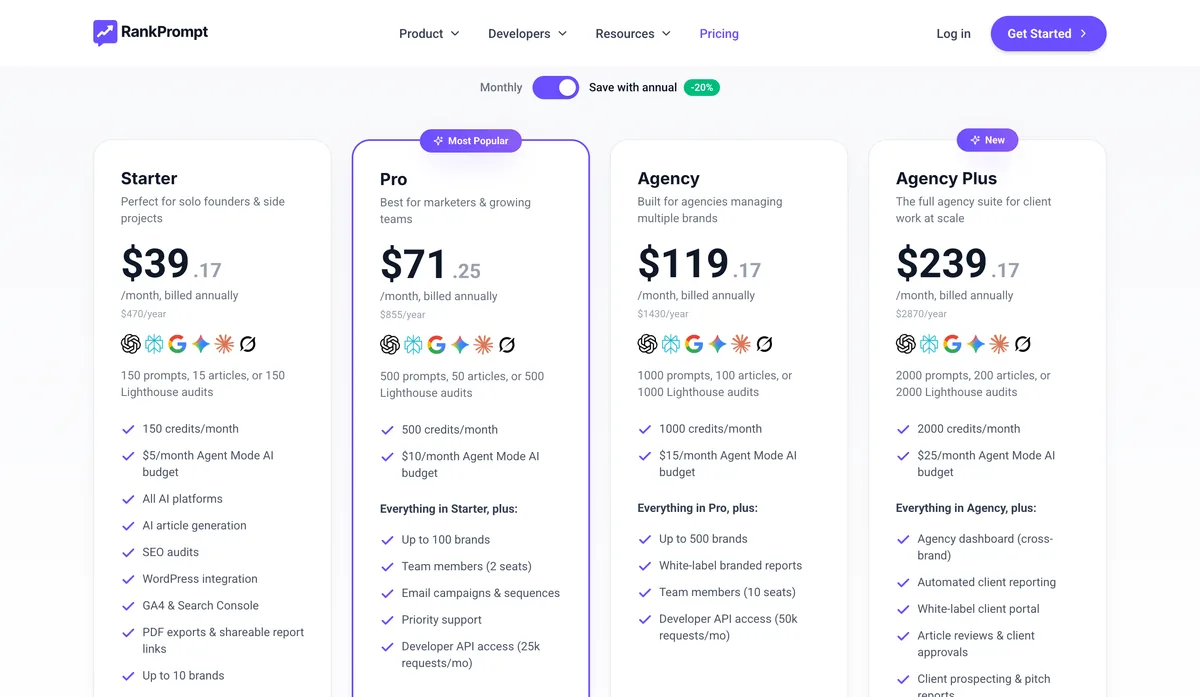
Annual billing is the single biggest discount in this comparison. Rank Prompt’s own pricing page on the annual toggle, captured 31 July 2026.
Entry price is the cheapest published self-serve plan. “Engines at entry” is what the entry tier covers, not the top tier. All verified 31 July 2026.
| Tool | Entry price | What that buys | Engines at entry | Free option | API at entry |
|---|---|---|---|---|---|
 Rankscale Rankscale | $20/mo Essentials | Limits not published | Not published | ”Try Pro for Free” | No |
 Otterly.ai Otterly.ai | $29/mo Lite | 15 prompts, daily | 4 | Free trial, terms unstated | No |
 Rank Prompt Rank Prompt | $49/mo ($39.17 annual) | 150 prompts a month | All 6 | Free first report, no card | Yes, 10k requests |
 Ahrefs custom prompts Ahrefs custom prompts | $50/mo Basic | 2,500 checks | Any supported platform | Free AI visibility checker | Via base plan |
 Knowatoa Knowatoa | $59/mo Starter | Counts not published | 3 of 7 services | Free trial, terms unstated | No |
 ZipTie ZipTie | $69/mo Basic | 500 AI Search checks | 3 | 14-day trial, 75 checks | Not stated |
 Peec AI Peec AI | $95/mo ($80 annual) | 50 prompts, daily | 3 of 6 | Free trial | No |
 Profound Profound | $99/mo, billed yearly | 50 prompts, 1,500 responses | ChatGPT only | Free AEO report | No |
 Semrush AI Visibility Semrush AI Visibility | $99/mo per domain, annual | 25 prompts, daily | 4 | None for this toolkit | Not stated |
 Athena HQ Athena HQ | Free, then $295/mo | 300 credits free | 5 free, 9 paid | Real free plan | Paid add-on |
Two rows deserve a flag before you read any further.
Profound and Semrush both publish annual-only prices. Profound’s $99 and $399 tiers are marked “billed yearly”, and Semrush’s $99 is “billed annually”, so the cash commitment is roughly $1,188 either way rather than $99.
Rankscale’s $20 tier publishes almost nothing. No credit count, no response count, no engine list. It is the cheapest number on this page and the least comparable.
Cost Per 1,000 AI Responses
Our pillar guide to AI visibility tools built this table from the four vendors that publish response counts outright. This is the extended version, and it adds three more sourcing routes.
Read the last column before the last number. A published figure and one we derived are not the same evidence.
| Plan | Price/mo | AI responses/mo | Cost per 1,000 | How the number is sourced |
|---|---|---|---|---|
| Ahrefs custom prompts, Scale | $250 | 25,000 checks | ~$10 | Published unit price |
| Peec AI Advanced (annual) | $420 | 31,500 | ~$13 | Vendor’s own formula |
| Ahrefs custom prompts, Growth | $100 | 7,000 checks | ~$14 | Published unit price |
| Otterly.ai Standard | $189 | 12,000 | ~$16 | Derived |
| Otterly.ai Lite | $29 | 1,800 | ~$16 | Derived |
| Rankscale Growth | $385 | up to 22,000 | ~$18 | Published |
| Ahrefs custom prompts, Basic | $50 | 2,500 checks | ~$20 | Published unit price |
| Rankscale Pro | $99 | up to 4,800 | ~$21 | Published |
| Peec AI Starter (monthly) | $95 | 4,500 | ~$21 | Vendor’s own formula |
| ZipTie Pro | $159 | 6,000 | ~$27 | Derived |
| Profound Growth | $399 | 9,000 | ~$44 | Published |
| ZipTie Basic | $69 | 1,500 | ~$46 | Derived |
| Profound Starter | $99 | 1,500 | ~$66 | Published |
| Athena HQ Starter | $295 | 3,600 | ~$82 | Published, “1 credit = 1 AI response” |
| Rank Prompt Agency | $149 | 1,000 | ~$149 | Published prompt allowance, conservative reading |
| Rank Prompt Starter (annual) | $39.17 | 150 | ~$261 | Published prompt allowance, conservative reading |
| Rank Prompt Starter | $49 | 150 | ~$327 | Published prompt allowance, conservative reading |
How each route works, so you can check our arithmetic:
- Published means the vendor states responses per month on its own pricing page.
- Published unit price is Ahrefs, which prices a check directly. Its page states that “Tracking one prompt on one platform in one location uses 1 check”, with overage at $0.020, $0.015 and $0.010 per check across the three packages.
- Vendor’s own formula is Peec AI, whose pricing FAQ gives the multiplication itself: “If you are running 25 prompts across 3 models for 30 days, we would analyze 25x3x30 = 2250 AI answers.” We applied that formula to its own published plan limits.
- Derived means we multiplied the vendor’s published prompts by its published engines by daily tracking. Otterly.ai publishes 15 prompts, four engines and daily frequency. ZipTie states that “Every AI Search covers data from Google AI Overviews, ChatGPT and Perplexity”, so 500 checks is 1,500 engine reads.
Rankscale is still the cheapest tool that publishes a response count outright, which is the comparison our pillar made. Everything cheaper on this table rests on evidence the pillar deliberately did not use.
Semrush is the one entry-level tool we could not compute. It publishes 25 prompts and four engines, but its own help centre describes prompt tracking on “platforms like Google AI Mode and ChatGPT”, which is not the same as all four. We would rather leave a gap than invent a denominator.
Now the part that does not flatter us. Rank Prompt is last on this table by a factor of about thirty against Ahrefs at the cheap end, and we rank ourselves last on purpose.
We also have to declare a second thing. Rank Prompt does not publish an AI-responses-per-month figure anywhere, so we applied the least flattering reading of our own published allowance: one tracked prompt to one AI response.
Holding ourselves to the standard we apply to rivals means taking the worse number when our own page is ambiguous.
What this means for you
- Buying pure sampling volume? Ahrefs custom prompts, Peec AI or Rankscale will out-sample everything else per dollar.
- A 30x unit-price gap is not a quality signal. It mostly reflects what else the credit does.
- Ask what a credit buys before you compare two credit-based tools. Rankscale charges 0.25 credits per engine per prompt and 2 credits for Claude. Athena HQ charges 1 credit per response. Those are different products.
What You Give Up at the Cheap End
This is the table we wish existed when we started buying these tools. Five things get cut at entry level, and they get cut in a predictable order.
| Tool | Entry price | Sampling at entry | Engines at entry | Seats at entry | API at entry | Notable cut |
|---|---|---|---|---|---|---|
| Rankscale Essentials | $20 | Not published | Not published | Not published | No | No credit rollover, unlike Pro |
| Otterly.ai Lite | $29 | Daily | 4 of 7 | Unlimited | No | Claude, Gemini, AI Mode are add-ons |
| Rank Prompt Starter | $49 | Scheduled, you set it | All 6 | 1 | Yes | No team seats, no white-label |
| Ahrefs custom prompts Basic | $50 | Monthly to daily | Any, 1 check each | Per base plan | Via base plan | Claude costs 8 checks per query |
| Knowatoa Starter | $59 | Weekly digest | 3 of 7 | Not published | No | No API, MCP or Looker until $199 |
| ZipTie Basic | $69 | Auto monitoring | 3 | 1 | Not stated | 14 countries only |
| Peec AI Starter | $95 | Daily | 3 of 6 | Unlimited | No | 1 project and 1 country |
| Profound Starter | $99 | Daily | ChatGPT only | 1 | No | No data exports at all |
| Semrush Base | $99/domain | Daily | 4 | 1, +$45/mo each | Not stated | Priced per domain |
| Athena HQ Essential | Free | Not published | 5 of 9 | Unlimited | Paid add-on | 300 credits total |
The pattern is consistent enough to plan around.
- Engines go first. Profound’s $99 tier is ChatGPT only, Knowatoa’s $59 covers three of seven services, Otterly’s $29 covers four of seven and sells the other three back at $9 to $29 each.
- API access goes second. Only Rank Prompt ships it on the entry plan. Otterly opens it at $189, Rankscale at $385, and Profound, Scrunch and Peec AI reserve it for Enterprise.
- Exports and seats go third. Profound Starter has no CSV or JSON export and one seat. Semrush charges from $45/mo per extra user on top of $99 per domain.
- Geography goes quietly. Peec AI’s Starter plan covers one country per project, ZipTie covers fourteen countries at every tier.
- History is barely published by anyone. Profound states all-time history on every tier, which is unusual. Most of the rest say nothing, which is a question worth asking a salesperson.
There is one more cut that only shows up on your second invoice. Rank Prompt’s monthly allowance does not roll over. Rankscale rolls unused credits forward up to 2x on Pro and 3x on Growth, and that is a real advantage for teams whose usage is lumpy.
What this means for you
- Price the tier with the engines you need, not the tier on the pricing page’s default toggle.
- Add the add-ons before you compare. Otterly Lite with all seven engines is $76/mo, not $29.
- Check exports before you sign. A tool you cannot get data out of will not survive contact with your reporting stack.
Free Plans vs Free Trials
“Free” means five different things in this category, and the difference decides whether you can actually evaluate a tool before paying.
| Vendor | Free option | What it is | Card required |
|---|---|---|---|
| Athena HQ | Essential plan | A real free tier, 300 credits, 5 models, unlimited members | Not required |
| ZipTie | 14-day trial | Capped trial: 75 AI searches, 3 summaries, 5 optimizations | Not stated |
 Scrunch Scrunch | 7-day trial | Full Core plan | Advertised as not required |
| Rank Prompt | Free first report, then a 7-day trial | A full AI visibility report on your own prompts, then all features for 7 days | Not for the report, yes for the trial |
| Rankscale | ”Try Pro for Free” | Length and terms not published | Not stated |
| Otterly.ai | Free trial | ”We provide a free trial for new users”, no length given | Not stated |
| Knowatoa | Free trial | Length and terms not published | Not stated |
| Ahrefs | Free AI Visibility Checker | One-shot lookup, not a subscription | Not required |
| Profound | Free AEO report | One-shot report, not a subscription | Not required |
| Semrush | None for this toolkit | Help centre: “No, the AI Visibility Toolkit does not offer a free trial” | n/a |
Three honest observations about that table.
Only Athena HQ ships a free plan rather than a trial. 300 credits at one credit per AI response is a few days of real usage, but it renews the conversation rather than ending it, and it needs no card.
Semrush is the outlier worth knowing about. Its pricing page carries the site-wide “Try Semrush free for seven days” banner while its own help centre states plainly that this toolkit is excluded. Trust the help centre.
Free one-shot checkers are useful and are not measurement. That includes Ahrefs’, Profound’s and our own. They tell you whether you exist today. They cannot tell you whether you are gaining.
What this means for you
- Run two tools on the same prompt set during their trials, not one tool for twice as long.
- Start with a free checker to set the baseline conversation, then pay for the trend line.
- A trial with no published length is a support ticket, so ask before you plan around it.
The 8 Best Affordable AI Visibility Tools
1. Rank Prompt
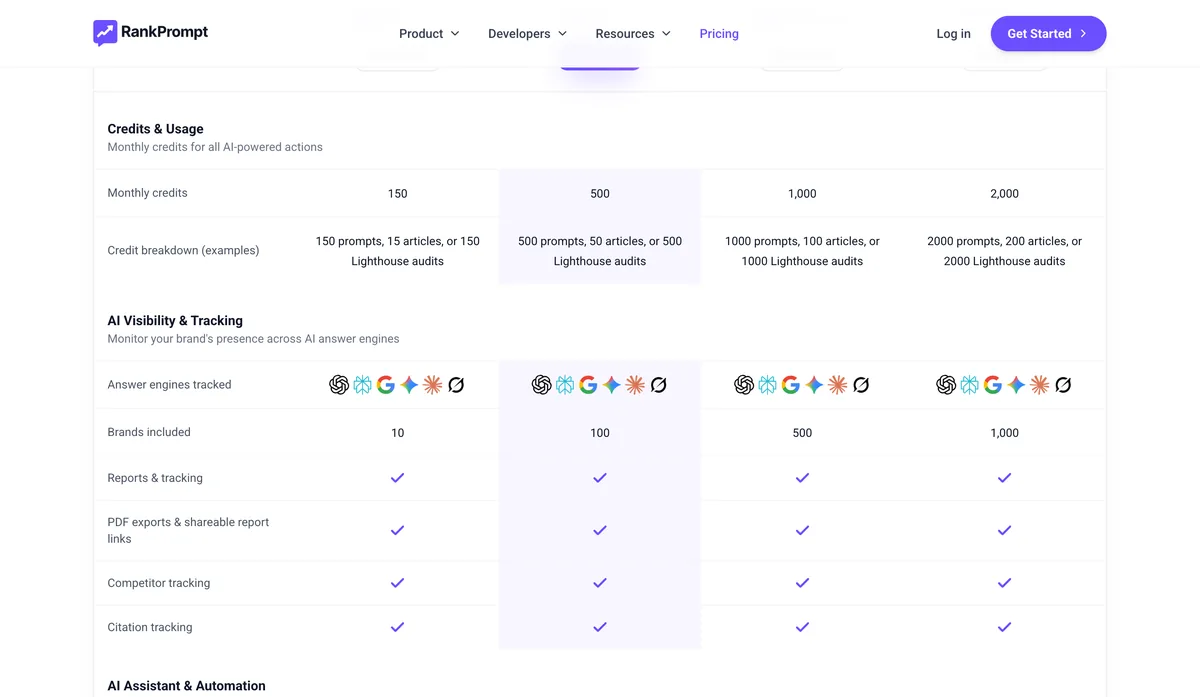
The entry tier gets the same six answer engines as every tier above it. It also gets 150 tracked prompts a month, which is the arithmetic behind our last place on cost per AI response.
Our own product, and the one we would still buy under $50 a month, because it is the only tool here that puts all six assistants and a working API on its entry plan.
It is also, by our own arithmetic above, the most expensive tool per AI response in this comparison. Both of those are true and you should weigh them against each other.
- Best for: Solo founders, small teams and agencies who want full engine coverage plus the ability to act on what they find, without buying a second tool.
- Pricing (July 2026): Starter $49/mo (150 tracked prompts a month), Pro $89/mo (500), Agency $149/mo (1,000), Agency Plus $299/mo (2,000). Annual billing takes 20% off, which puts Starter at $39.17/mo, or $470 a year. Your first full AI visibility report is free and needs no card; the 7-day trial of a paid plan does.
Pros
- All six assistants on the $49 plan. ChatGPT, Perplexity, Google AI Mode, Claude, Gemini and Grok, with no engine gating between tiers.
- REST API with 10,000 requests a month on Starter, plus an MCP server you can drive from Claude Code or Cursor. Every other tool here gates the API at $189 or above.
- One monthly allowance covers the work, not just the measurement. The same budget pays for content generation, brand audits, Lighthouse audits and author discovery from citations, which is the actual argument against the unit price.
- Ten brands on the $49 plan, so a freelancer can cover a small client book before upgrading.
- Annual billing is the biggest discount in this comparison, at 20% against the 15% to 17% offered by most rivals.
Cons
- The most expensive option per AI response here. 150 tracked prompts at $49 is 150 sampled responses a month on the conservative reading. Ahrefs sells 2,500 checks for $50.
- We do not publish a responses-per-month figure, which is exactly the thing we criticise other vendors for. That is a fair hit and it is on our list to fix.
- One allowance covers everything, and it does not roll over. An AI-written article costs the same as ten tracked prompts, so a heavy content month eats the tracking budget, and anything unused disappears on your billing date.
- Starter is a single-seat plan. Team members start at Pro, and white-label reporting starts at Agency.
- No published SOC 2 attestation or SAML SSO. If procurement requires either, Profound and Athena HQ are further along and we lose those deals.
2. Otterly.ai
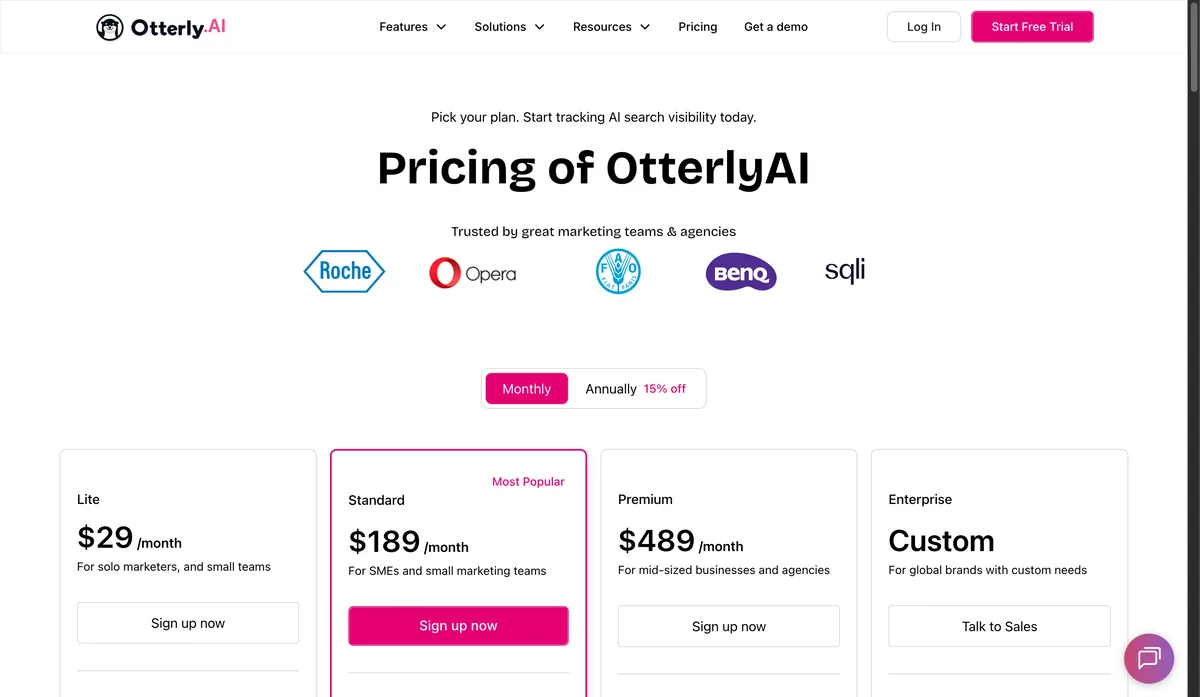
Otterly.ai’s monthly tiers on 31 July 2026. Lite at $29 is the cheapest entry point here that publishes what it covers, and the next step up is $189.
The cheapest plan in this comparison that publishes what it actually does, which is more than the $20 tier above it manages.
- Best for: Solo marketers and small teams who need a real daily trend line on four engines for under $30 a month.
- Pricing (July 2026): Lite $29/mo (15 prompts), Standard $189/mo (100), Premium $489/mo (400), Enterprise custom. Annual billing takes 15% off. Prices exclude tax.
Pros
- $29/mo with daily tracking across ChatGPT, Google AI Overviews, Perplexity and Microsoft Copilot.
- Unlimited team members on every plan, including Lite. Nothing else at this price does that.
- About $16 per 1,000 AI responses on Lite by our derivation, which makes it good value as well as cheap.
- 1,000 GEO audits a month on Lite, plus multi-country support across 50+ markets at no extra charge.
- A prompt calculator and a pricing calculator published on the pricing page, which is a small thing that saves a sales call.
Cons
- 15 prompts is a very small sample. Enough for a baseline, thin for a category, and directly exposed to the sample-size problem above.
- Claude, Gemini and Google AI Mode are paid add-ons. On Lite that is $29, $9 and $9 a month, so full coverage is really $76/mo.
- No API or MCP until Standard at $189. The jump from $29 has nothing in between.
- Trial terms are not published. The FAQ confirms a free trial exists for new users and stops there.
3. Rankscale
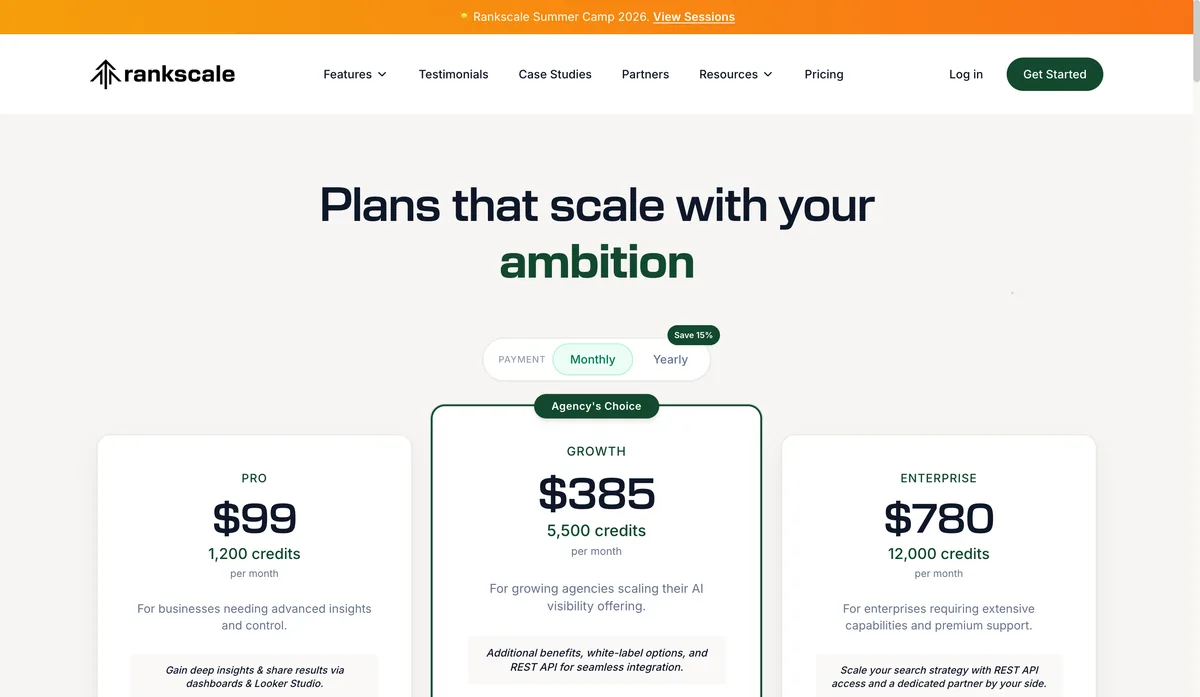
Rankscale leads with Pro at $99 for 1,200 credits. The $20 Essentials tier we quote is not one of the cards, and it publishes no credit, response or engine figure at all.
The volume play, and the cheapest published number on this page. It is also the least documented, which is the trade.
- Best for: Teams who want the most AI responses per dollar on a paid tier and have someone to do the analysis.
- Pricing (July 2026): Essentials from $20/mo, Pro $99/mo (1,200 credits, up to 4,800 AI responses), Growth $385/mo (5,500 credits, 22,000 responses), Enterprise $780/mo (12,000 credits, 48,000 responses). Yearly billing saves 15%.
Pros
- About $21 per 1,000 AI responses on Pro, from published figures rather than derived ones.
- Credit rollover up to 2x on Pro and 3x above it, the only rollover in this comparison. Lumpy usage stops being wasted.
- Scheduling from hourly to monthly, so you can buy sample frequency directly rather than accept a fixed cadence.
- Transparent credit maths. The page states “typically 0.25 credits per engine per prompt” and prices Claude at 2 credits and DeepSeek at 1.
- Published Enterprise pricing at $780/mo, the only tool here that does not hide its top tier behind a call.
Cons
- Essentials at $20 publishes no limits at all. No credits, no responses, no engine list. You are buying on faith at the bottom of the range.
- No credit rollover on Essentials, so the cheap tier loses the tool’s best budget feature.
- REST API starts at Growth, $385/mo. That is a long way up from $20.
- The “17+ engines” headline is a claim, not a list. Around ten are actually named.
4. Ahrefs custom prompt packages
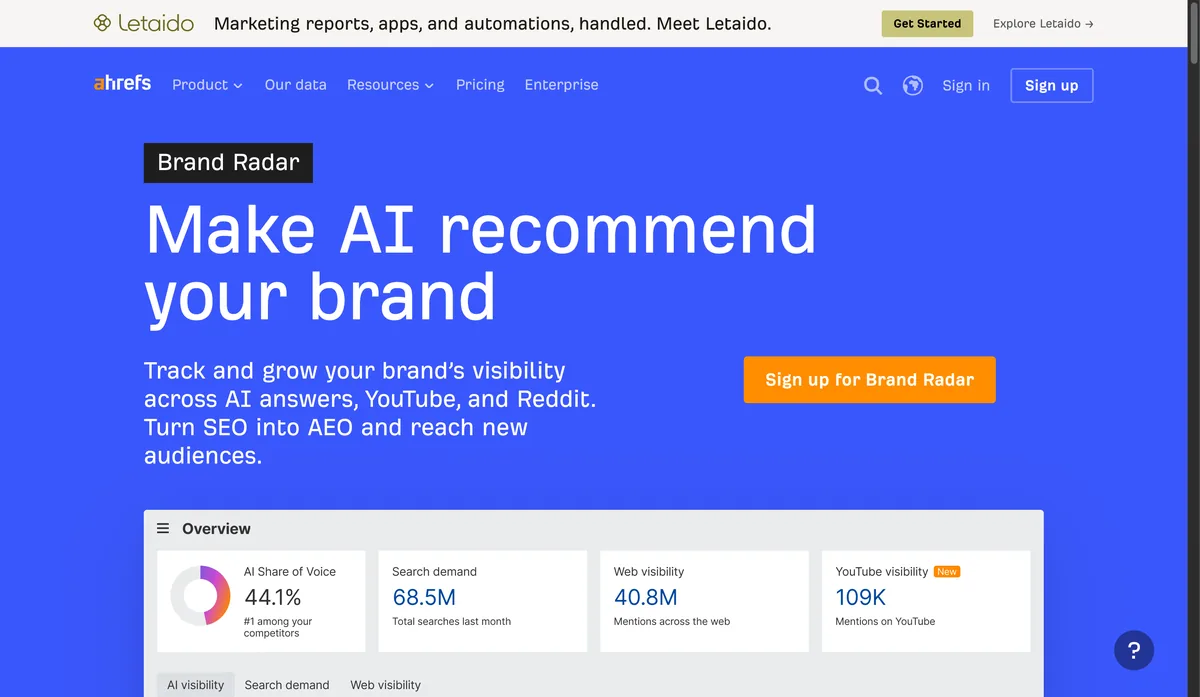
What Ahrefs sells on this page is the Brand Radar subscription, $199 a month per platform index and $398 with two indexes pre-ticked. The $50 package is bought separately.
The cheapest published unit price in the entire category, and almost nobody knows it exists because it is buried under a $1,499 enterprise plan.
- Best for: Teams who want raw prompt tracking at the lowest possible per-check cost, especially if they already pay for Ahrefs.
- Pricing (July 2026): Standalone custom prompt packages at Basic $50/mo (2,500 checks), Growth $100/mo (7,000) and Scale $250/mo (25,000), with overage at $0.020, $0.015 and $0.010 per check. Brand Radar itself is $199/mo per AI platform index or $699/mo for all platforms. Base Ahrefs plans run Lite $129/mo through Enterprise $1,499/mo.
Pros
- $10 to $20 per 1,000 checks, published as a unit price. No other vendor here lets you compute your bill this precisely.
- You buy frequency, not seats. A check is one prompt on one platform in one location, so you decide whether to run 80 prompts daily or 2,400 prompts monthly.
- Custom prompts are included from the Lite plan onwards, at 5, 10 and 20 tracked prompts on Lite, Standard and Advanced.
- A genuinely free AI visibility checker with no signup, useful for the baseline conversation before you spend anything.
Cons
- Claude checks consume eight checks each, which quietly multiplies the price of the engine many buyers most want.
- Ahrefs publishes two different entry prices for Brand Radar on two of its own pages, “from $199/mo” on the pricing page and $398/mo on the Brand Radar page, where two platforms come pre-selected.
- Two different prompt-corpus figures are live today, 458M+ on the marketing pages and 405+ million in the help centre.
- The packages track prompts, they are not a GEO platform. No content generation, no outreach, no white-label client reporting.
5. Peec AI
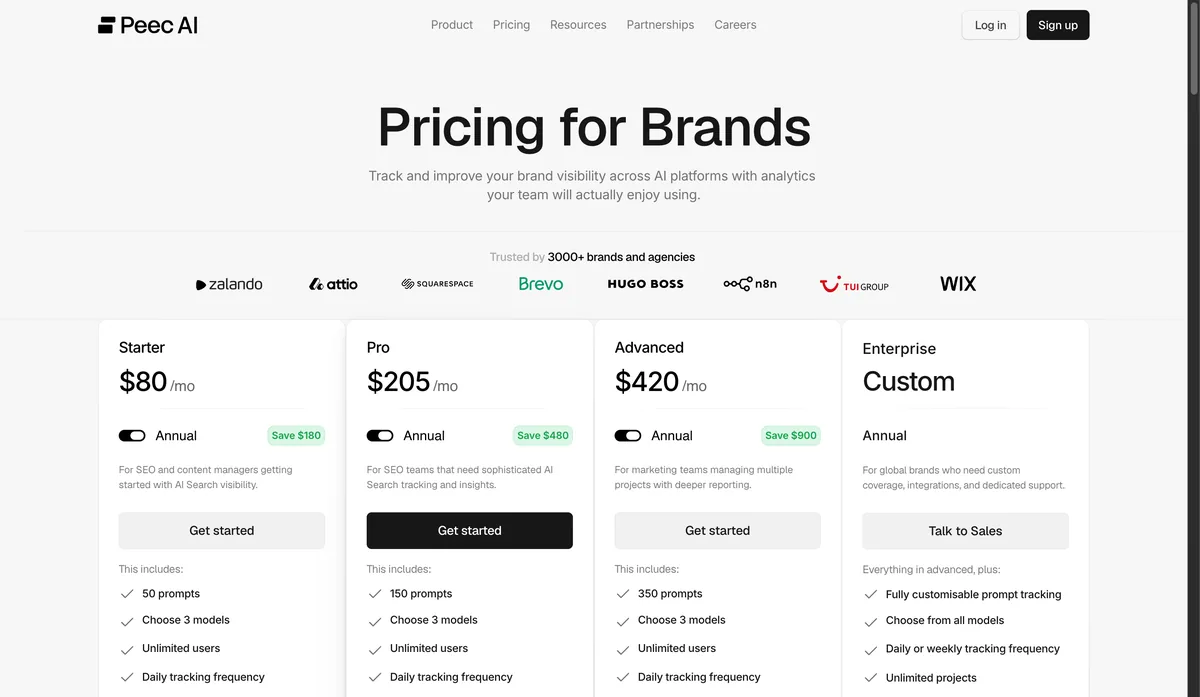
Peec AI on the annual toggle, where $80 a month buys 50 prompts, unlimited users and daily tracking. The cards state three models of six, and the country cap sits in the matrix below.
The cheapest way to get daily tracking with unlimited seats, and the only vendor here that publishes the arithmetic behind its own sampling.
- Best for: In-house marketing teams who want everyone to have a login and do not need an API.
- Pricing (July 2026): Starter $95/mo (50 prompts), Pro $245/mo (150), Advanced $495/mo (350), billed monthly. Annual billing takes 15% off, which puts those at $80, $205 and $420. Enterprise is custom.
Pros
- About $21 per 1,000 AI responses on Starter, using Peec’s own published formula rather than our estimate.
- Unlimited users on every tier, including the $95 plan. That is unusual and it matters for teams over five people.
- Daily tracking on every tier, with no cheaper, slower cadence to trip over.
- No surcharge for countries or languages. Its FAQ states pricing “remains tied to usage of prompts, not the number of regions or languages”.
- Annual billing is genuinely cheap for what you get, at $80/mo for 50 prompts across three models tracked daily.
Cons
- One country per project on Starter. The no-surcharge promise is about pricing, not about plan limits: the matrix allows 1 country on Starter and 3 on Pro and Advanced. If you sell in three markets, Pro is your real entry point.
- Three models only on Starter, Pro and Advanced, chosen from six. Extra models cost $30 to $140 a month depending on tier.
- One project on Starter, which rules it out for anyone tracking two brands.
- API and MCP are Enterprise, so there is no self-serve programmatic access at any published price.
- Measurement only. No content generation or outreach, so budget for a second tool.
6. Knowatoa
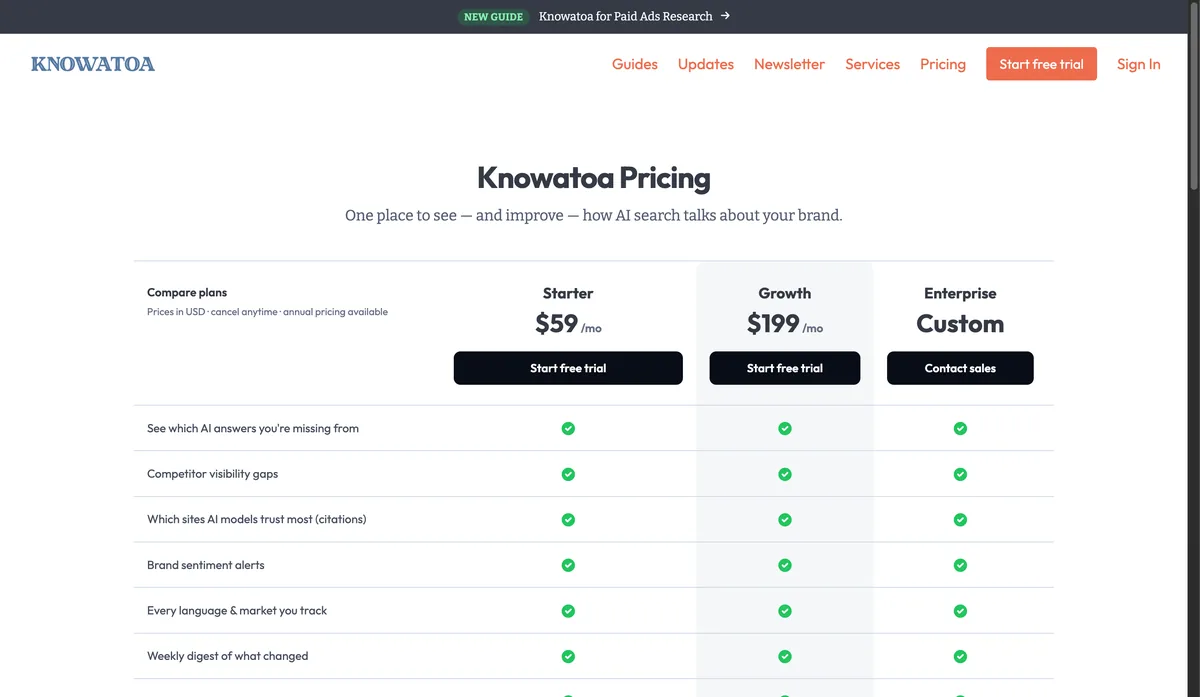
Knowatoa publishes two paid tiers and a tick matrix rather than any prompt or response count. Citations and competitor gaps are ticked on the $59 plan, which is the budget case.
Positioned around recommendations rather than dashboards, which suits a small team with nobody whose job is GEO.
- Best for: Small teams who want to be told what to fix and do not need to see the raw sampling.
- Pricing (July 2026): Starter $59/mo, Growth $199/mo, Enterprise custom. Prices in USD, cancel anytime, annual pricing available but not published.
Pros
- Every language and market you track is included on both paid tiers, with no regional surcharge.
- Citation data and competitor visibility gaps on the $59 plan, which several pricier tools reserve for higher tiers.
- Brand sentiment alerts and a weekly digest on Starter, which fits a team that reviews rather than monitors.
- Slack and email support at the entry tier.
Cons
- Starter covers three of seven services: ChatGPT, AI Overviews and AI Mode. Claude, Gemini, Meta AI and Perplexity all require the $199 Growth plan.
- No prompt or response counts published anywhere, so you cannot compare its sampling cost against anything else on this page.
- API, MCP, Looker Studio and NinjaCat are all Growth, a $140/mo jump.
- Trial length and annual pricing are not stated.
7. ZipTie
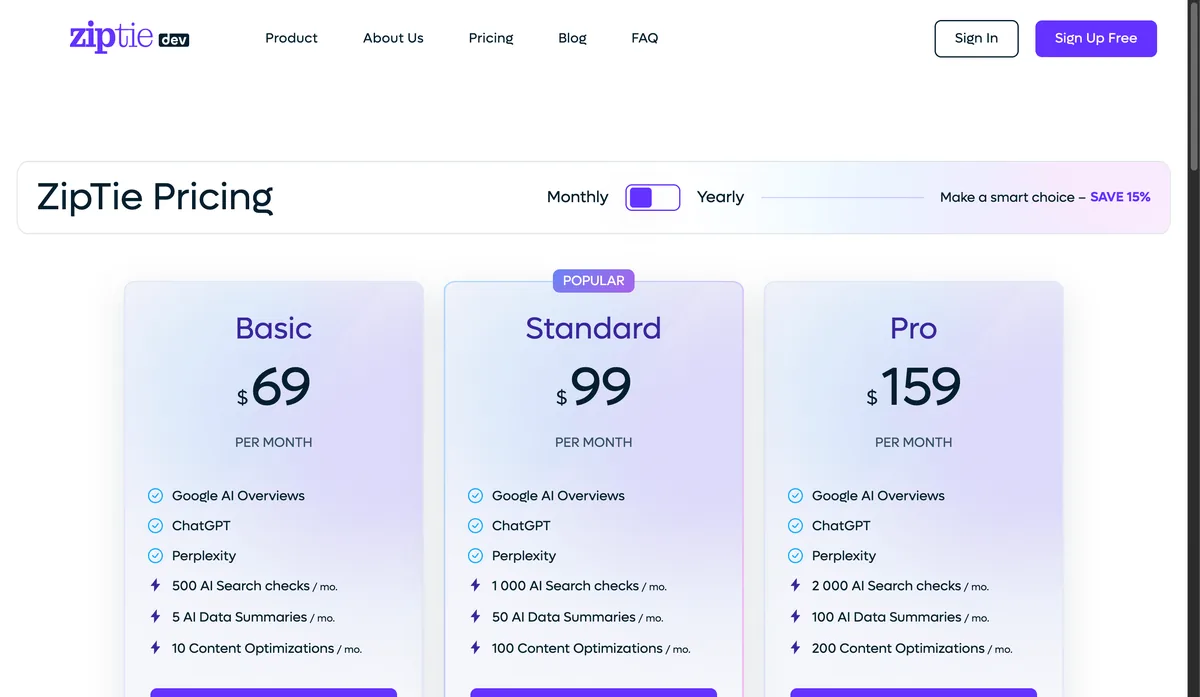
ZipTie gates nothing behind an upgrade. All three tiers list the same three engines, so the extra $90 between Basic and Pro buys checks and content optimizations, not coverage.
The most transparent trial in the comparison, and a clean three-engine tracker for teams who do not need more than that.
- Best for: Small teams tracking a handful of pages who want to try the product properly before paying.
- Pricing (July 2026): Basic $69/mo (500 AI Search checks), Standard $99/mo (1,000), Pro $159/mo (2,000). Yearly billing saves 15%. A 14-day free trial includes 75 AI searches.
Pros
- A 14-day trial with published limits, which is longer than every 7-day trial here and more honest than the ones that publish nothing.
- One check covers all three engines, so 500 checks is 1,500 engine reads by its own footnote.
- Content optimizations bundled with tracking, 10 a month on Basic rising to 200 on Pro.
- Flat engine coverage across all tiers, so nothing is gated behind an upgrade.
Cons
- Three engines only, at every price. No Claude, no Gemini, no Copilot, no Grok.
- One seat on every tier, including the $159 plan.
- 14 countries only, which is a hard stop rather than a surcharge.
- No API stated anywhere on the pricing page.
8. Athena HQ
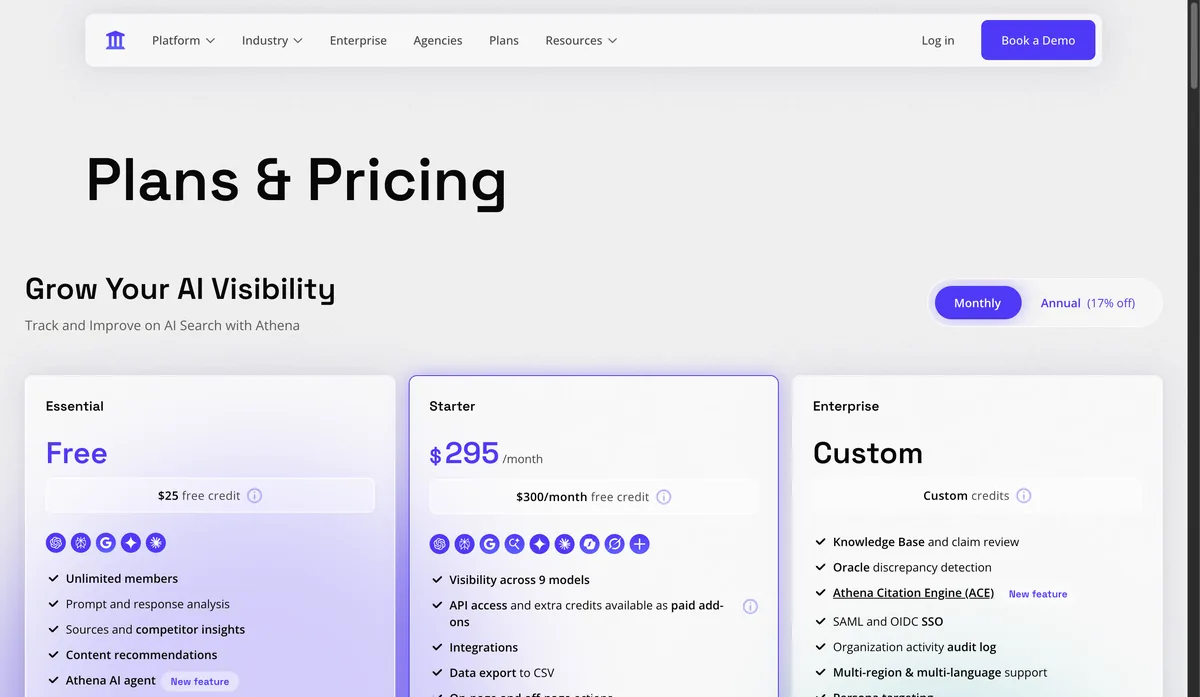
The only genuinely free plan in this comparison, and the steepest gap above it. Essential is free with $25 of credit, and the next step is Starter at $295 a month.
Included here for one reason that matters on a budget: it is the only tool in this comparison with a real free plan rather than a trial. We describe it strictly from its own pricing page.
- Best for: Teams who want to spend nothing this month and still see something real.
- Pricing (July 2026): Essential free with $25 of credit (300 credits), Starter $295/mo with $300 of monthly credit (3,600 credits), Enterprise custom. Annual billing is advertised at 17% off with no dollar figure shown. Athena states that “1 credit = 1 AI response”.
Pros
- A real free tier with 300 credits and no card required, across five models.
- Unlimited members even on the free plan.
- The clearest credit definition on this page. One credit, one AI response, stated at every tier.
- About $82 per 1,000 AI responses on Starter, cheaper sampling than Profound Starter.
Cons
- Nothing between free and $295/mo. That is the steepest gap in this comparison.
- API access is a paid add-on on Starter, billed on top, with pricing available only on request.
- Whether the 300 free credits refresh monthly is not stated.
- Four of the nine models are paid-tier only.
Three Budgets: $0, $50 and $150 a Month
Most buying advice in this category assumes you have already decided to spend. Here is the version that starts from the number you actually have.
At $0 a month
- Run a free one-shot checker to find out whether the engines mention you at all. Ours is here, Ahrefs and Profound publish theirs.
- Sign up for Athena HQ’s Essential plan for 300 credits with no card, the only ongoing free measurement here.
- Take a free first AI visibility report on your own prompts. Rank Prompt gives every new account one with no card, which reads all six engines rather than one.
- Fix crawler access first. Confirm OAI-SearchBot, PerplexityBot and Claude-SearchBot are permitted. This costs nothing and gates everything.
- Stack the free trials deliberately. ZipTie’s 14 days plus Scrunch’s 7 gives you three weeks of real product on the same prompt set.
At about $50 a month
- Widest coverage: Rank Prompt Starter at $49, or $39.17 on annual billing. Six engines, API access, ten brands, one seat.
- Most responses: Ahrefs custom prompts Basic at $50 for 2,500 checks, if you only need tracking and nothing else.
- Cheapest real plan: Otterly.ai Lite at $29, with $21 left over for the Google AI Mode and Gemini add-ons.
- Do not buy Profound or Semrush here. Both publish annual-only pricing, so $99 a month is a $1,188 commitment.
At about $150 a month
- Agency work: Rank Prompt Agency at $149 for white-label reports, ten team seats and 1,000 tracked prompts a month.
- Pure volume: Rankscale Pro at $99 with $50 left for a top-up, or Ahrefs Growth at $100 for 7,000 checks.
- Team access: Peec AI Starter at $95 with unlimited seats, if three models is enough.
- Two tools instead of one is often the right answer at this level: a cheap high-volume tracker plus a free checker beats a mid-tier single vendor.
What this means for you
- Set the budget before the shortlist, because every vendor’s marketing is written for the tier above yours.
- Spend the first month on crawler access and a baseline, not on the most expensive plan you can justify.
- Re-price at 90 days. You will know your real prompt count by then, and nobody’s first estimate survives.
When Cheap Is a False Economy
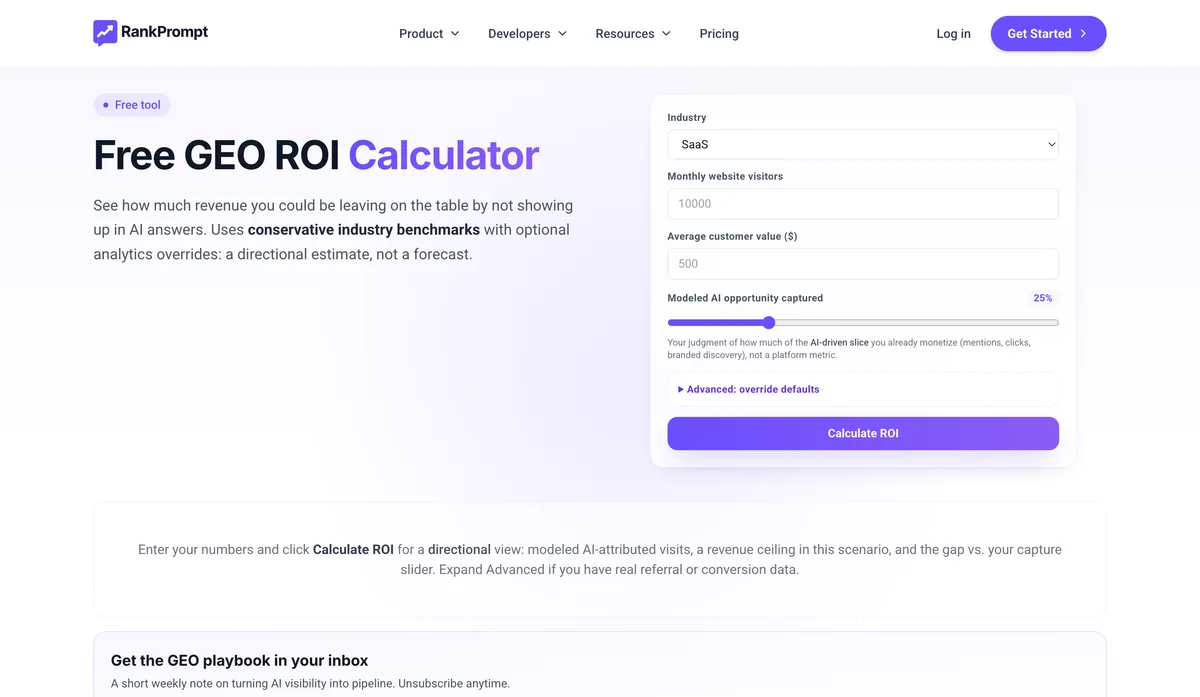
Before arguing about a $29 plan against a $99 plan, put a number on the revenue at stake. Rank Prompt’s free GEO ROI calculator is a directional model, not a forecast.
Four situations where the cheap plan costs more than the expensive one. We have watched each of these happen.
- When the sample is too small to trust. The uncertainty research above found citation rankings unstable across repeated samples, so 15 prompts checked daily on four engines can still leave you arguing about noise. Paying $29 to have the wrong argument every Monday is not a saving.
- When the entry tier covers one engine. Profound’s $99 plan tracks ChatGPT only. If a competitor is beating you inside Perplexity and Gemini, you will not see it, and you will conclude everything is fine.
- When you cannot get the data out. Profound Starter has no exports. A tool that cannot feed your reporting stack becomes a tab nobody opens, which is a 100% waste rather than a discount.
- When the tool measures but nothing acts. The original GEO research from KDD 2024 found that adding quotations, statistics and cited sources “can boost visibility by up to 40%”, while keyword stuffing produced “little to no performance improvement”. The dashboard does not write those. Someone has to, and that cost dwarfs the subscription.
The last one is the one that decides most budgets. Google states plainly that “No third-party tool has access to our internal ranking or AI systems”, so every tool on this page is inferring from samples, and none of them moves the number for you.
There is real money on the other side of the decision. Pew found that users who saw an AI summary clicked a traditional result in 8% of visits, against 15% when no summary appeared.
Google says AI Overviews now reach over 2.5 billion monthly active users, so the audience behind that click gap is not small.
If you want to put a number on your own side of that trade before you pick a plan, our free GEO ROI calculator is a directional model, not a forecast, and it costs nothing.
What this means for you
- Budget for the work as well as the dashboard. The tool is usually a small fraction of the cost of moving the number.
- Never buy an engine-gated entry tier unless you are certain your buyers only use that engine.
- Cheap plus a person beats expensive plus nobody, every time.
What We Left Out of the Budget Cut
Four things we deliberately did not rank here.
- Anything over $200 a month at entry. Scrunch’s cheapest published plan is $250/mo for 125 prompts across four LLMs, which is a reasonable product and not a budget one. Profound Growth at $399 and Athena HQ Starter at $295 sit in the same bucket.
- Semrush’s AI Visibility Toolkit as a cheap option. At $99 per domain billed annually with no free trial for the toolkit, it is a sensible add-on for existing Semrush customers and a poor first purchase for a small budget.
- TrackerAI. It is not a real AI visibility product. Our pillar checked five domains under that name in July 2026 and found parked pages and unrelated software.
- Done-for-you services. Agencies buy on a different process and get their own ranking in best AI visibility agencies.
Where This Fits
This is the budget cut of our AI visibility cluster. The full head-to-head ranking, the scoring criteria and the complete competitive set live in the pillar, best AI visibility tools.
The neighbouring guides take the cuts we kept short here. AI visibility tools for ecommerce handles catalogs, and best AI visibility agencies covers done-for-you.
For the underlying concepts of AI search optimization, start with what is AI visibility, then answer engine optimization. Our wider vendor inventory is AI search visibility tracking tools, and the SEO-adjacent set is best AI SEO tools.
Check your AI visibility free → No card, no subscription. See which engines mention you today.
Sources
All vendor pricing, tier gates and limits were read off each vendor’s own live page on 31 July 2026.
 Google: Search Central: AI features and your website (primary)
- Google: New opportunities, control and insights for website owners (primary)
 OpenAI: Bots and crawlers (primary)
 Perplexity: Crawler documentation (primary)
 Anthropic: Does Anthropic crawl data from the web? (primary)
- Sielinski, R. (2026). Quantifying Uncertainty in AI Visibility: A Statistical Framework for Generative Search Measurement. arXiv:2603.08924 (academic, preprint)
- Aggarwal, P. et al. (2023). GEO: Generative Engine Optimization. arXiv:2311.09735, KDD 2024 (academic, peer-reviewed)
- Grossman, R., Liu, S., Chen, M. K. (2026). How Generative AI Disrupts Search. arXiv:2604.27790, ACM SIGIR 2026 (academic, peer-reviewed)
- Liu, N. F., Zhang, T., Liang, P. (2023). Evaluating Verifiability in Generative Search Engines. arXiv:2304.09848, Findings of EMNLP 2023 (academic, peer-reviewed)
- Pew Research Center: Google users are less likely to click on links when an AI summary appears (independent)
- Cloudflare: The crawl-to-click gap (independent)
- Vendor pricing pages, each cited as primary for its own product: Rank Prompt, Otterly.ai, Rankscale, Ahrefs plans, Ahrefs Brand Radar, Brand Radar help article, Peec AI, Knowatoa, ZipTie, Profound, Semrush, Semrush AI Visibility Toolkit help article, Athena HQ, Scrunch

 Grok
Grok