
Quick Answer
The best AI visibility tools for ecommerce in 2026 are Rank Prompt (best overall for category and comparison queries, six engines from $49/mo), Profound (best SKU-level tracking inside ChatGPT Shopping, Enterprise only), Goodie (best for Amazon and Alexa for Shopping), Semrush AI Visibility (best if your ecommerce SEO team already lives in Semrush) and Peec AI (best for multi-market retail groups).
Product-level AI visibility is the measurement of whether a specific product, SKU or product line appears in AI-generated shopping answers, as opposed to whether the brand name is mentioned anywhere in the response. Almost every tool in this category measures the second thing and sells it as the first.
Every price and tier gate below was read off the vendor’s own live page in July 2026. This category re-prices constantly, so check before you buy.
Key Takeaways
- Brand-level and product-level tracking are different products. Most tools only do the first one.
- Product-level tracking is an Enterprise upsell almost everywhere. Profound, Scrunch, Semrush and Goodie all put it above their entry plan, verified on their own pricing pages this month.
- Your product pages are probably your weakest asset. Adobe scored US retail product pages at 66% machine readable, the lowest of any page type it measured.
- A prompt budget does not stretch over a catalog. 25 to 150 tracked prompts covers categories, not thousands of SKUs. Plan around that or you will be disappointed.
- Feeds now matter more than pages for shopping surfaces. ChatGPT, Google and Amazon each read a merchant feed you control, and your robots.txt has nothing to do with it.
- We build Rank Prompt. It ranks first here for category-query coverage and price. It also does not ingest a product feed, which rules it out for pure SKU shelf tracking.
Why Ecommerce Breaks Ordinary AI Visibility Tools
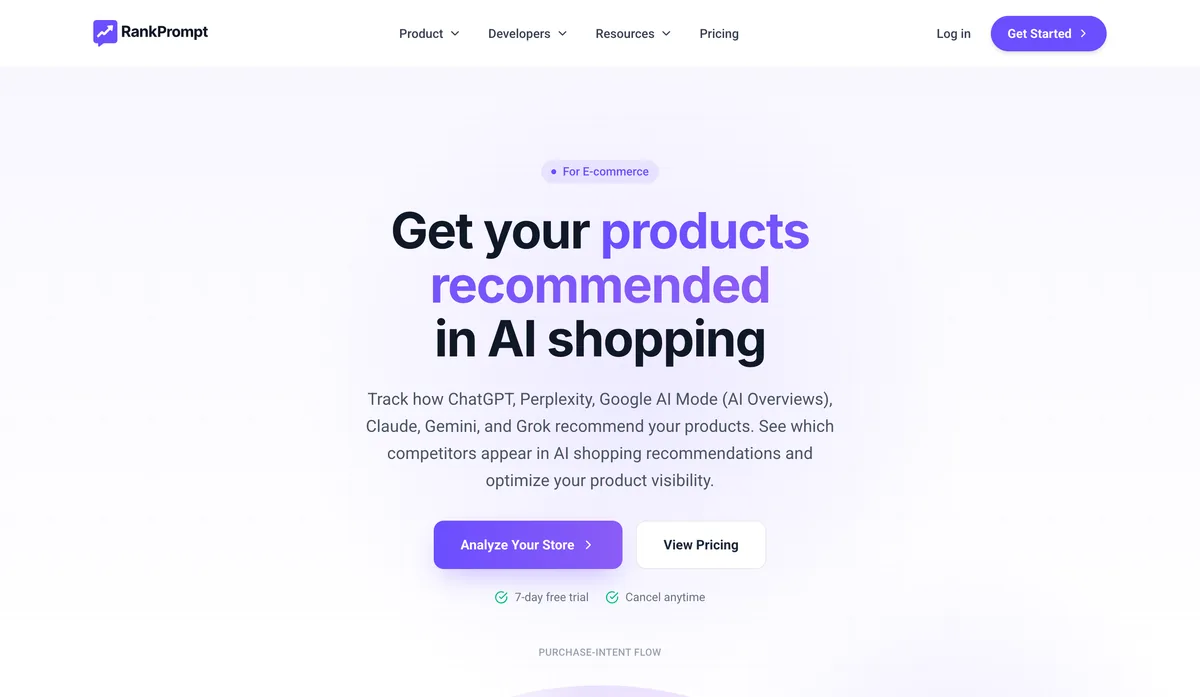
The question an ecommerce AI visibility tool has to answer is about products, not brand names. Rank Prompt’s own ecommerce page, captured July 2026.
A general AI visibility tool answers one question: does an assistant say your brand name. That question is close to useless when you sell 12,000 SKUs and the shopper asked for a waterproof hiking boot under $150.
The demand is real and it is being measured. Adobe, working from more than a trillion visits to US retail sites, found that traffic from AI sources to US retail sites grew 393% year over year in the first quarter of 2026.
The buyers are better than average too. Adobe’s March 2026 data has AI traffic converting 42% better than non-AI traffic, which it calls a record. A year earlier the same measurement had AI traffic converting 38% worse.
Then comes the part nobody quotes. Adobe scored retail pages with its AI Content Visibility Checker and found homepages average 75% readable by machines, category pages 74%, and individual product pages 66%, the worst score of any page type it published.
Adobe’s own summary of that: “Retailers have thousands of SKUs, and our data shows that much of the content is currently invisible to LLMs.”
So the asset most likely to convert is the asset least likely to be readable. That gap is what an ecommerce AI visibility tool is supposed to find, and most of them cannot see it because they are looking at brand mentions.
What this means for you
- Do not buy on engine count. Buy on whether the tool can see a product, a category and a competitor SKU.
- Audit your PDP template before you audit anything else. One template fault multiplies across every SKU you own.
- Assume your category pages are the entry point, because that is where “best X for Y” questions land.
Comparison Table: 8 Tools for Ecommerce
Entry price is the cheapest published self-serve plan. “Product-level” means the vendor’s own site says it tracks individual products or SKUs rather than only brand mentions. All checked July 2026.
| Tool | Entry price | Product-level tracking | Shopping surfaces named | Prompts at entry | Best for |
|---|---|---|---|---|---|
 Rank Prompt Rank Prompt | $49/mo | Category and product-line prompts, no feed ingestion | ChatGPT, Perplexity, Google AI Mode, Claude, Gemini, Grok | 150 a month | Category and comparison queries across every engine |
 Profound Profound | $99/mo | Yes, SKU-level, Enterprise only | ChatGPT Shopping | 50 prompts | Enterprise retail on ChatGPT Shopping |
 Goodie Goodie | $399/mo | Yes, product-level | Amazon Rufus / Alexa for Shopping, on Pro and above | 100 prompts | Amazon sellers |
 Semrush AI Visibility Semrush AI Visibility | $99/mo per domain | Product-line analysis, Enterprise demo only | ChatGPT, Google AI, Gemini, Perplexity | 25 prompts | Ecommerce SEO teams already on Semrush |
 Peec AI Peec AI | $95/mo | ”AI Shopping” listed, no tier detail published | None named. 3 general models chosen from 6 | 50 prompts | Multi-market and multi-brand retail groups |
 Scrunch Scrunch | $250/mo | ”Product Observability”, Enterprise only | None named. 4 general LLMs at Core | 125 prompts | Making a storefront legible to AI agents |
 Otterly.ai Otterly.ai | $29/mo | No | None named. 4 general engines | 15 prompts | Small DTC brands watching one category |
 Rankscale Rankscale | $20/mo | No | None named | Not published at $20 | Sampling the most category queries per dollar |
Where Product-Level Tracking Actually Starts
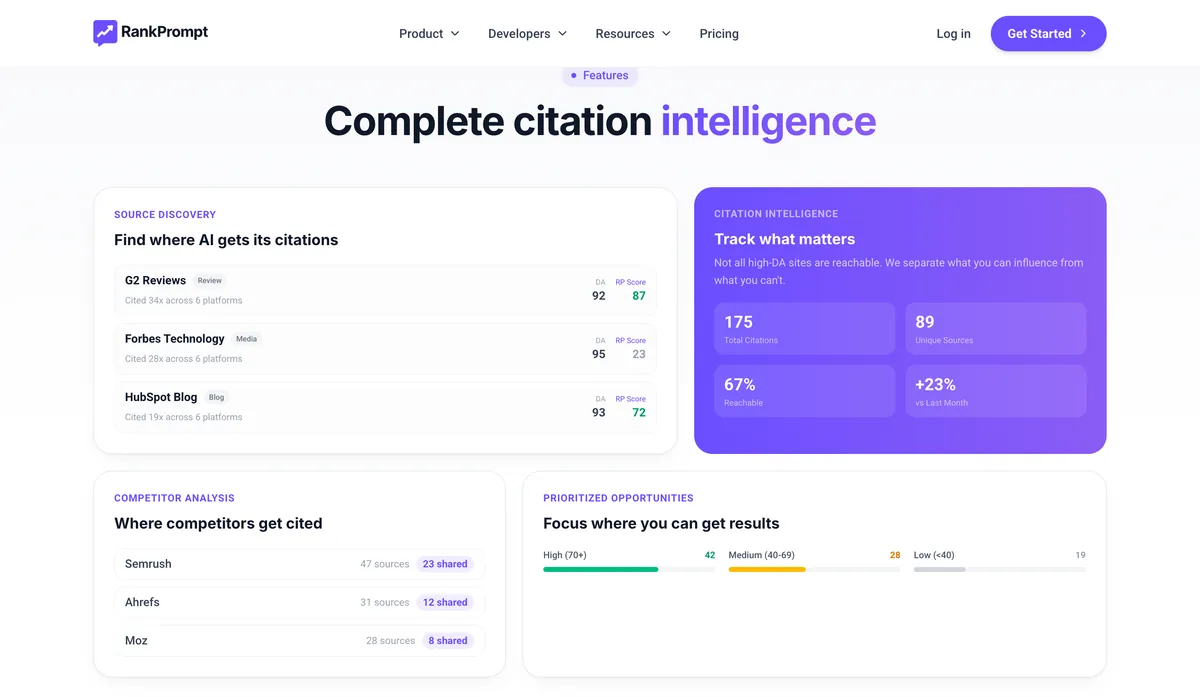
Citation-level detail is what tells you whether a review site, a marketplace listing or your own PDP was the source behind an answer. Sample data shown on Rank Prompt’s product page.
This is the table I wish someone had handed me before we started testing. Four vendors sell product-level tracking. All four put it above their entry plan, and three of them put it behind a sales call.
| Vendor | Product feature | Cheapest tier that includes it | Evidence |
|---|---|---|---|
| Profound | ChatGPT Shopping | Enterprise, custom pricing | Pricing matrix reads No / No / Yes across Starter, Growth, Enterprise |
| Scrunch | Product Observability | Enterprise, custom pricing | Pricing matrix shows a dash on Core, a tick on Enterprise |
| Semrush | ”Detailed analysis by brand, concept, or product line” | Enterprise, demo required | Listed only under the Enterprise demo block, not the $99 plan |
| Goodie | Amazon Rufus coverage | Pro, custom pricing | Explorer at $399/mo lists ChatGPT, AI Overviews and Perplexity as its core models |
Every one of those was read off the vendor’s own pricing page on 31 July 2026.
The practical effect is that the sticker price of product-level AI visibility is not $99 or $250. It is whatever a sales team quotes you, and you will not find out until you book the call.
There is a second reading of the same table, and it is more interesting. Product-level tracking is where these companies think the money is.
When four independent vendors put the same feature behind the same wall, they are telling you what retail buyers will pay for.
What this means for you
- Ask for the Enterprise quote first if product-level tracking is the reason you are shopping. The self-serve tier will not do it.
- Budget the sales cycle, not just the licence. Three of the four require a demo before you see a number.
- If categories are enough for you, you save a lot of money. Category-query tracking is available at $29 to $99.
How We Scored These Tools for Ecommerce
Six criteria, ordered by how much they change a catalog owner’s decision. The first two are the ones general tool roundups skip.
- Product and PDP granularity. Can it report on a SKU, a product line or a category, or only on the brand name.
- Shopping-surface coverage. ChatGPT Shopping, Google AI Mode, Alexa for Shopping and Perplexity behave differently and are not interchangeable.
- Catalog economics. What one tracked prompt costs, multiplied by the number of categories you actually sell into.
- Feed and structured-data awareness. Whether the tool looks at the merchant feed and Product markup that shopping surfaces read.
- Revenue attribution. Whether AI-sourced sessions can be tied to orders, usually through GA4.
- Multi-market and multi-storefront support. Most retailers run more than one locale and more than one domain.
We did not score design, onboarding or support quality. Those matter, but they are not why an ecommerce team buys this.
What this means for you
- Score criterion 3 with your real category count, not the vendor’s example.
- Skip criterion 4 if you have a technical team who already own the feed.
- Weight criterion 5 heavily if you have to justify the spend to a finance team.
The 8 Best AI Visibility Tools for Ecommerce
1. Rank Prompt
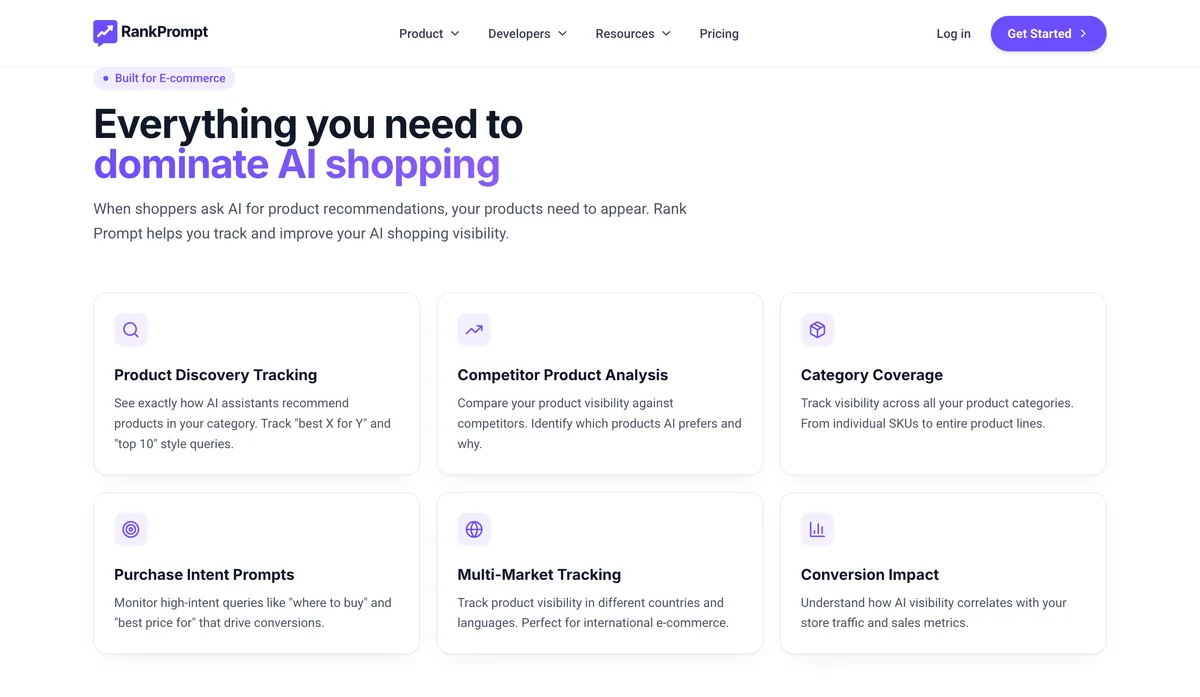
The six ecommerce capabilities Rank Prompt publishes, including category coverage and purchase-intent prompts. These are prompt-based, which is also the limitation described below.
Our own product, ranked first on two things a catalog owner can verify: all six assistants on every tier, and the lowest published entry price for that coverage.
It is the wrong pick if you need SKU shelf tracking. I come back to that below.
- Best for: DTC and retail brands who need to win “best X for Y” category and comparison queries across every assistant, then fix the pages behind them.
- Pricing (July 2026): Starter $49/mo (150 tracked prompts a month), Pro $89/mo (500), Agency $149/mo (1,000), Agency Plus $299/mo (2,000). Annual billing takes 20% off. Your first full AI visibility report is free and needs no card; the 7-day trial of a paid plan does.
Pros
- Six assistants on the $49 plan. ChatGPT, Perplexity, Google AI Mode, Claude, Gemini and Grok, with no engine gating between tiers.
- Category and purchase-intent prompt tracking built around the queries shoppers actually type, including “where to buy” and “best price for”.
- Citation-level source data, so you see which review site, marketplace listing or retailer page an answer was built from.
- GA4 and Search Console integration on every tier, which is how you tie AI-sourced sessions back to orders.
- Multi-market tracking in any language, included rather than sold as a regional add-on.
- Content generation and outreach in the same account, so a category gap can become a brief without a second tool.
Cons
- No product feed ingestion. Rank Prompt tracks prompts you define. It does not read your Merchant Center feed or your ACP catalog, so it cannot tell you where SKU 4471 sits on a ChatGPT shelf. If that is the job, buy Profound Enterprise or Goodie.
- Starter does not cover a catalog. 150 tracked prompts is 150 sampled responses a month. A 40-category retailer will burn it in a week and need Pro or Agency.
- One allowance covers everything, tracked prompts, articles and audits alike, so a heavy content month eats the tracking budget.
- No published SOC 2 or SAML SSO, which loses us enterprise retail deals. That is a fair outcome and we know it.
2. Profound
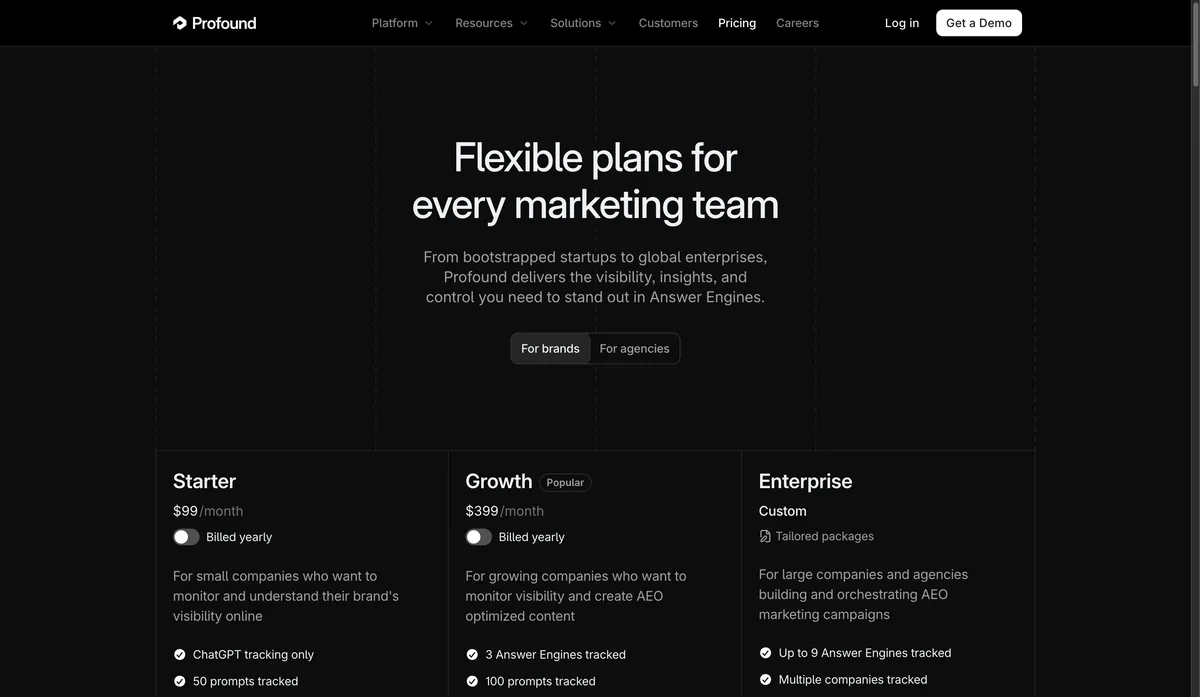
Profound’s public tiers on 31 July 2026. Starter at $99 a month is ChatGPT tracking only with 50 prompts, and Growth is $399 for three engines. ChatGPT Shopping, the reason an ecommerce team looks at Profound at all, is on neither of them.
The deepest product-level tooling in the category, sold at a price that only makes sense above a certain revenue line.
- Best for: Enterprise retail teams whose priority is where their SKUs land inside ChatGPT Shopping.
- Pricing (July 2026): Starter $99/mo, Growth $399/mo, Enterprise custom. Both published prices are billed yearly with two months free.
Pros
- A real shopping module, which its own page describes as covering shopping visibility, attribute accuracy, shopper sentiment and SKU-level analysis.
- A merchant layer that reports which third-party retailers and direct stores own your brand’s checkout options, useful if you sell through resellers.
- Shopping Mode Rate, which tracks how often queries in your category trigger a shopping interface rather than a text answer. Nobody else publishes that metric.
- Feed and structured-data recommendations aimed at the fields that decide whether ChatGPT identifies your product correctly.
- Deep sampling at the paid tiers, 1,500 responses a month on Starter and 9,000 on Growth.
Cons
- ChatGPT Shopping is Enterprise only. The pricing matrix reads No on Starter, No on Growth, Yes on Enterprise. The $99 and $399 plans do not include it.
- The shopping module is single-surface. Their page marks it “Powered by ChatGPT”, so Google AI Mode and Amazon are not covered.
- Starter tracks ChatGPT alone, so brand-level multi-engine coverage starts at $399.
- API is Enterprise only, which matters if you want SKU data in your own warehouse.
Readers already on Profound and considering a move should weigh it against the full competitive set in our best AI visibility tools pillar.
3. Goodie
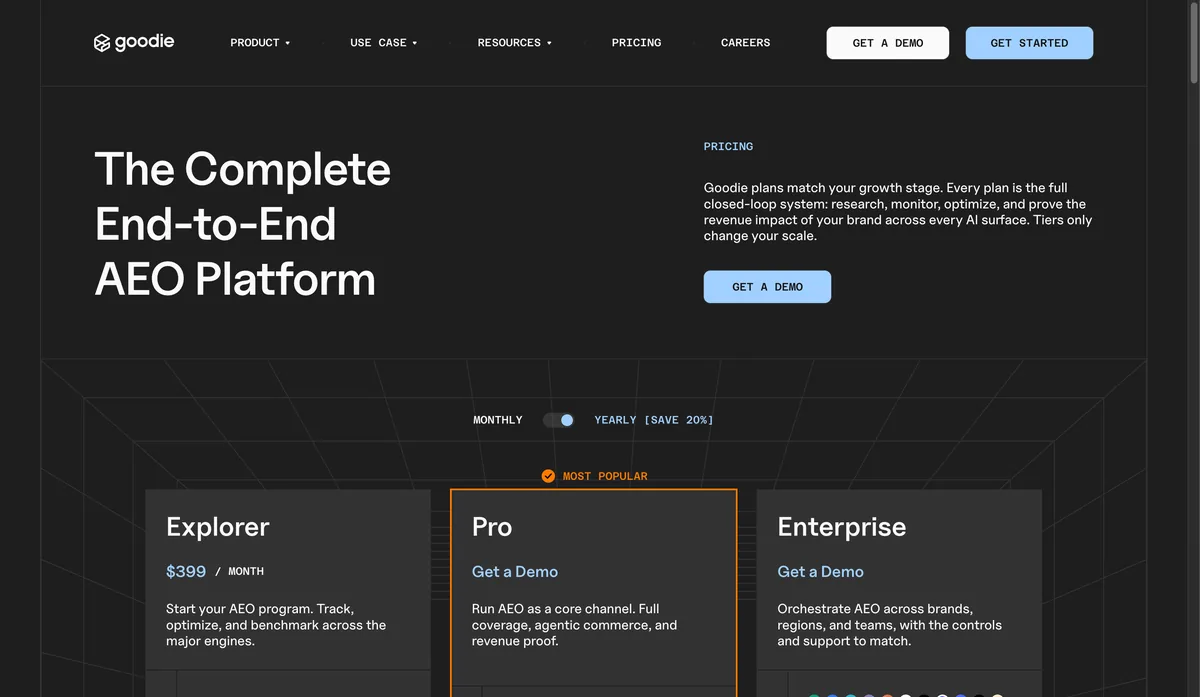
Goodie’s published pricing on 31 July 2026. Explorer is $399 a month, and Pro, the tier that carries Amazon coverage, is a Get a Demo button rather than a number.
The only tool here built around Amazon, which makes it the obvious pick for sellers whose demand starts and ends on the marketplace.
- Best for: Amazon-first brands and sellers who need to know how Alexa for Shopping, formerly Rufus, recommends their listings.
- Pricing (July 2026): Explorer $399/mo with 100 prompts and 3,000 AI responses, three seats and one brand. Pro and Enterprise are quote only. A 7-day free trial is offered on Explorer. The site is higoodie.com.
Pros
- Amazon coverage nobody else publishes. Amazon says Rufus “helped over 300 million customers in 2025” before it became Alexa for Shopping, and no other tool in this list names that surface.
- Product-level by design, tracking product mentions, AI-assigned labels, category visibility share and competitive positioning.
- Listing-specific recommendations covering product listings, reviews and Q&A rather than generic content advice.
- Up to eleven models at Enterprise, among the widest published coverage in this comparison.
Cons
- Rufus is not in the $399 plan. Explorer’s core models are ChatGPT, AI Overviews and Perplexity. Amazon coverage sits on Pro, which has no published price.
- The most expensive prompt in this list. 100 prompts at $399 works out near $4 per tracked prompt per month.
- One brand on Explorer, which rules it out for a house of brands without a quote.
- Amazon changed the target mid-year. The Rufus brand was retired in May 2026, so any tooling built on it is chasing a moving surface.
4. Semrush AI Visibility Toolkit
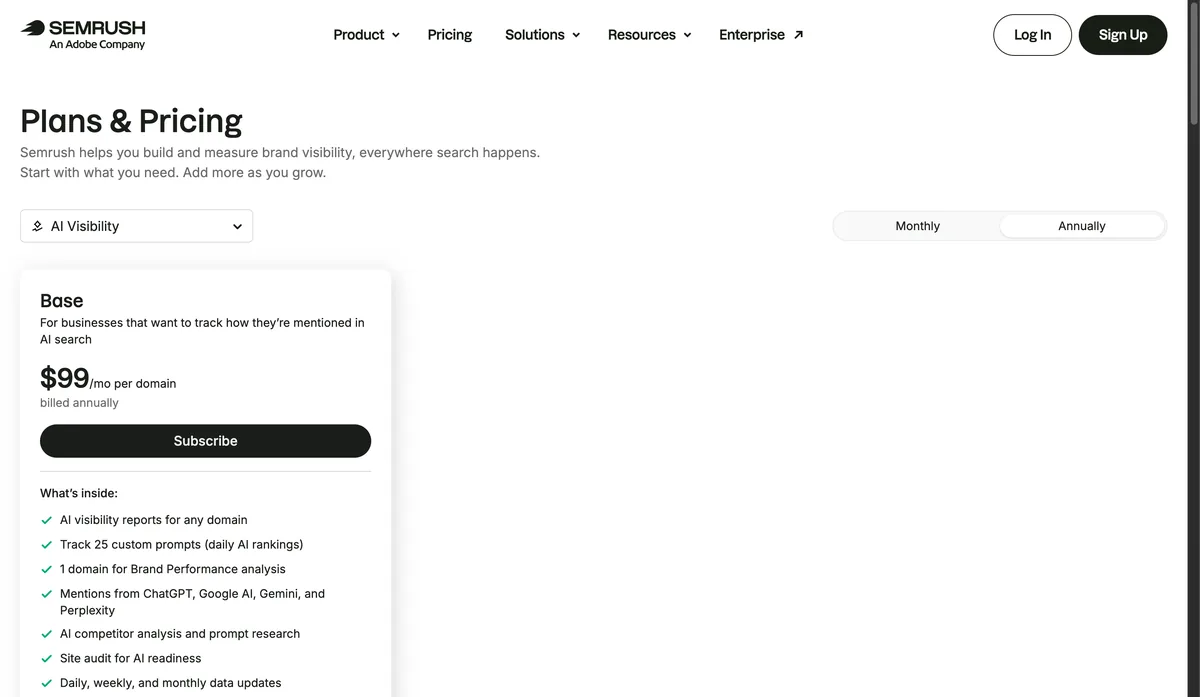
Semrush prices the AI Visibility Toolkit per domain rather than per seat, at $99 a month billed annually for 25 custom prompts. Per domain is the line that hurts if you run a separate storefront per market.
The pragmatic answer when your ecommerce SEO team already runs on Semrush and a tenth login is not happening.
- Best for: In-house ecommerce SEO teams with an existing Semrush workflow and reporting stack.
- Pricing (July 2026): $99/mo per domain, stated on the pricing page as billed annually. Additional users start at $45/mo.
Pros
- One reporting stack covering keyword, backlink and AI visibility data for the same store.
- AI readiness site audit included, which is the closest thing here to Adobe’s machine-readability check.
- Prompt research to find which category questions trigger AI answers in your vertical.
- Four engines at the base price: ChatGPT, Google AI, Gemini and Perplexity.
Cons
- Product-line analysis is an Enterprise ask. “Detailed analysis by brand, concept, or product line” appears only in the Enterprise demo block, not in the $99 plan.
- 25 prompts is nothing for a catalog. That is roughly one prompt per category for a mid-size retailer.
- Priced per domain, which punishes anyone running separate storefronts per country.
- Annual billing on the headline price, so the monthly commitment is higher than it looks.
5. Peec AI
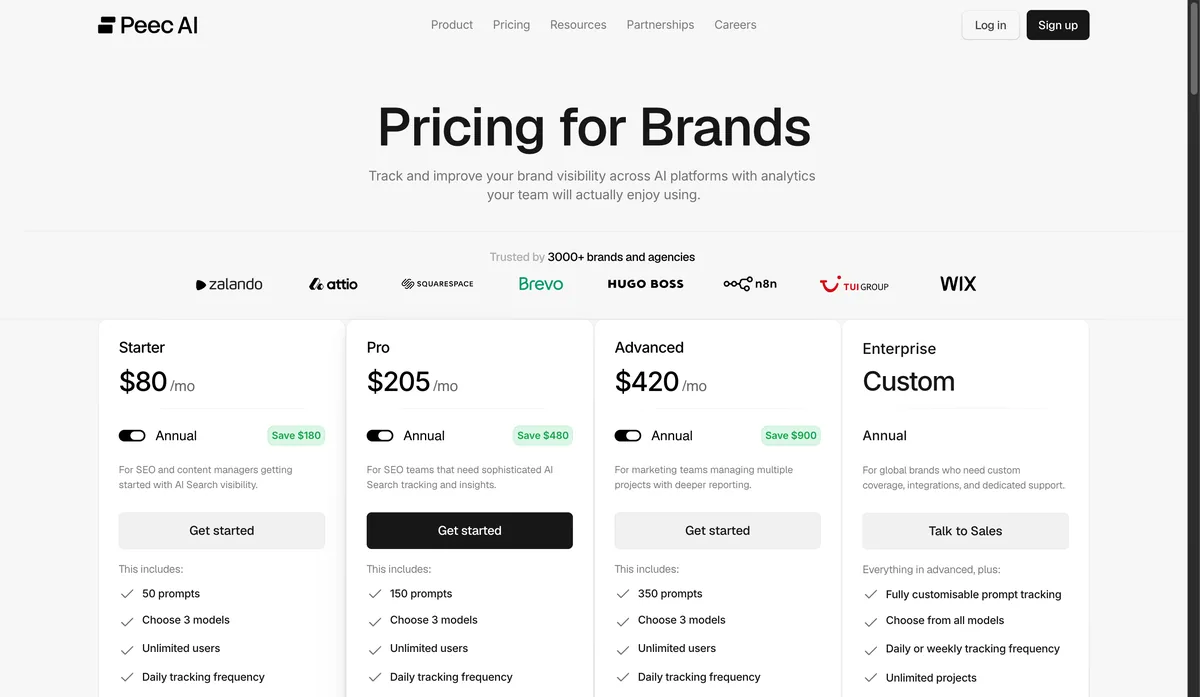
Peec AI’s plan cards on 31 July 2026, shown on the annual toggle at $80, $205 and $420. Monthly is $95, $245 and $495, and every standard tier is capped at three models.
A well-built analytics product for teams who run several brands or several countries and want the same view across all of them.
- Best for: Retail groups and agencies tracking multiple brands or markets without an enterprise contract.
- Pricing (July 2026): Starter $95/mo (50 prompts), Pro $245/mo (150), Advanced $495/mo (350), billed monthly. Annual drops those to $80, $205 and $420. Enterprise is custom.
Pros
- Daily tracking on every tier, including the $95 plan.
- Unlimited users on all plans, which suits merchandising teams who all want a login.
- An AI Shopping row on the pricing page, marked “Included at launch”. It is the only mid-market tool here that has put shopping on the roadmap in public.
- Multi-country from the Advanced tier, three countries per project, unlimited on Enterprise.
- Looker Studio from Advanced, so AI visibility sits in the same board as commerce reporting.
Cons
- AI Shopping has no published tier breakdown. The row exists, the per-plan detail does not, so treat it as unproven until you see a demo.
- One country on Starter. If you sell across three markets, the real entry price is the $495 Advanced plan.
- Three models on every standard tier, picked from six, with extra models at $30 to $140 a month.
- Measurement only, so you will pair it with something that writes and fixes.
6. Scrunch
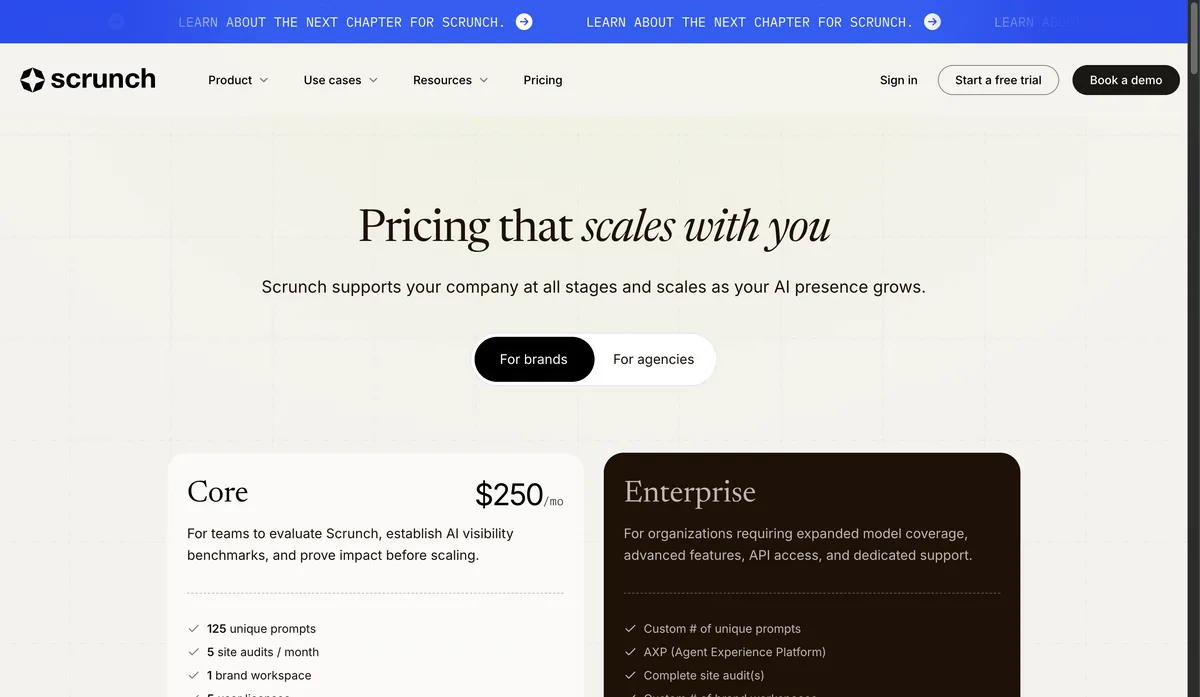
Scrunch publishes two tiers and nothing in between. Core is $250 a month for 125 prompts and five site audits, and Product Observability sits on the Enterprise side of that line.
Positioned around how AI agents experience a site, which is a different bet from answer tracking and a relevant one once agents start doing the checkout.
- Best for: Enterprise retailers whose priority is making the storefront itself legible to shopping agents.
- Pricing (July 2026): Core $250/mo with 125 prompts, five site audits, one brand workspace and five licences across four LLMs. Enterprise is custom with nine LLMs.
Pros
- Its own nav describes a Shopping module as “See AI search performance at the product level”.
- Site audits and site maps included at Core, which is unusual at this price and speaks to the PDP readability problem.
- Agent traffic analysis, described on their site as analysing AI website traffic.
- 7-day free trial advertised without a credit card.
Cons
- Product Observability is Enterprise only. The Core column on their comparison table carries a dash.
- $250/mo before you get the product feature you probably came for.
- API, MCP, CLI and Looker are all Enterprise, so no self-serve data export.
- One brand workspace at Core, which is thin for a group.
7. Otterly.ai
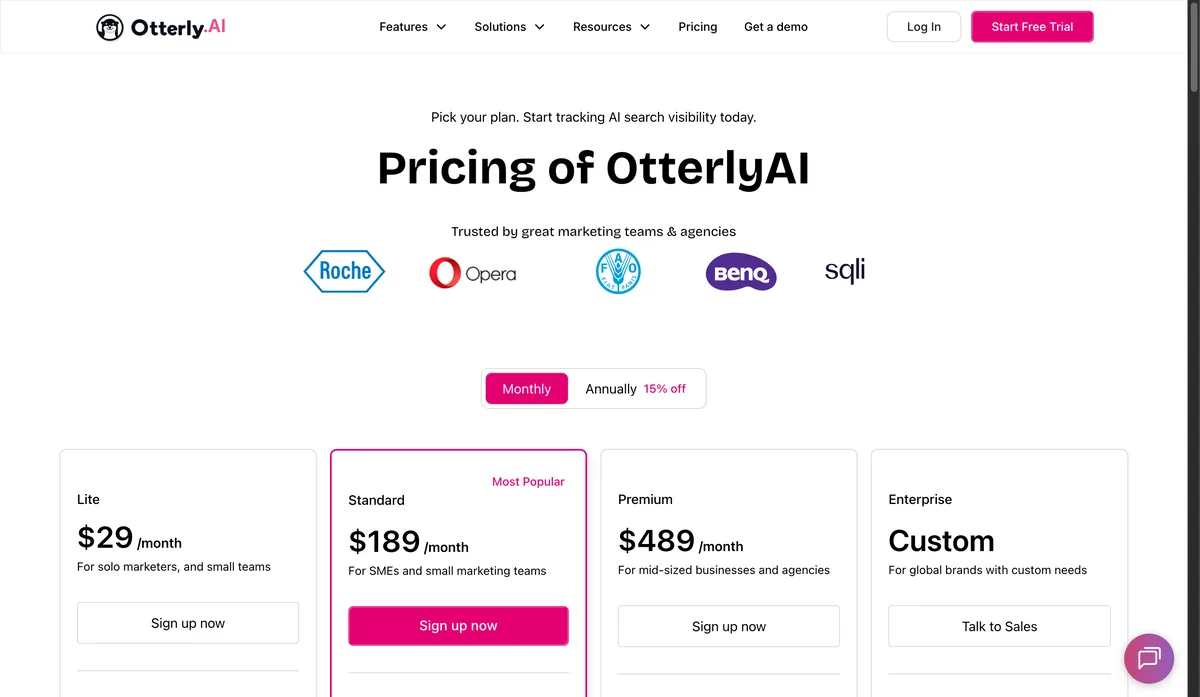
Otterly.ai on the monthly toggle, 31 July 2026. Lite at $29 is the cheapest entry point in this comparison, and the next step up is $189 with nothing between them.
The cheapest honest starting point if you sell in one or two categories and want a trend line rather than a project.
- Best for: Small DTC brands watching a handful of category queries on a real budget.
- Pricing (July 2026): Lite $29/mo (15 prompts), Standard $189/mo (100), Premium $489/mo (400). Annual takes 15% off. Prices exclude tax.
Pros
- $29/mo with daily tracking across ChatGPT, Google AI Overviews, Perplexity and Copilot.
- A free trial for new users, stated on the pricing page, though the card requirement is not spelled out there.
- API and MCP from $189/mo, well below where Profound and Scrunch open theirs.
- Unlimited team members on every plan.
Cons
- No product-level tracking. Brand and category prompts only.
- 15 prompts is about three categories once you include competitor variants.
- Claude, Gemini and Google AI Mode are paid add-ons, which matters as Gemini shopping grows.
- The jump from $29 to $189 has nothing in between.
8. Rankscale
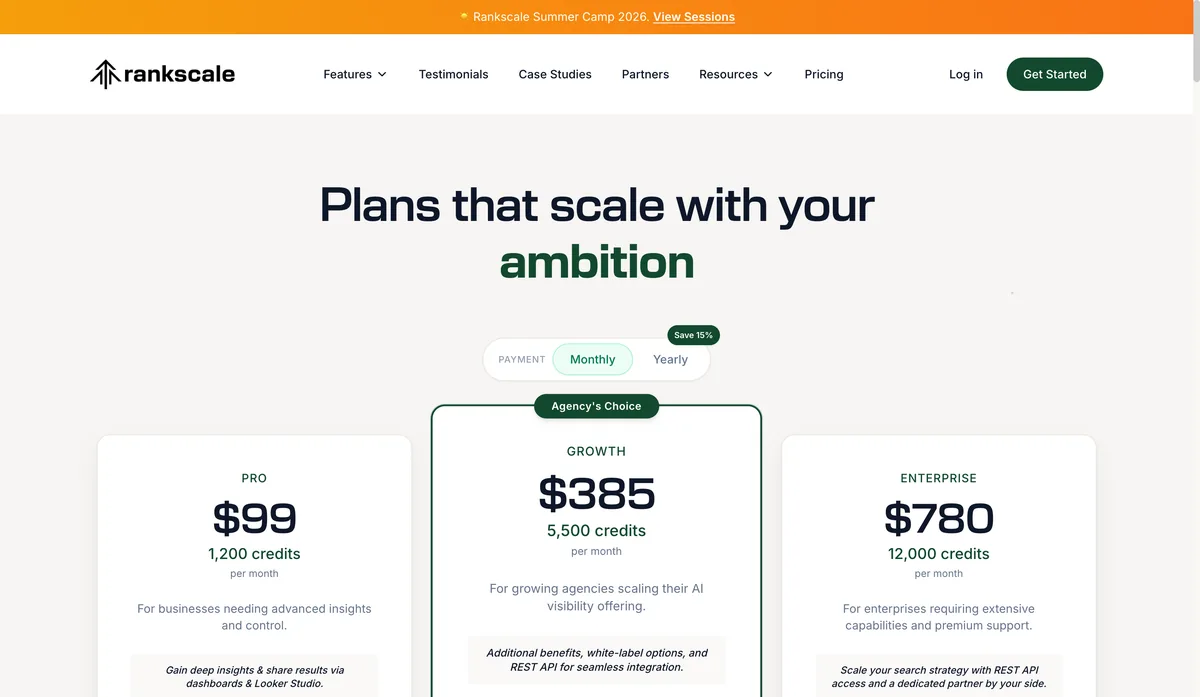
Rankscale on the monthly toggle, 31 July 2026. Pro at $99 for 1,200 credits is the cheapest sampling here, which is what you are buying instead of product-level tracking.
The volume play. If your plan is to sample hundreds of category questions and do the analysis yourself, nothing here is cheaper per response.
- Best for: Teams who want maximum category-query coverage per dollar and have someone to act on it.
- Pricing (July 2026): Essentials from $20/mo, Pro $99/mo (1,200 credits, up to 4,800 AI responses), Growth $385/mo (5,500 credits, 22,000 responses), Enterprise $780/mo. Yearly saves 15%.
Pros
- Roughly $21 per 1,000 AI responses on Pro, by far the cheapest sampling in this comparison.
- Unlimited search terms and all regions on Pro, which suits a wide category set.
- White-labeled dashboard links on Growth, useful for agencies running retail clients.
- Published Enterprise pricing, the only vendor here that does not hide the top tier.
Cons
- No product-level tracking or feed awareness. You are buying raw sampling.
- Engine coverage at the $20 tier is not published, so the cheap plan is a leap of faith.
- “17+ engines” is a claim, not a list. Around ten are named on the site.
- Thinner public track record than the larger vendors here.
What Each AI Shopping Surface Actually Reads
Tools measure the output. This table is about the input, because for shopping surfaces the input is usually a feed you control rather than a page a crawler found.
| Surface | What decides inclusion | Who you configure it with | Primary documentation |
|---|---|---|---|
| ChatGPT shopping and Instant Checkout | A merchant-supplied product feed, plus crawled pages | OpenAI, via the Agentic Commerce Protocol | OpenAI Developers |
| Google AI Mode, Gemini, AI Overviews | Shopping Graph listings, Merchant Center feed, on-page Product markup | Google Merchant Center | Google Search Central |
| Alexa for Shopping (formerly Rufus) | Your Amazon catalog: listing copy, images, reviews, Q&A | Amazon Seller or Vendor Central | About Amazon |
| Perplexity | Crawled pages. Their docs say to allow PerplexityBot to appear in results | robots.txt | Perplexity docs |
| Claude and general assistant answers | Crawled pages and third-party sources | robots.txt | Anthropic |
| Shopify agentic storefronts | Shopify Catalog, synced automatically from your product data | Shopify sales channels | Shopify Help Center |
Four things worth pulling out of that table.
Google is unusually direct about the ecommerce route. Its AI optimization guide says that “Using products like Merchant Center (such as Merchant Center feeds) and Google Business Profiles can help your products and services to be visible in both AI responses and other Google Search results.”
The same page also kills a popular myth: “Structured data isn’t required for generative AI search, and there’s no special schema.org markup you need to add.”
Product markup still earns rich results and still helps Google verify your data, and Google recommends supplying both markup and a feed to maximise eligibility. It is just not a magic AI switch.
OpenAI reads a feed too. Its agentic commerce docs describe merchants providing “a secure, regularly refreshed feed (CSV or JSON) containing key details such as identifiers, descriptions, pricing, inventory, media, and fulfillment options”, and note that recommended attributes such as rich media and reviews “improve ranking, relevance, and user trust”.
Shopify quietly automates a chunk of this. Its help centre says eligible products are “automatically discoverable by AI channels through Shopify Catalog”, which “continuously updates your product data”.
Two caveats there. Products sold only to business or wholesale customers get excluded from AI channels where Shopify can identify them, and Google AI Mode and Gemini are still early access.
What this means for you
- Fix the feed before you buy a dashboard. The required Merchant Center attributes are unglamorous and they gate everything: id, title, description, link, image_link, availability, price, brand and a GTIN or MPN.
- Do not treat one surface as a proxy for the rest. A ChatGPT shelf position tells you nothing about Alexa for Shopping.
- Check who else can sell your SKU. On several surfaces the checkout is owned by a reseller, not you.
Six Things That Break at Catalog Scale
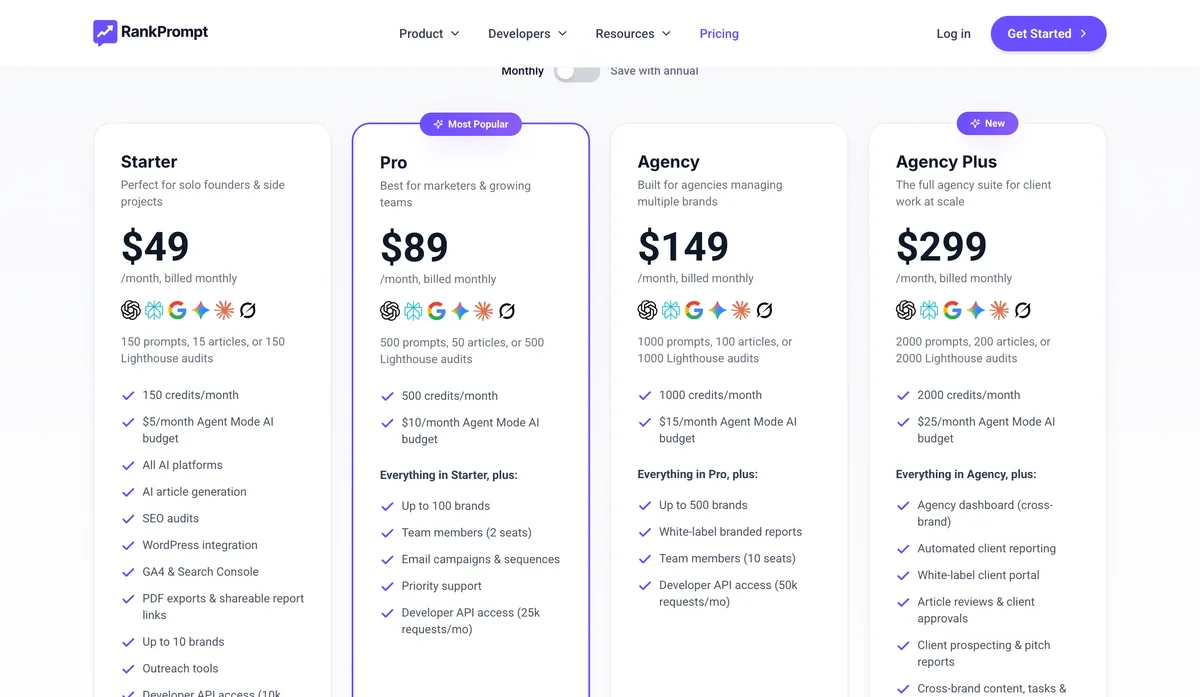
Rank Prompt’s monthly tiers. 150 tracked prompts on Starter is 150 sampled responses a month, which is the arithmetic behind the first failure in the list below.
Everything above assumes the tool works. These are the six failures we see most often once a real catalog goes in.
- The prompt budget runs out immediately. 25 prompts at Semrush, 15 at Otterly Lite, 150 at Rank Prompt Starter. Divide by your category count and the number gets uncomfortable.
- Category pages carry the query, product pages carry the conversion. Teams optimise the PDP and wonder why nothing moves on “best waterproof hiking boots”.
- Variants multiply the measurement. One boot in nine sizes and four colours is one product to you and up to 36 rows in a feed.
- Seasonal catalogs invalidate your baseline. Comparing December visibility to March visibility on a rotating assortment measures the assortment, not your work.
- Resellers outrank you for your own product. If a marketplace listing is the cited source, the fix is a marketplace fix, not a content brief.
- The score moves and nobody knows why. Answer engines are non-deterministic, and a study that sampled three consumer product topics every ten minutes found “citation rankings are unstable across samples”, with many apparent differences sitting inside the noise floor.
That last one deserves a moment, because it is the one that damages trust in the whole exercise. Their conclusion is blunt: single-run visibility metrics give “a misleadingly precise picture”.
Sample size is the antidote, which is also why cheap plans with 15 prompts are a baseline rather than a measurement.
What this means for you
- Count your categories first, then pick a plan. Not the other way round.
- Set the baseline on a stable assortment, or accept that seasonality is in your numbers.
- Ignore week-to-week movement unless the tool reports variance with the score.
What We Left Out, and Why
Three groups of tools did not make the ranking, and it is worth saying why rather than pretending they do not exist.
- General trackers with no ecommerce angle. ZipTie publishes clear pricing at $69, $99 and $159 a month for 500, 1,000 and 2,000 AI Search checks across Google AI Overviews, ChatGPT and Perplexity, with a 14-day free trial. It is a reasonable cheap tracker and it names no product-level features, so it competes on price rather than on ecommerce fit. Knowatoa and Athena HQ are in the same position for our purposes.
- Ahrefs Brand Radar. Genuinely strong on prompt demand data and it has a free checker, but nothing on its page describes product-level or shopping-surface tracking. Its published pricing also moved while we were checking it, so we are not quoting a number we cannot pin down.
- Free one-shot checkers. Several exist, including our own. Fine for a baseline conversation. Not a measurement, for the sampling reasons above.
We also left out done-for-you services, which buy differently and get their own ranking in best AI visibility agencies.
How to Choose for Your Catalog
Pick by constraint. Five constraints cover almost every ecommerce team we talk to.
- You sell mostly on Amazon: Goodie, and budget for the Pro quote rather than the $399 Explorer plan.
- You need SKU positions inside ChatGPT Shopping: Profound Enterprise. There is no cheaper route to it today.
- You need category and comparison queries across every assistant: Rank Prompt at $49, or Otterly at $29 if four engines is enough. The full budget cut is in affordable AI visibility tools.
- You run several countries or storefronts: Rank Prompt, where multi-market tracking is included at $49, or Peec AI Advanced at $495 if you want unlimited seats with it. Watch the per-domain pricing at Semrush here.
- You already pay Semrush or Ahrefs: price their add-on before adding a vendor. Tool sprawl kills more retail GEO programmes than budget does.
One more, and it is the honest one. If your product pages score like Adobe’s benchmark, buying a tracking tool this quarter is the wrong order of operations. Fix the template, fix the feed, then measure.
What this means for you
- Trial two tools on the same category prompts, not one tool for twice as long.
- Expect the tools to disagree. Different prompt sets and sampling schedules produce different numbers from the same reality.
- Buy the tier with the product feature, because upgrading later is the most common regret in this category.
What No Tool Can Do for an Ecommerce Brand
Four limits apply to everything on this list, and vendor marketing rarely mentions any of them.
- None of them can see inside a ranking system. Google states it plainly: “No third-party tool has access to our internal ranking or AI systems.” Treat any claim of internal shopping metrics as a red flag.
- None of them fix your feed. Google’s product data specification warns that inaccurate data causes “disapprovals, limited eligibility, incorrect displays for your products”. That is a data job, not a dashboard job.
- None of them make the model neutral. A 2026 preprint testing three commercial LLMs on skincare products found that well-known brands took 100% of recommendations when all products had identical specifications, and that the advantage collapsed once a rival gained less than a tenth of a star in rating. Incumbency is a real force in these answers and no tool removes it.
- None of them stop the copy game. Kumar and Lakkaraju showed that inserting a strategic text sequence into a product page substantially raised the chance an LLM listed it first, even for products that were rarely recommended. A separate EMNLP 2025 study found that social proof language reliably boosts recommendation rate while scarcity and exclusivity reduce visibility, which is the opposite of what most ecommerce copywriters have been trained to do.
The scale behind all this keeps growing. Google’s Shopping Graph now holds “over 60 billion product listings”, and agentic checkout is rolling out with named retailers on Search.
For what does move the number, the original GEO research from KDD 2024 remains the most useful finding: adding quotations, statistics and cited sources “can boost visibility by up to 40%”, while keyword stuffing produced “little to no performance improvement”.
What this means for you
- Put the feed work ahead of the tooling work. Every surface reads it.
- Get real reviews and real specifications onto the PDP. That is the version of the research finding that is also good for shoppers.
- Budget for the fixing, not just the watching. The dashboard is the cheap part.
Where This Fits
This is the ecommerce cut of our AI visibility cluster. The general ranking, the scoring criteria and the full competitive set live in the pillar, best AI visibility tools.
The neighbouring guides handle the cuts we kept short here: affordable AI visibility tools for the budget maths and best AI visibility agencies for done-for-you.
On the technical side of AI search optimization, start with the best schema markup for ranking in AI answers, then how to track your brand in Google AI Mode and AI Overviews. Our wider vendor inventory is AI search visibility tracking tools, and our own ecommerce product page is AI visibility for ecommerce brands.
Check your store’s AI visibility free → See which assistants recommend your products today, and which ones recommend a competitor.
Sources
All vendor pricing, tier gates and feature availability were read off each vendor’s own live page on 31 July 2026.
 Google: Search Central: AI features and your website (primary, updated July 2026)
- Google Search Central: Product structured data (primary)
- Google Merchant Center: Product data specification (primary)
- Google: Universal Cart and agentic checkout (primary, May 2026)
 OpenAI Developers: Agentic commerce key concepts (primary)
- OpenAI Developers: Product feed specification (primary)
 Shopify Help Center: Shopify Catalog and product discovery for agentic storefronts (primary)
- Shopify: Agentic commerce for every developer, Spring ‘26 (primary, June 2026)
 Amazon: Meet Alexa for Shopping (primary)
 Perplexity: Crawlers (primary)
 Anthropic: Does Anthropic crawl data from the web? (primary)
- Kumar, A., Lakkaraju, H. (2024). Manipulating Large Language Models to Increase Product Visibility. arXiv:2404.07981 (academic, preprint)
- Filandrianos, G. et al. (2025). Bias Beware: The Impact of Cognitive Biases on LLM-Driven Product Recommendations. arXiv:2502.01349, EMNLP 2025 (academic, peer-reviewed)
- Chu, X., Hou, Y. (2026). Incumbent Advantage: Brand Bias and Cognitive Manipulation Dynamics in LLM Recommendation Systems. arXiv:2606.17443 (academic, preprint)
- Sielinski, R. (2026). Quantifying Uncertainty in AI Visibility. arXiv:2603.08924 (academic, preprint)
- Aggarwal, P. et al. (2023). GEO: Generative Engine Optimization. arXiv:2311.09735, KDD 2024 (academic, peer-reviewed)
- Pandya, V. (2026). Adobe report: U.S. retailers see surge in AI traffic, but many websites are not entirely readable by machines (independent, 16 April 2026; based on over 1 trillion visits to US retail sites and a survey of more than 5,000 US respondents)
- Vendor pages: Rank Prompt, Profound pricing and Profound Shopping, Goodie, Semrush, Peec AI, Scrunch, Otterly.ai, Rankscale, ZipTie

 Grok
Grok