

We looked at 29,635 YouTube citations in AI answers across 1,594 brands and 13,788 prompts. Then we searched every one of those prompts on YouTube. 86% of the videos the AI cited were not in YouTube’s own top 10 for the same question. The cited videos had fewer views, were newer, ran longer, and came from small channels more often than not.
We run Rank Prompt, an AI visibility platform that tracks what  Google AI Mode (AI Overviews),
  Perplexity,
  Gemini,
  Grok and
  ChatGPT say about brands.
  YouTube keeps showing up in those answers, so we pulled every YouTube link cited between June 23 and September 23, 2026 and asked what those videos have in common.
The short version: YouTube SEO and AI visibility are not the same game. A video can win one and be invisible in the other.
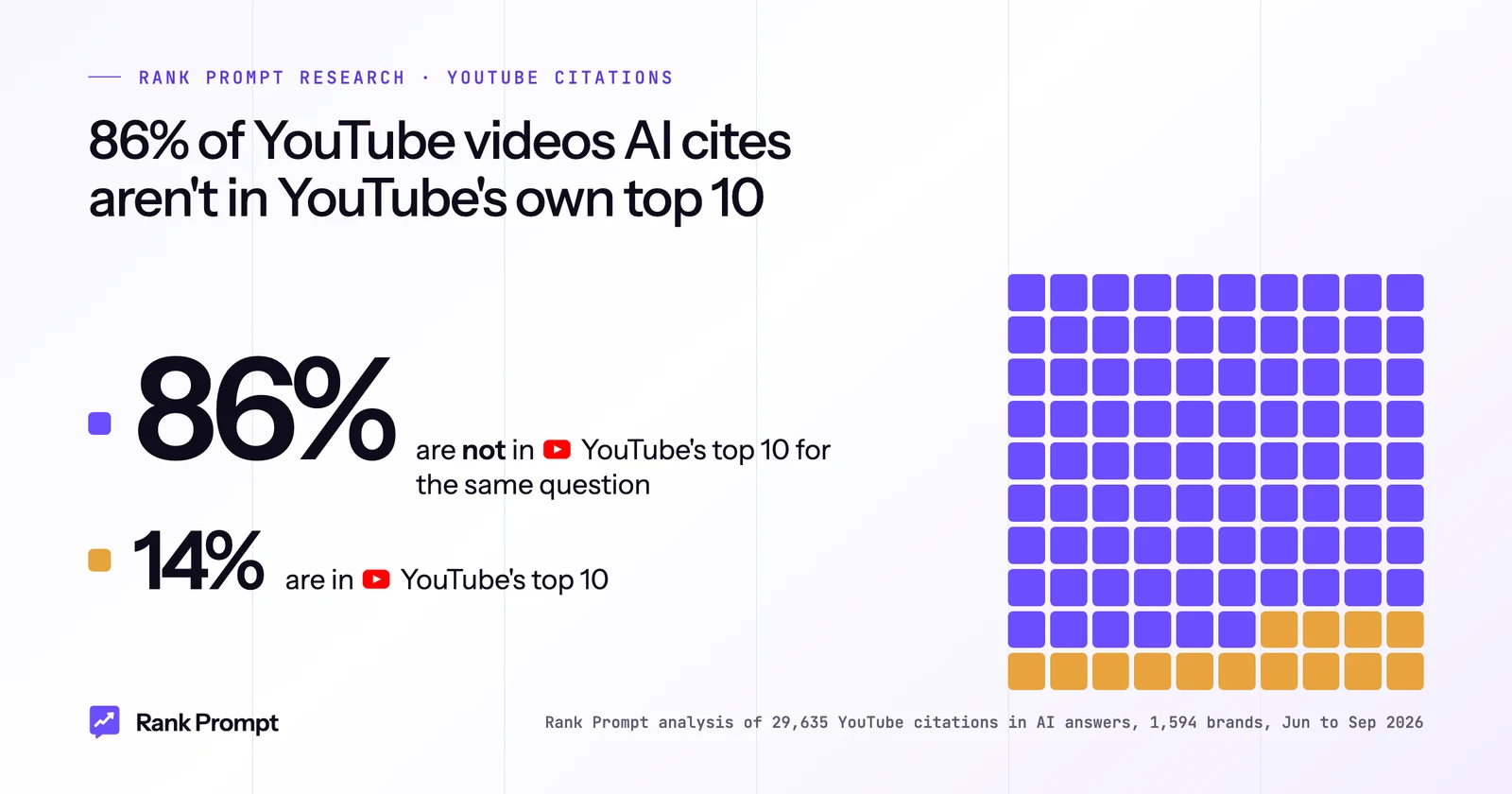
Each square is one cited video in a hundred. YouTube’s top 10 was searched on September 23, 2026, in each prompt’s country and language.
Quick answer
Across 13,788 prompts, 14% of AI-cited videos appear in YouTube’s top 10 for the same question (95% range 12.9% to 15.2%). The other 86% come from further down, or from searches YouTube doesn’t surface at all.
The typical cited video has about 2,100 views, is 16 months old, runs 9.1 minutes, and sits on a channel with around 13,700 subscribers. Shorts are 1.8% of citations.
Key findings
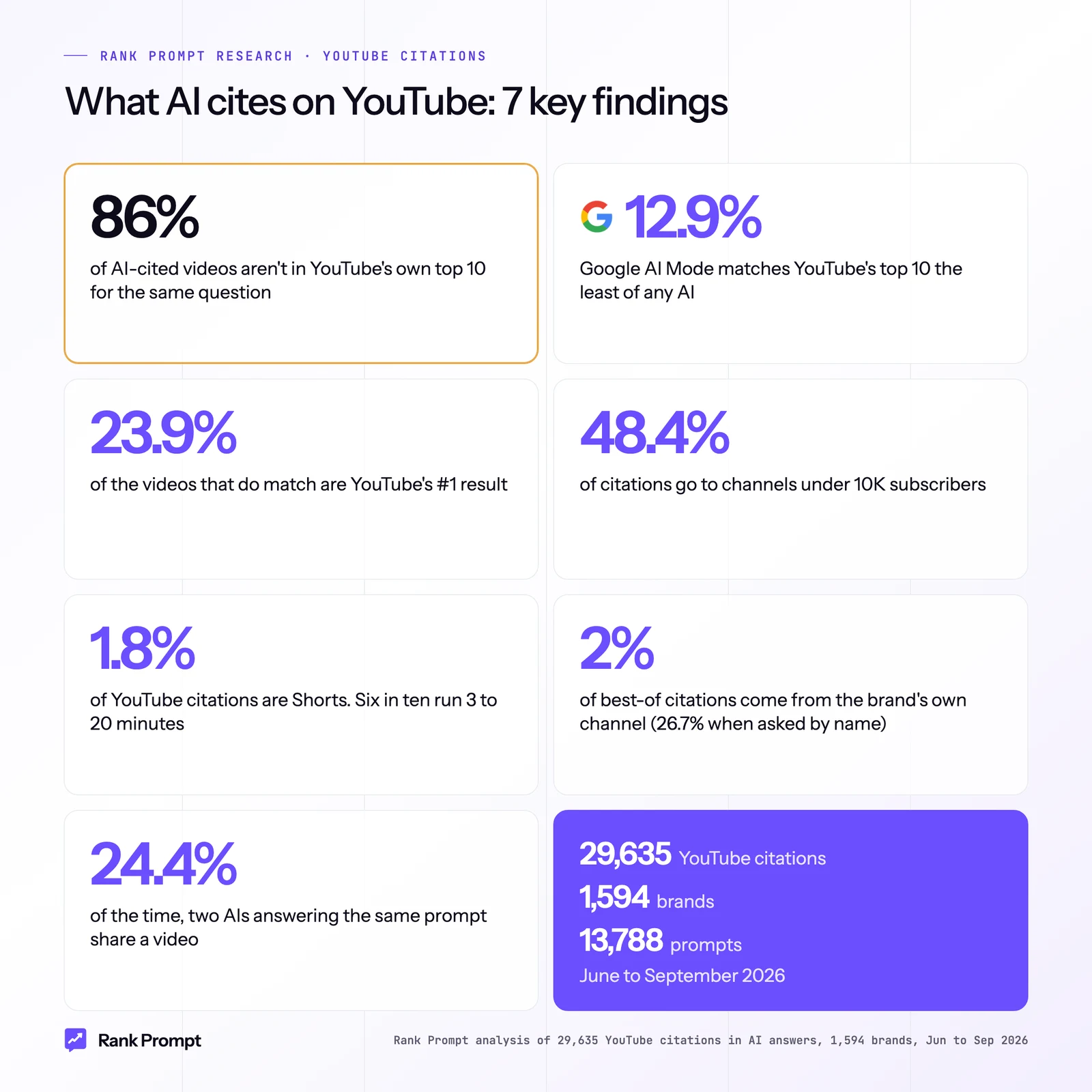
1. AI mostly ignores YouTube’s rankings. 86% of cited videos are not in YouTube’s top 10 for the prompt they were cited on.
2. Google AI Mode (AI Overviews) matches YouTube least. Only 12.9% of the videos it cites are in YouTube’s top 10, the lowest of any platform, across 1,302 brands. Google’s AI and Google’s video platform rank very differently.
3. When AI and YouTube agree, it’s on the top result. Of the 14% that do match, 23.9% are YouTube’s #1 video and half are in its top 3.
4. Small channels win. 48.4% of citations go to channels under 10,000 subscribers. Channels with 1M+ subscribers get 4%.
5. Shorts barely register. 1.8% of YouTube citations are Shorts. Six in ten cited videos run 3 to 20 minutes.
6. A brand’s own channel rarely carries it. For “best X” questions, the brand’s own channel is 2% of what gets cited. For questions about the brand by name, that climbs to 26.7%.
7. Every AI picks different videos. Two platforms answering the same prompt share at least one video only 24.4% of the time.
Does AI cite YouTube’s top-ranked videos?
For every prompt in the dataset, we ran the same question through YouTube search, from the prompt’s country and in its language, and compared the top 10 with what the AI cited.
The two lists barely meet. Here is how the cited videos compare with YouTube’s own top 10 for the same prompts.
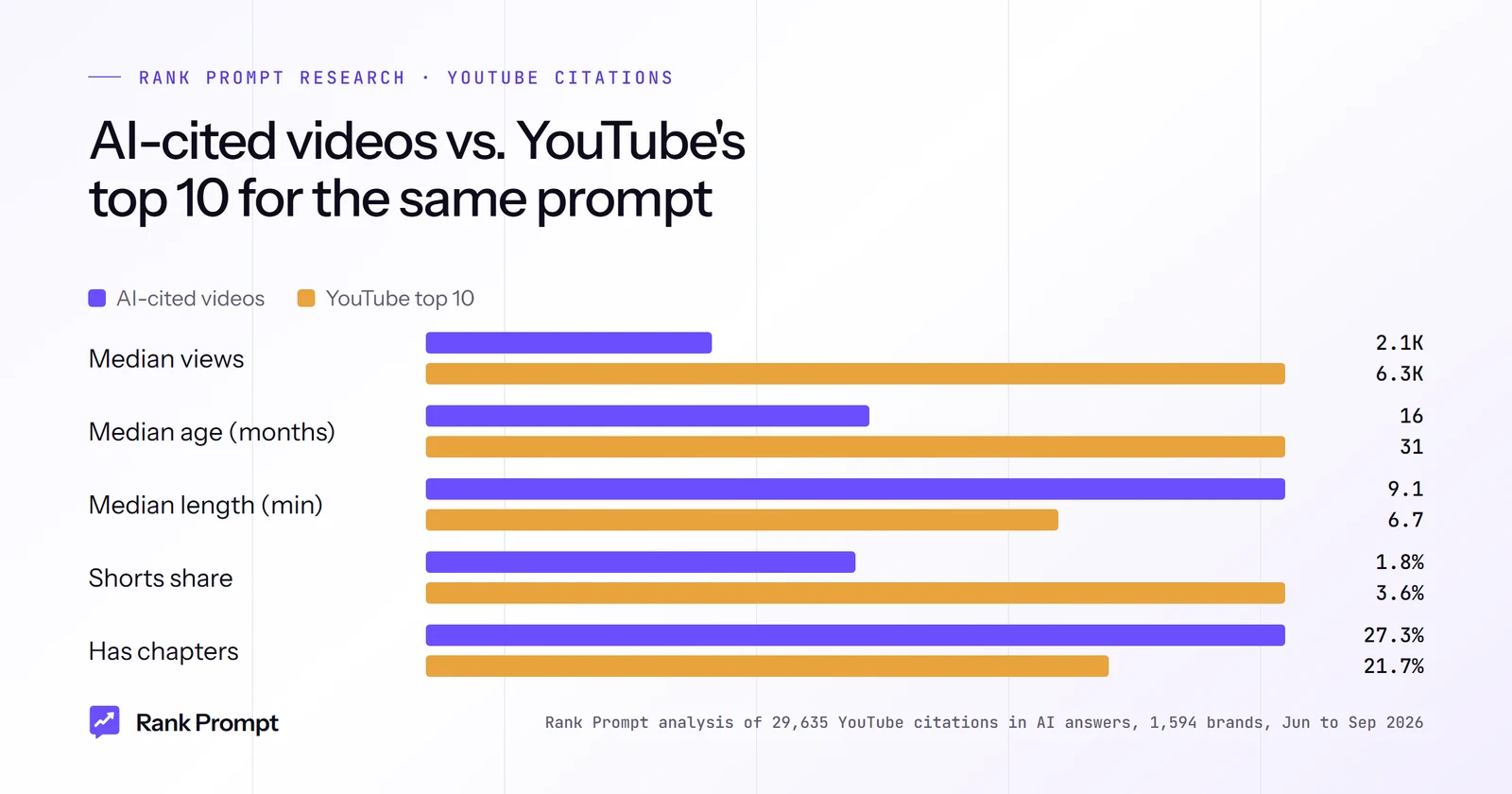
Medians and shares for the cited videos and for YouTube’s top 10 on the same prompts.
| Metric | AI-cited videos | YouTube top 10 |
|---|---|---|
| Median views | 2.1K | 6.3K |
| Median age (months) | 16 | 31 |
| Median length (min) | 9.1 | 6.7 |
| Shorts share | 1.8% | 3.6% |
| Has chapters | 27.3% | 21.7% |
Cited videos have about 3x fewer views (2,100 vs. 6,300) and are about half as old (16 vs. 31 months). They also run longer (9.1 vs. 6.7 minutes) and are half as likely to be Shorts.
What surprised us is what didn’t differ: cited videos use the prompt’s words in their titles and link out in the description about as often as YouTube’s top results. Keyword-matched titles don’t explain why AI picks one video over another.
Which AI platform follows YouTube’s ranking the most?
None of them follows it closely. Perplexity comes closest, and Google AI Mode (AI Overviews) sits furthest away.
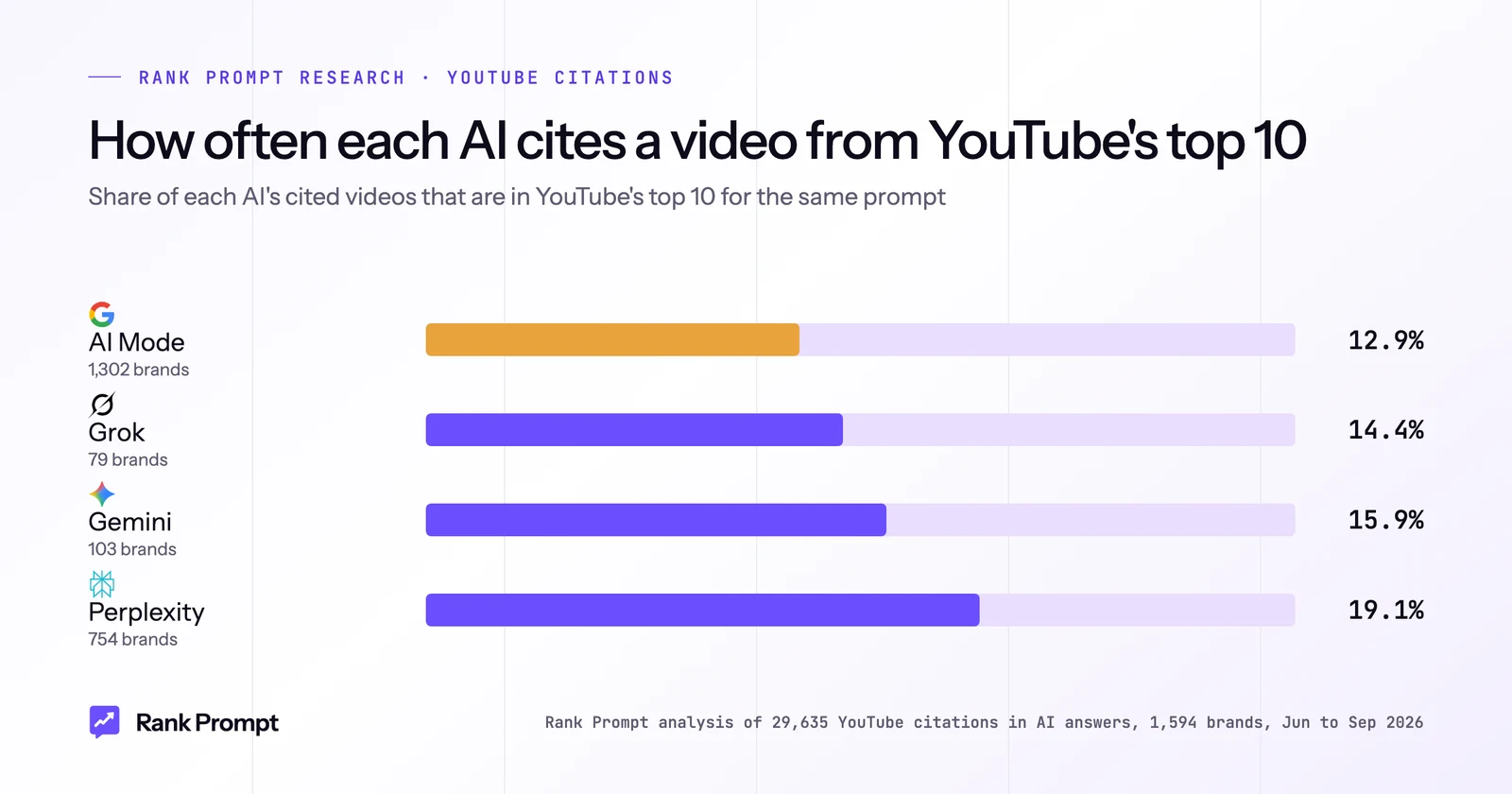
Share of each platform’s cited videos that are in YouTube’s top 10 for the same prompt.
The question type matters too. How-to and “what is” questions match YouTube’s top 10 more often (about 22%) than “best X” and comparison questions (13 to 14%).
When AI and YouTube agree, it’s on the top result
Only 14% of cited videos are in YouTube’s top 10, so this chart looks at that slice alone. Within it, YouTube’s #1 video is the most common pick by a wide margin.
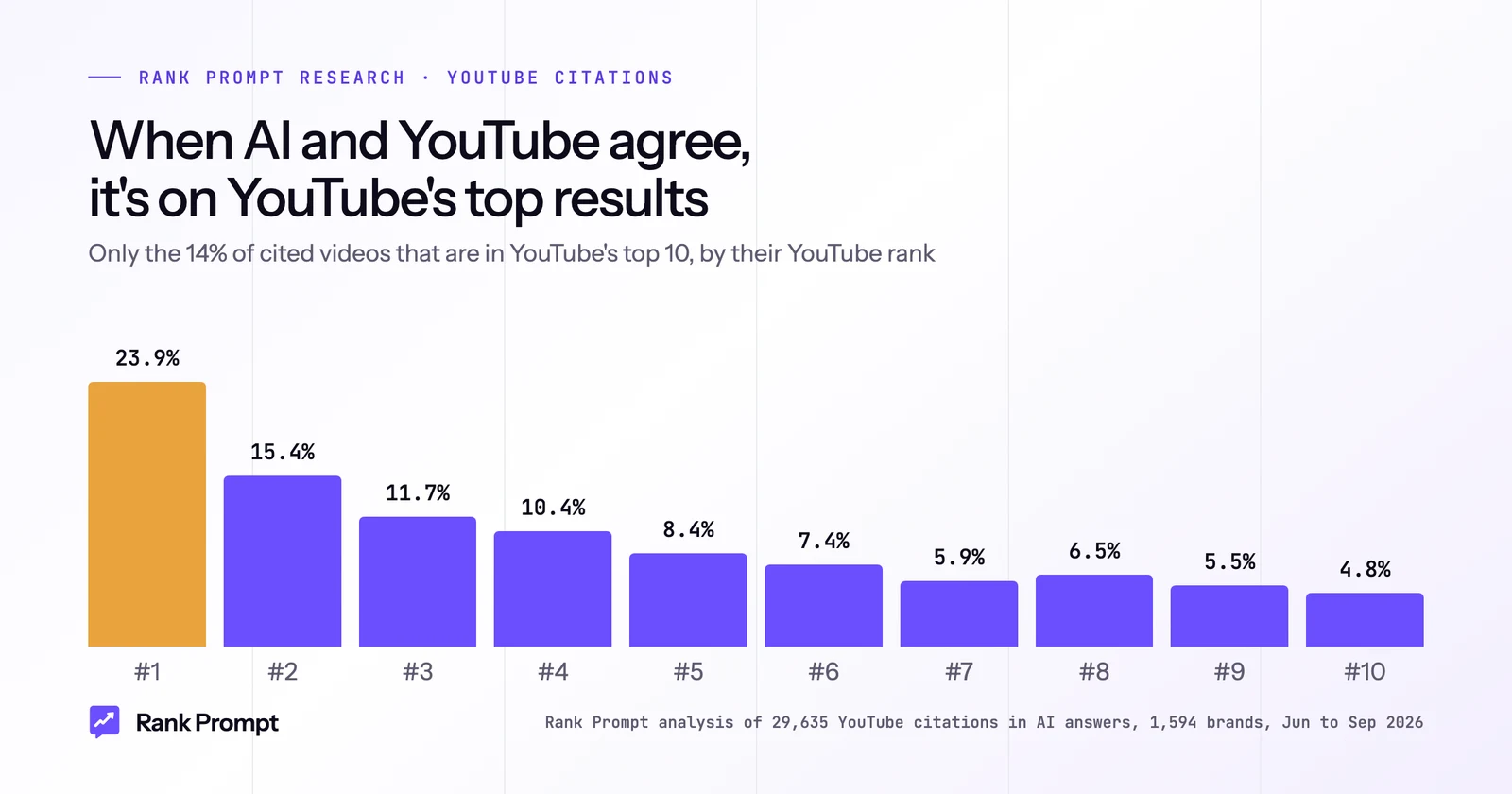
Only the cited videos that are in YouTube’s top 10, by their YouTube rank.
Put simply: ranking #4 on YouTube buys you little in AI answers. Ranking #1 helps, but most cited videos never ranked at all.
You don’t need a big channel to get cited
Almost half of cited videos come from channels with fewer than 10,000 subscribers. Channels with over a million account for 4%.
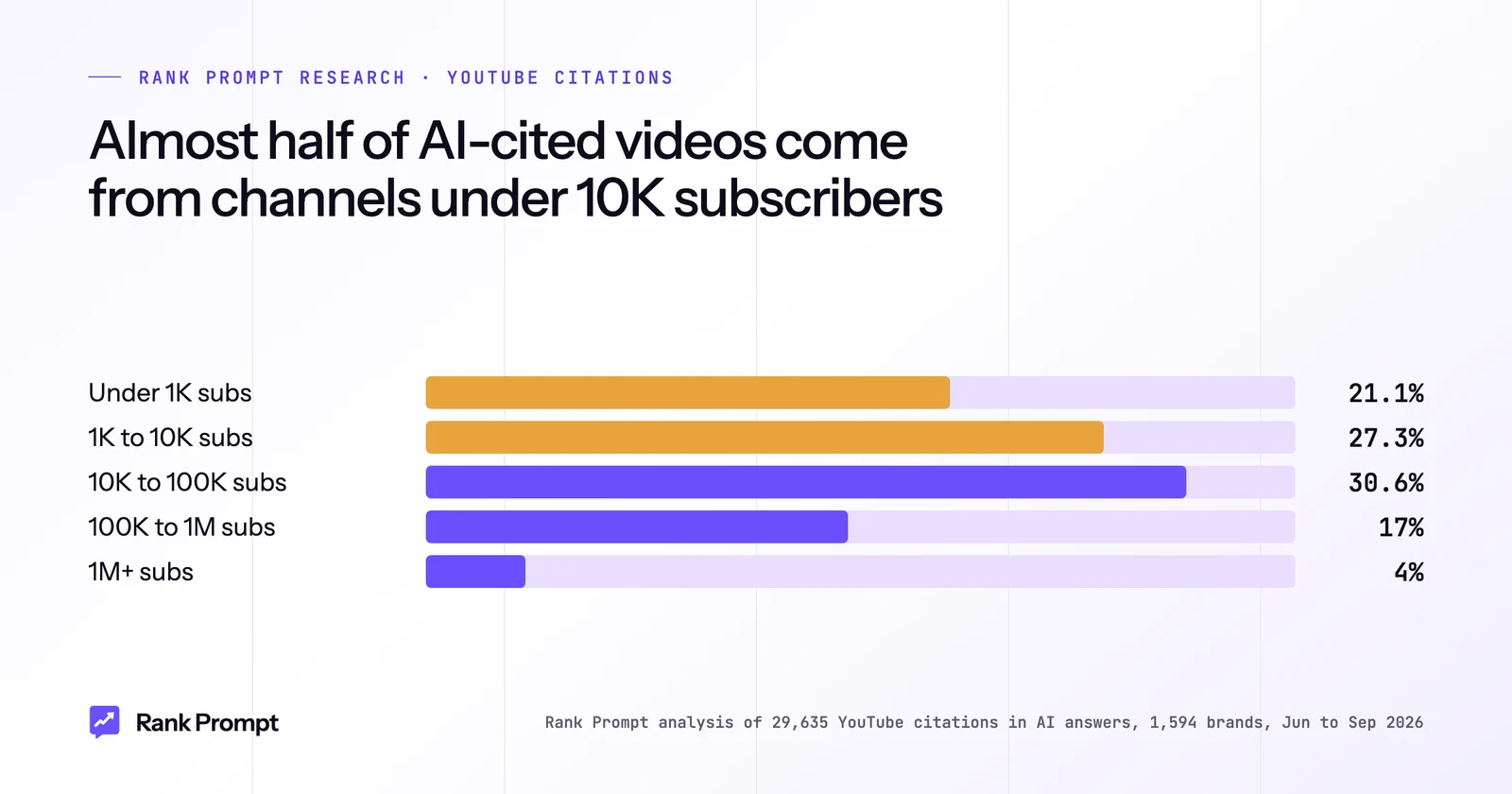
Subscriber count of the channel behind each cited video.
Views tell the same story. Almost three in four cited videos have fewer than 10,000 views, and 42% have fewer than 1,000.
Local questions lean even smaller. For prompts like “best roofer in Dallas,” 51.8% of citations come from channels under 10K subscribers, against 44.4% for everything else.
YouTube Shorts vs. long-form videos in AI answers
AI answers cite regular videos. Shorts are 1.8% of YouTube citations across every platform we track.
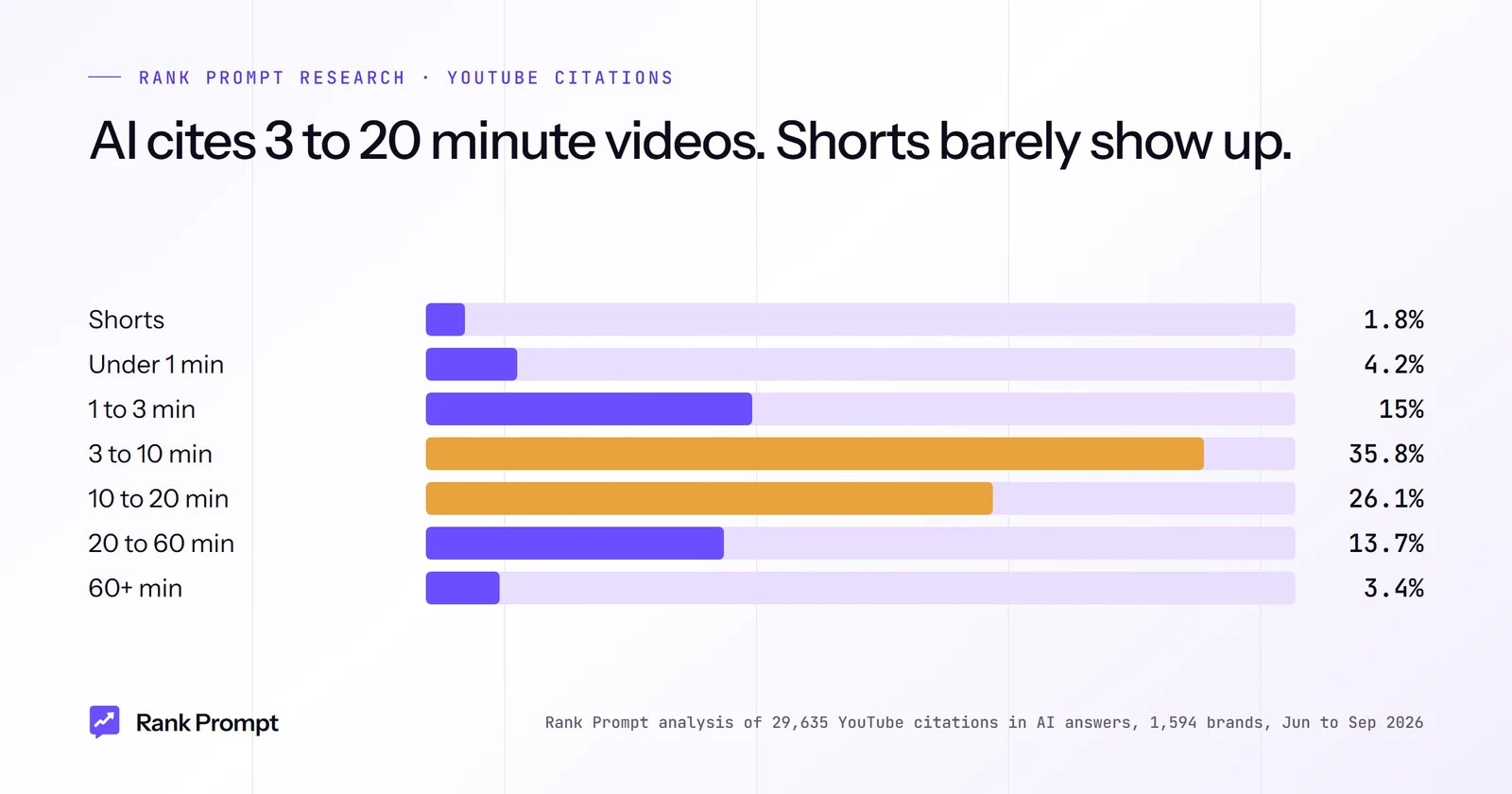
Length of each cited video, from Shorts to recordings over an hour.
The median cited video runs 9.1 minutes. Very short clips and hour-long recordings are both rare.
The platforms differ a little at the edges. Gemini and Google AI Mode (AI Overviews) cite a few Shorts, 3.4% and 2.5%, while Perplexity almost never does (0.4%).
How old are the videos AI cites?
The median cited video is 16 months old. Only 4% of citations go to videos under a month old, and a third go to videos over two years old.
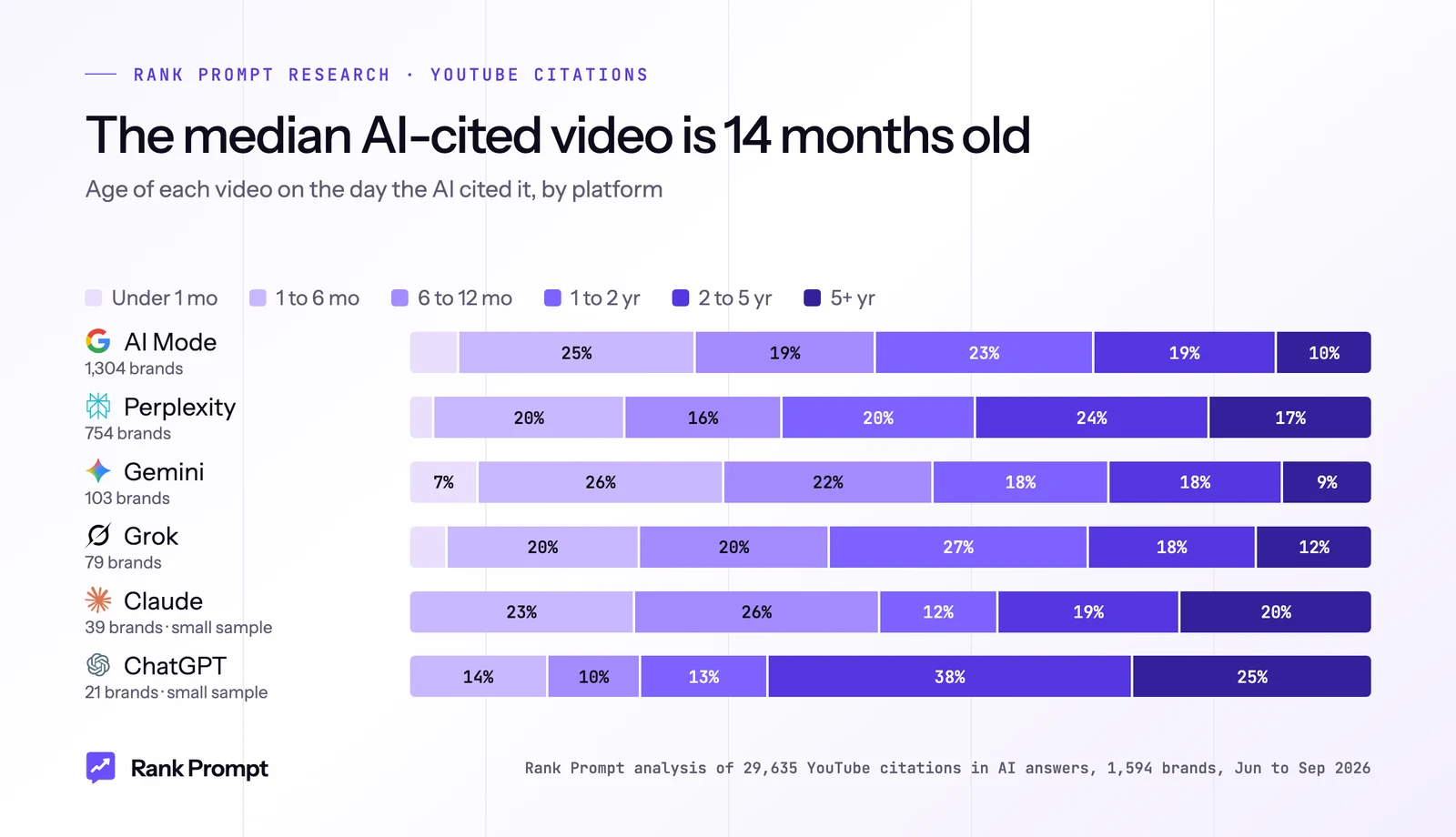
Age of each video on the day the AI cited it, by platform.
Perplexity leans the oldest, while Google AI Mode (AI Overviews) and Gemini pick up newer videos. Freshness isn’t the filter, but newer helps: cited videos are about half as old as YouTube’s top results for the same prompts.
Putting the year in the title (“Best CRM in 2026”) shows up in 15.6% of cited videos. Common, but most cited videos skip it.
Creators vs. brand channels
Cited videos split almost evenly between individual creators (41%) and company channels (42%). Media outlets, schools and public institutions make up the rest.
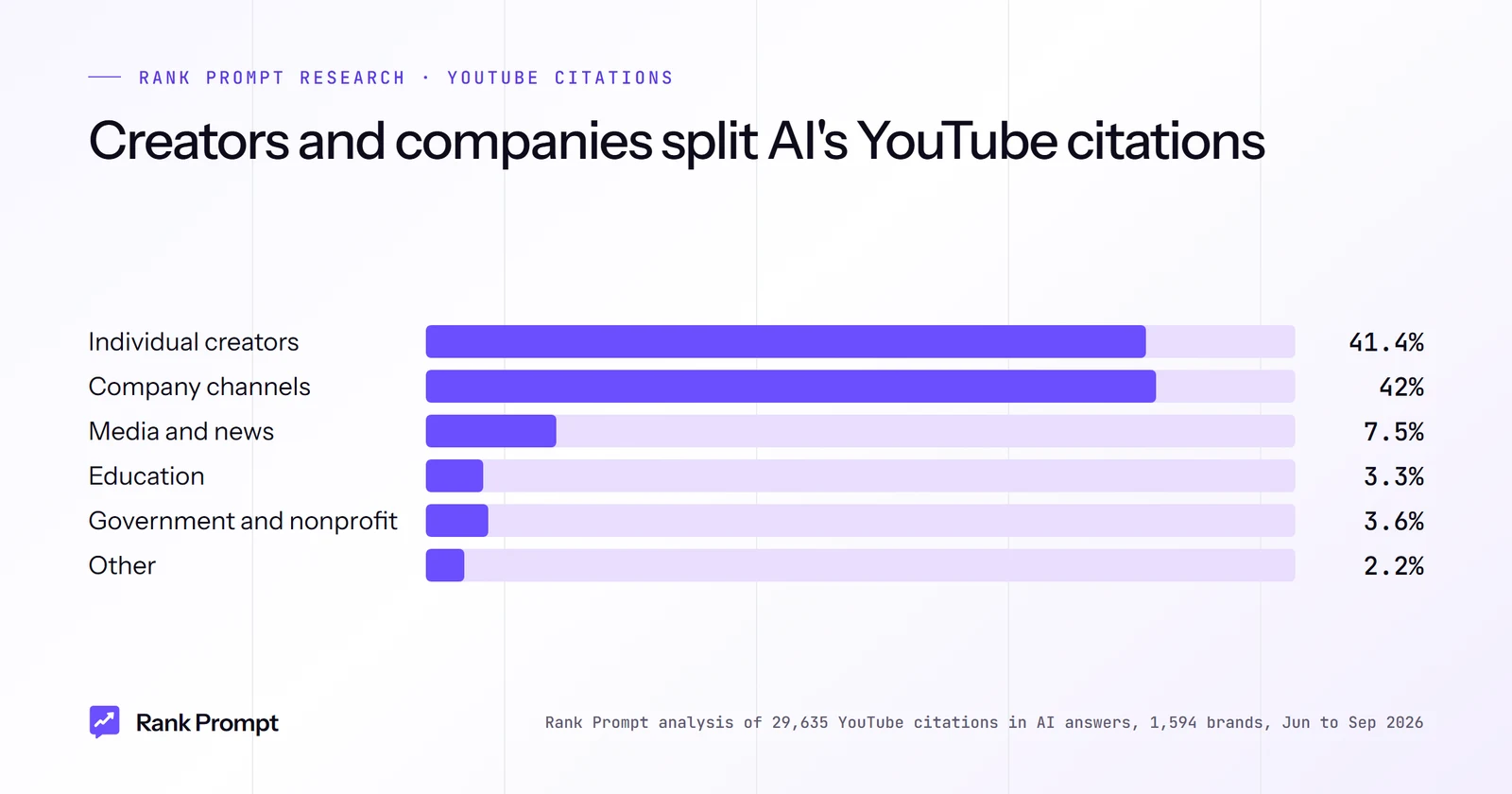
Who runs the channel behind each cited video.
Here’s the catch for brands. A brand’s own channel is only 2.1% of its YouTube citations overall, and 2% for “best X” questions.
That changes once someone asks about you by name. For brand questions, your own channel is 26.7% of what gets cited, and for reviews and trust questions it’s 12%.
The question decides which video gets cited
Different questions pull different kinds of videos. “Best X” pulls roundups, how-to pulls tutorials, and “what is” pulls explainers.
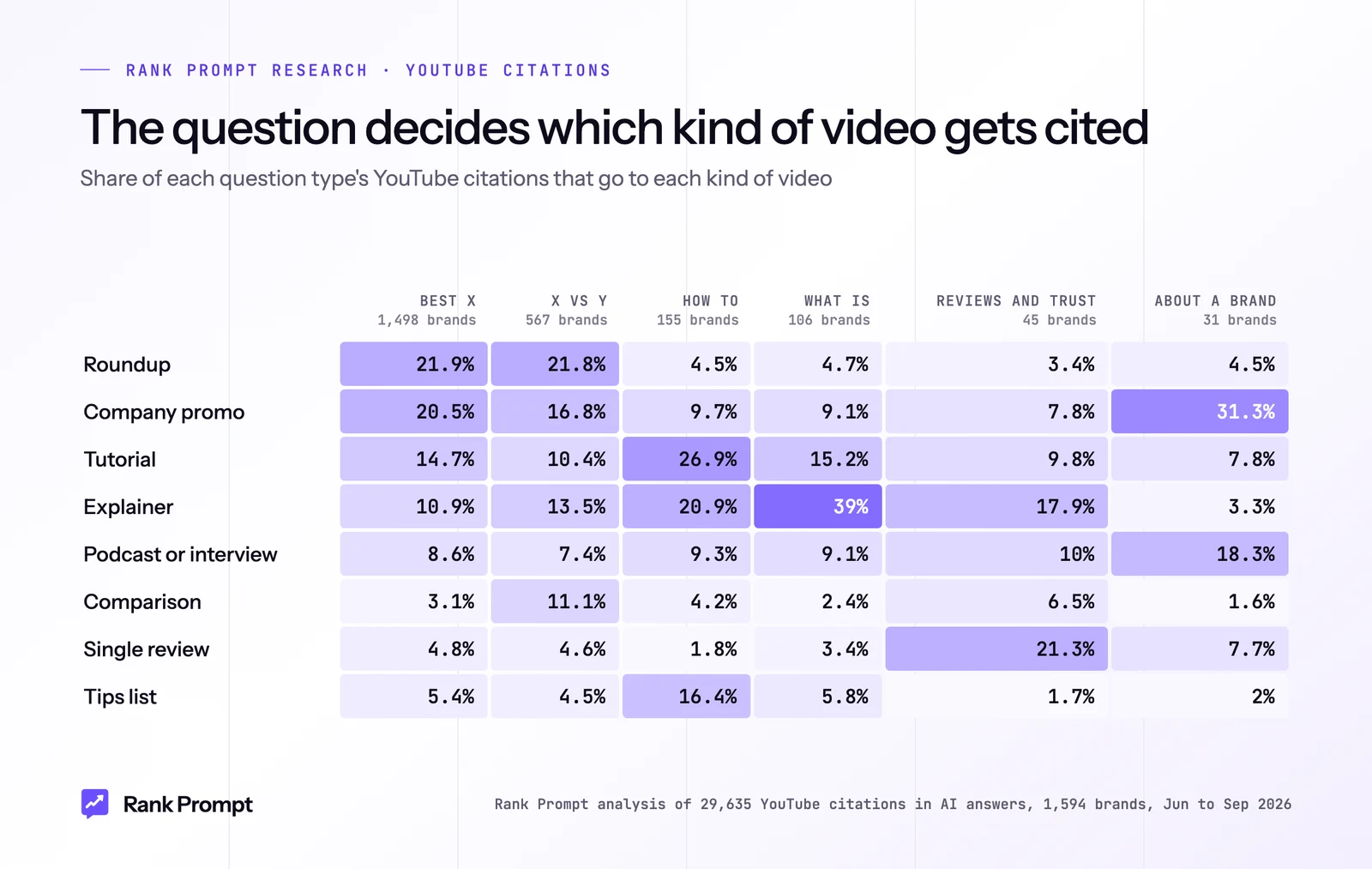
Share of each question type’s YouTube citations that go to each kind of video.
| Question type | Most-cited video type | Share of citations | Sample |
|---|---|---|---|
| Best X | Roundup | 21.9% | 1,498 brands |
| X vs Y | Roundup | 21.8% | 567 brands |
| How to | Tutorial | 26.9% | 155 brands |
| What is | Explainer | 39% | 106 brands |
| Reviews and trust | Single review | 21.3% | 45 brands |
| About a brand | Company promo | 31.3% | 31 brands |
Reviews and trust questions are the one place single-product reviews lead. Questions about a specific brand lean on the company’s own promo videos.
What does each type look like? Here’s a real video of each kind that AI answers cited, each for at least two different brands.
| Video type | Real example AI cited | Cited for |
|---|---|---|
| Roundup | Top 12 Digital Marketing Agencies to Hire in 2026 by DesignRush | 6 brands |
| Company promo | Stop Losing Hotel Guests to OTAs and Get More Direct Bookings by Cloudbeds | 2 brands |
| Tutorial | How to Hire a Social Media Marketing Agency by Clutch.co | 5 brands |
| Explainer | Generative Engine Optimization (GEO) Explained Like You’re 5 by Vendasta | 4 brands |
| Podcast or interview | The #1 Cloud Digital Signage Software Solution: Rise Vision by SourceForge | 3 brands |
| Comparison | I Tested Every All-In-One AI Video Generator: Full Comparison by Dan Kieft | 2 brands |
| Single review | QR Tiger Review 2026: Best QR Code Generator with Analytics? by Daniel | Tech & Data | 2 brands |
| Tips list | The Fastest Ways to Generate Agency Leads by Vendasta | 3 brands |
Only 3 in 10 cited videos directly answer the question
Most cited videos are on-topic rather than on-point. A general buyer’s guide gets cited for a specific “best X in Dallas” question all the time.
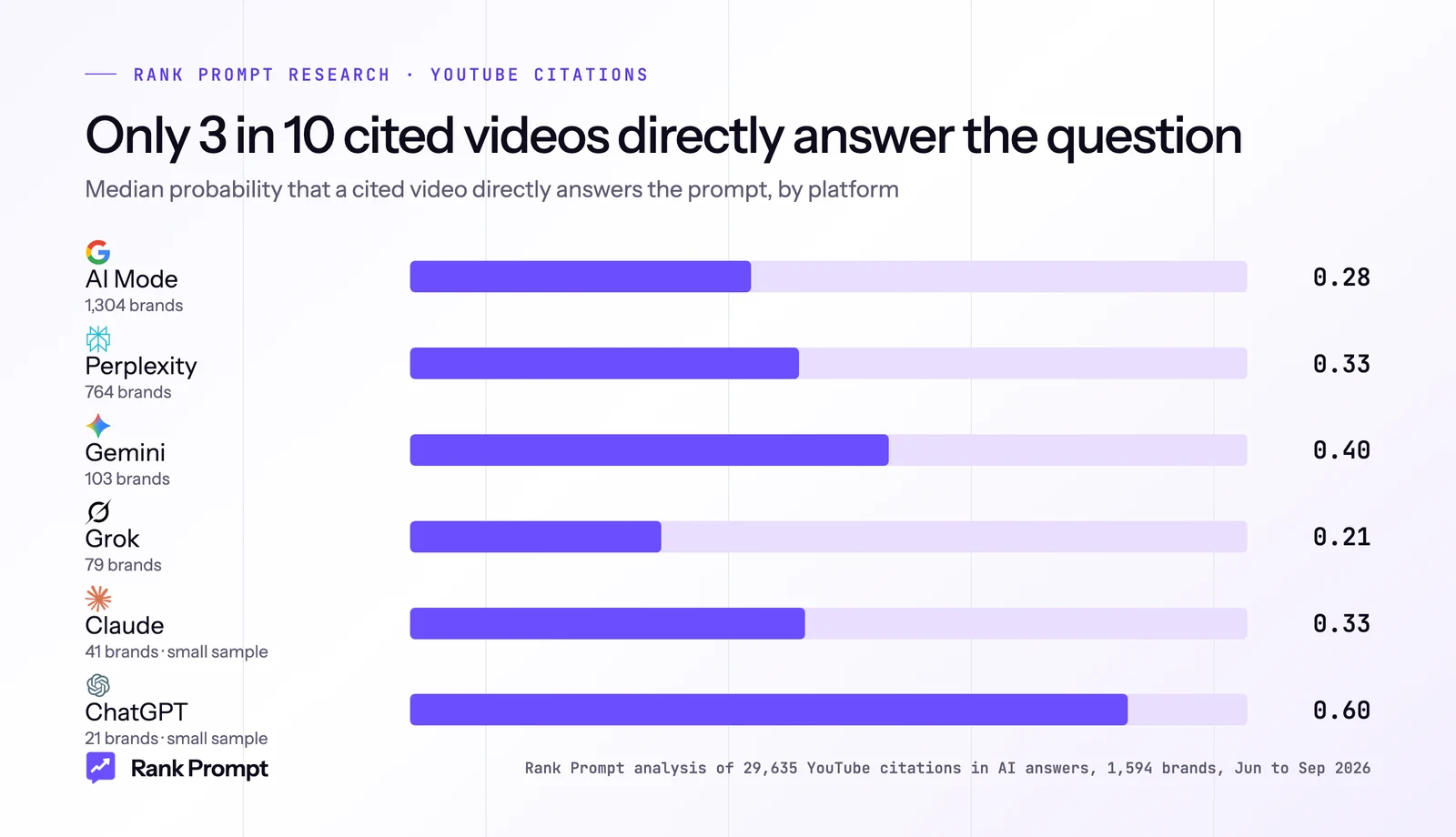
Median probability, per platform, that a cited video directly answers its prompt.
Gemini’s picks are the most on-point and Grok’s the least. ChatGPT looks high, but like Claude it cites so few videos that its number is directional.
Relevance also shapes where a video lands in the answer. Videos that directly answer the prompt tend to sit higher in the list of sources.
Roundup channels get cited across dozens of brands
No single video dominates. 96% of cited videos were cited for just one brand, and none for ten or more.
At the channel level, a pattern shows up. The channels cited across the most brands mass-produce “7 Best X Software” roundups, and the top one was cited for 68 different brands with 59 different videos.
Same prompt, different AI, different videos
We compared the videos each platform picked when two of them cited YouTube for the same prompt. Usually there’s no overlap at all.
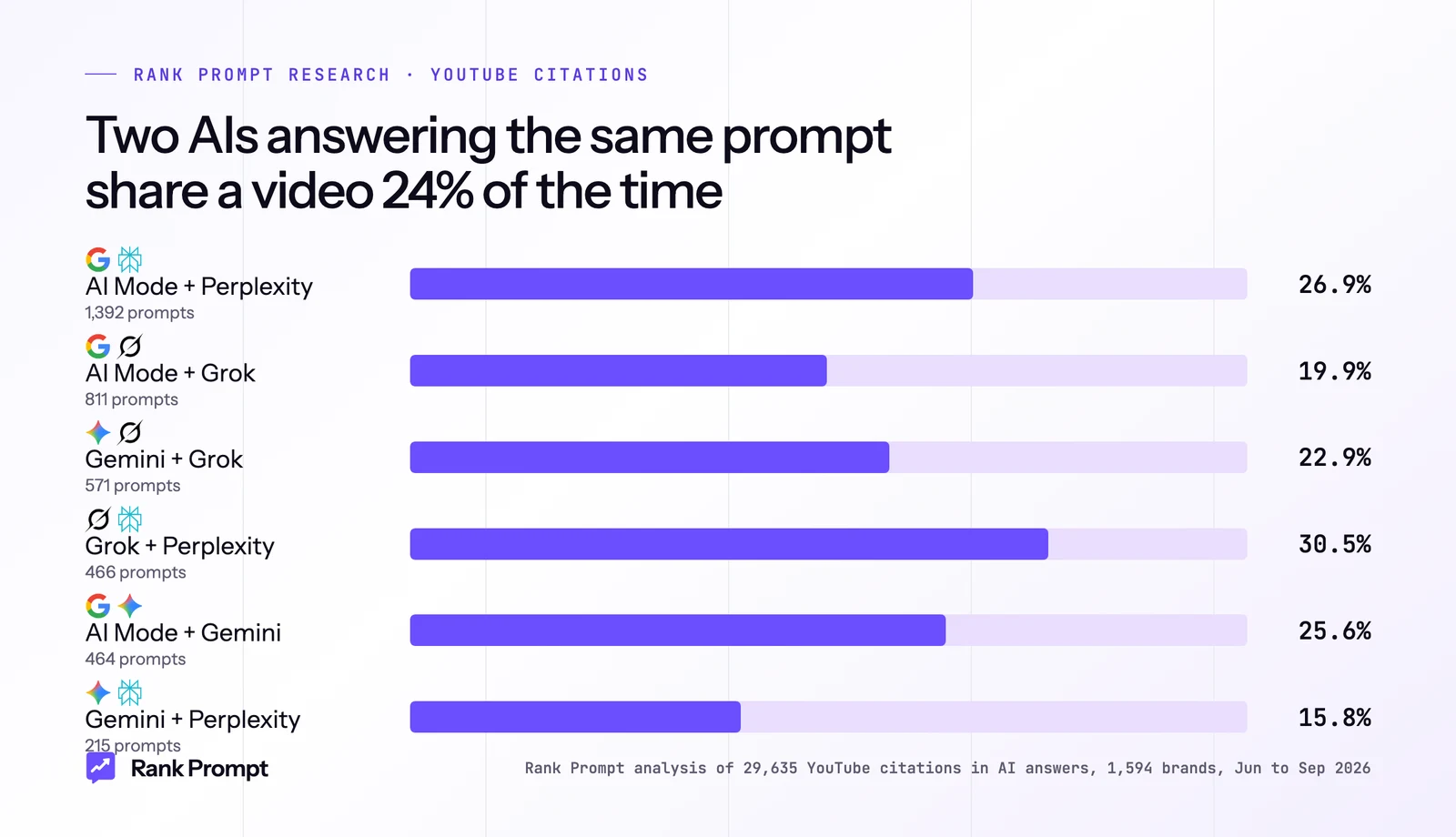
For each pair of platforms that cited YouTube on the same prompt, how often they picked at least one of the same videos.
On average, two platforms share 10.9% of their cited videos for a prompt. Optimizing for one AI engine doesn’t cover the others.
Which AI platforms cite YouTube at all?
Grok and Gemini lean on YouTube for most brands: 89% and 66% of brands tracked on those platforms get at least one YouTube citation. Google AI Mode (AI Overviews), at 58%, and Perplexity, at 47%, sit in the middle.
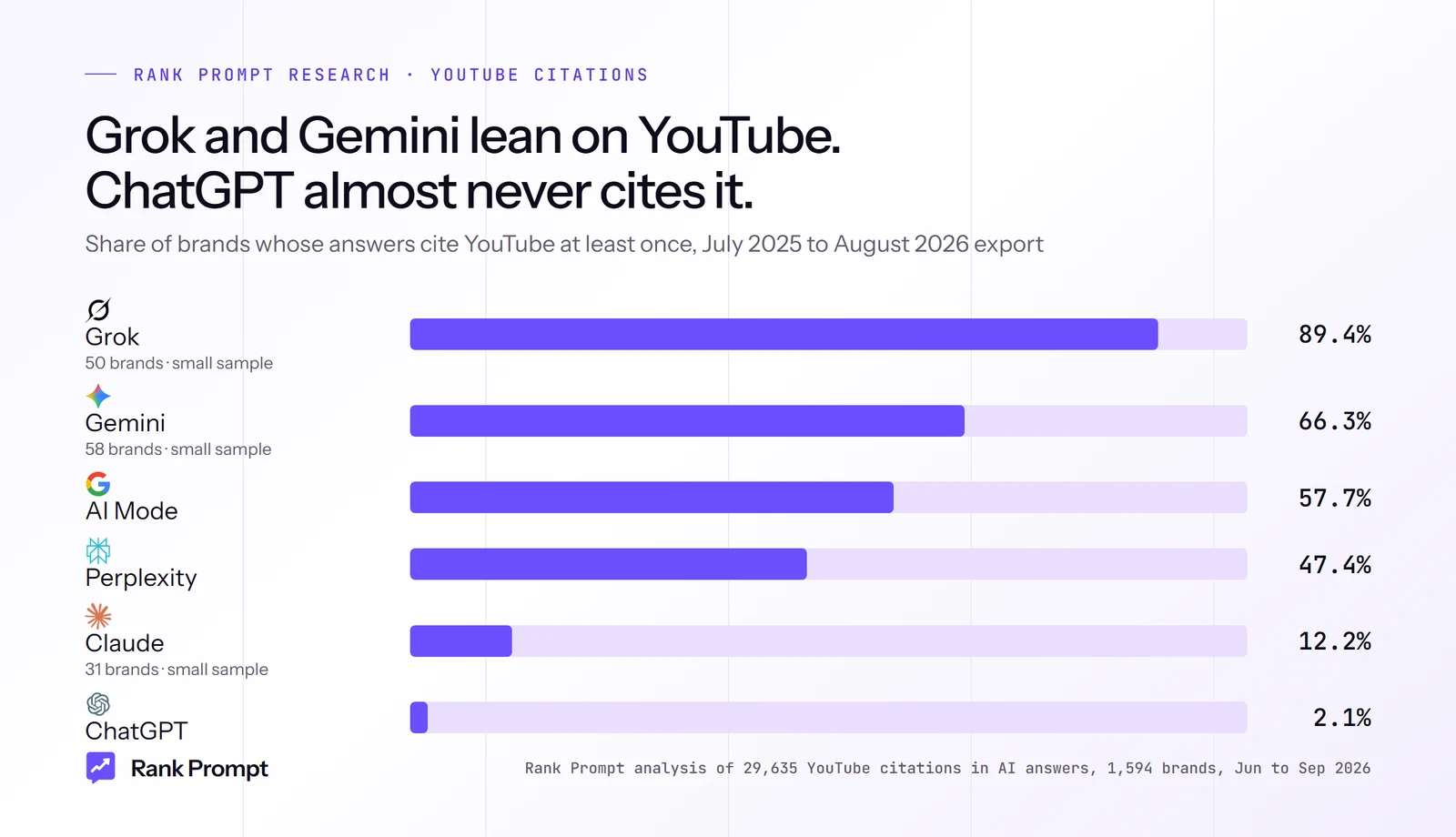
Share of brands whose answers on each platform cite YouTube at least once, from the separate July 2025 to August 2026 export (see Methodology).
| Platform | In YouTube’s top 10 | Brands citing YouTube |
|---|---|---|
| Google AI Mode | 12.9% | 57.7% |
| Perplexity | 19.1% | 47.4% |
| Gemini | 15.9% | 66.3% (small sample) |
| Grok | 14.4% | 89.4% (small sample) |
 Claude (search) Claude (search) | Too few videos | 12.2% (small sample) |
| ChatGPT | Too few videos | 2.1% |
ChatGPT almost never cites YouTube (2% of brands), and Claude’s search mode does it for about 12%. Grok, Gemini and Claude are smaller samples, so treat those numbers as directional.
The small-channel pattern holds on every platform. Each AI pulls most of its YouTube citations from channels under 100K subscribers.
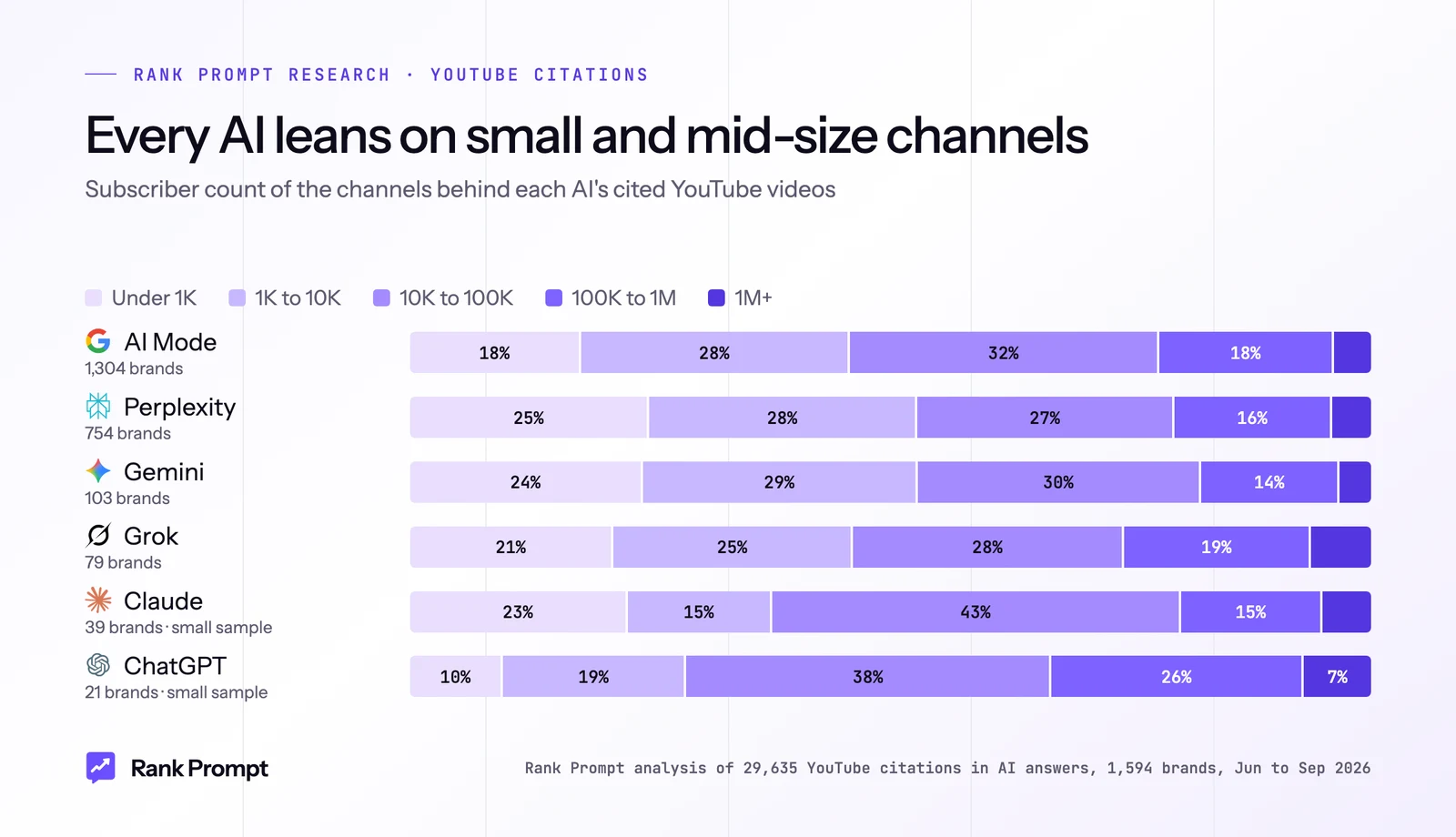
Subscriber count of the channels behind each platform’s cited videos.
YouTube citations outside English
English prompts get English videos 98% of the time. For Spanish and French prompts, about 1 in 4 citations still goes to an English video.
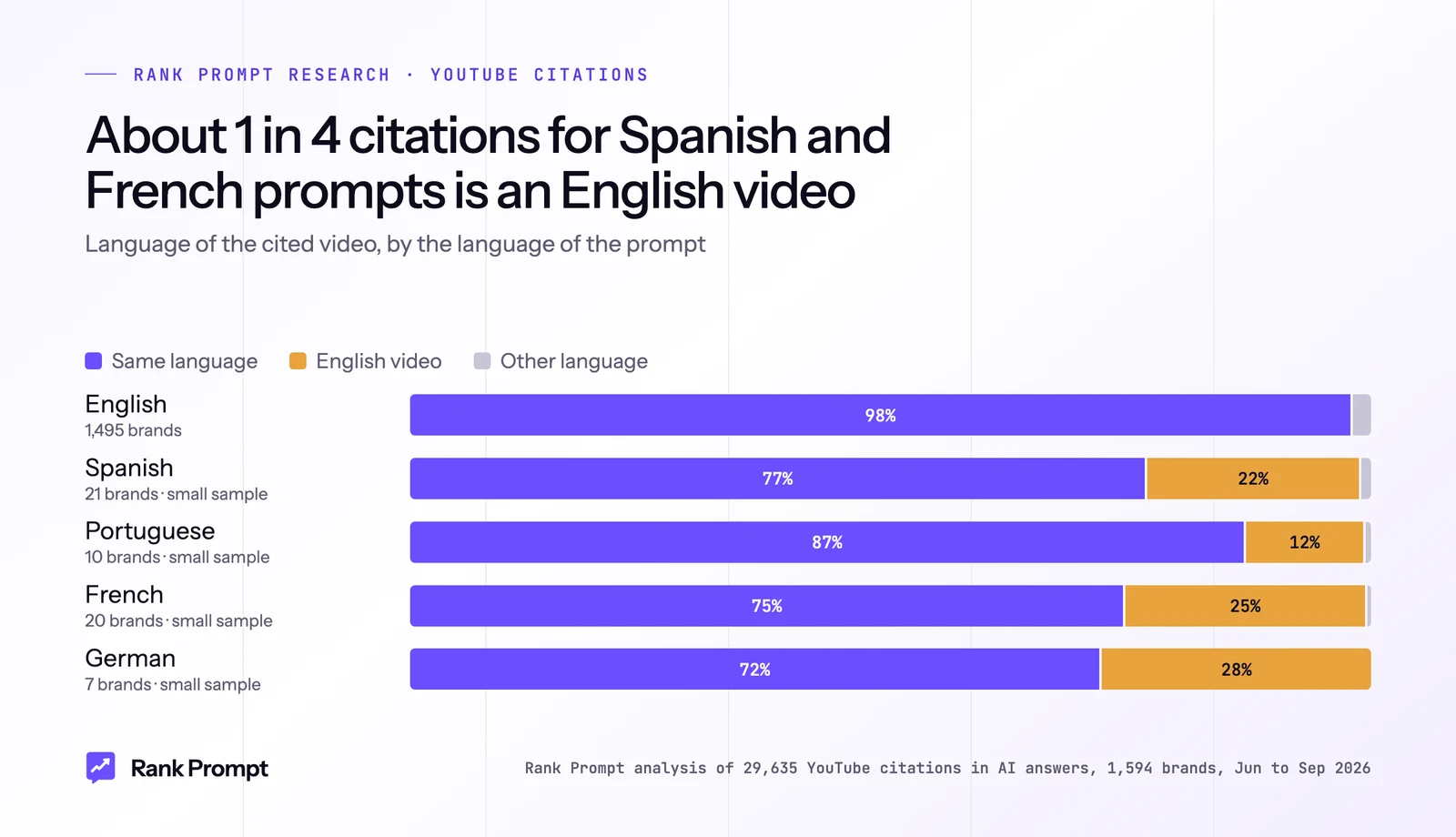
Language of the cited video, by the language of the prompt.
That’s a gap for anyone publishing in the buyer’s language. These samples are small (about 20 brands each), so read them as a signal, not a rule.
YouTube citations by industry
Who gets cited depends on what you sell. Retail and food brands are cited through individual creators about two-thirds of the time: reviewers, food vloggers and roundup channels.
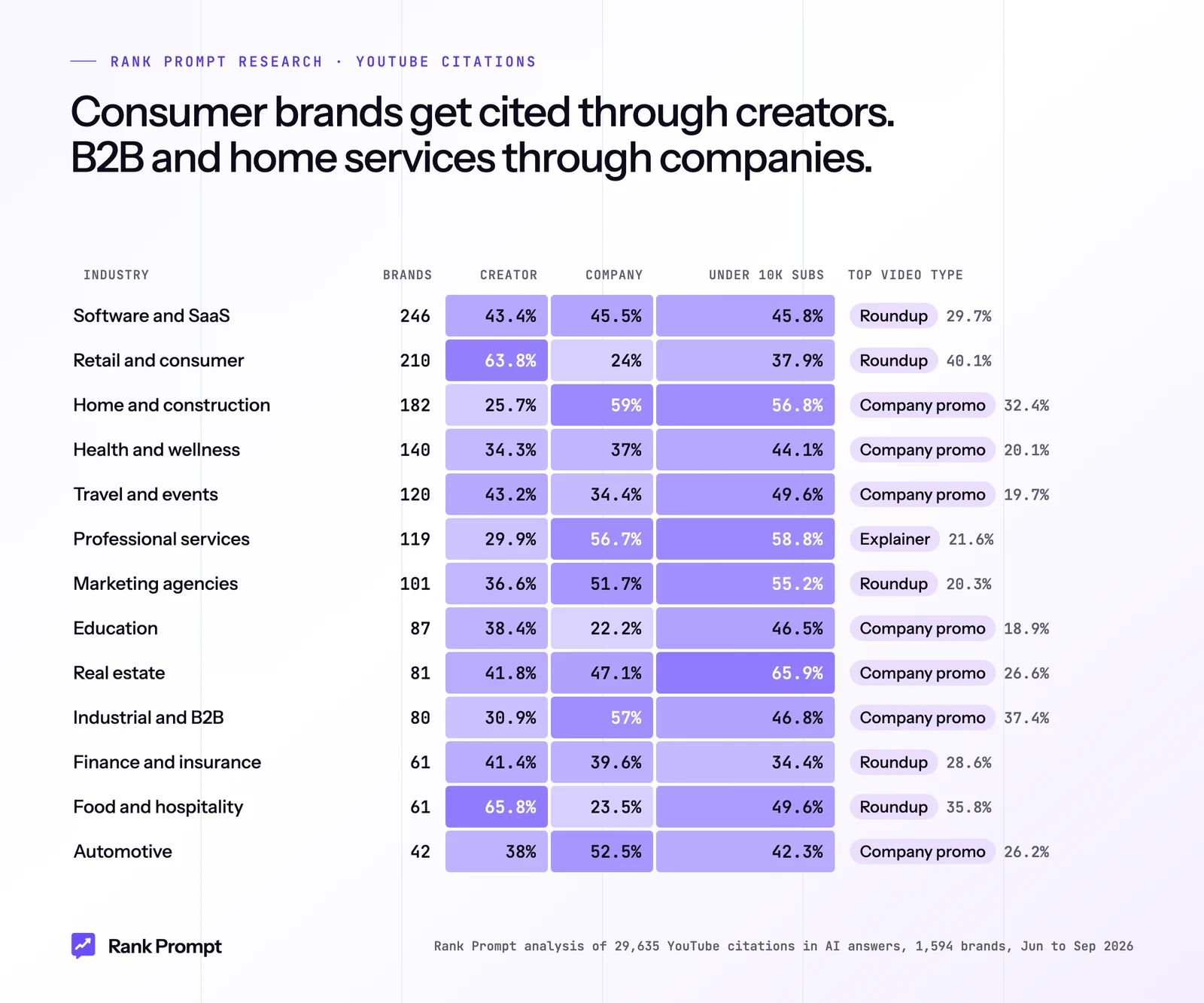
Creator, company and small-channel shares and the leading video type, by industry.
| Industry | Brands | Creators | Companies | Under 10K subs | Top type |
|---|---|---|---|---|---|
| Software and SaaS | 246 | 43.4% | 45.5% | 45.8% | Roundup (29.7%) |
| Retail and consumer | 210 | 63.8% | 24% | 37.9% | Roundup (40.1%) |
| Home and construction | 182 | 25.7% | 59% | 56.8% | Company promo (32.4%) |
| Health and wellness | 140 | 34.3% | 37% | 44.1% | Company promo (20.1%) |
| Travel and events | 120 | 43.2% | 34.4% | 49.6% | Company promo (19.7%) |
| Professional services | 119 | 29.9% | 56.7% | 58.8% | Explainer (21.6%) |
| Marketing agencies | 101 | 36.6% | 51.7% | 55.2% | Roundup (20.3%) |
| Education | 87 | 38.4% | 22.2% | 46.5% | Company promo (18.9%) |
| Real estate | 81 | 41.8% | 47.1% | 65.9% | Company promo (26.6%) |
| Industrial and B2B | 80 | 30.9% | 57% | 46.8% | Company promo (37.4%) |
| Finance and insurance | 61 | 41.4% | 39.6% | 34.4% | Roundup (28.6%) |
| Food and hospitality | 61 | 65.8% | 23.5% | 49.6% | Roundup (35.8%) |
| Automotive | 42 | 38% | 52.5% | 42.3% | Company promo (26.2%) |
Home services, industrial and professional services flip that. Most of their cited videos come from company channels, and often small ones.
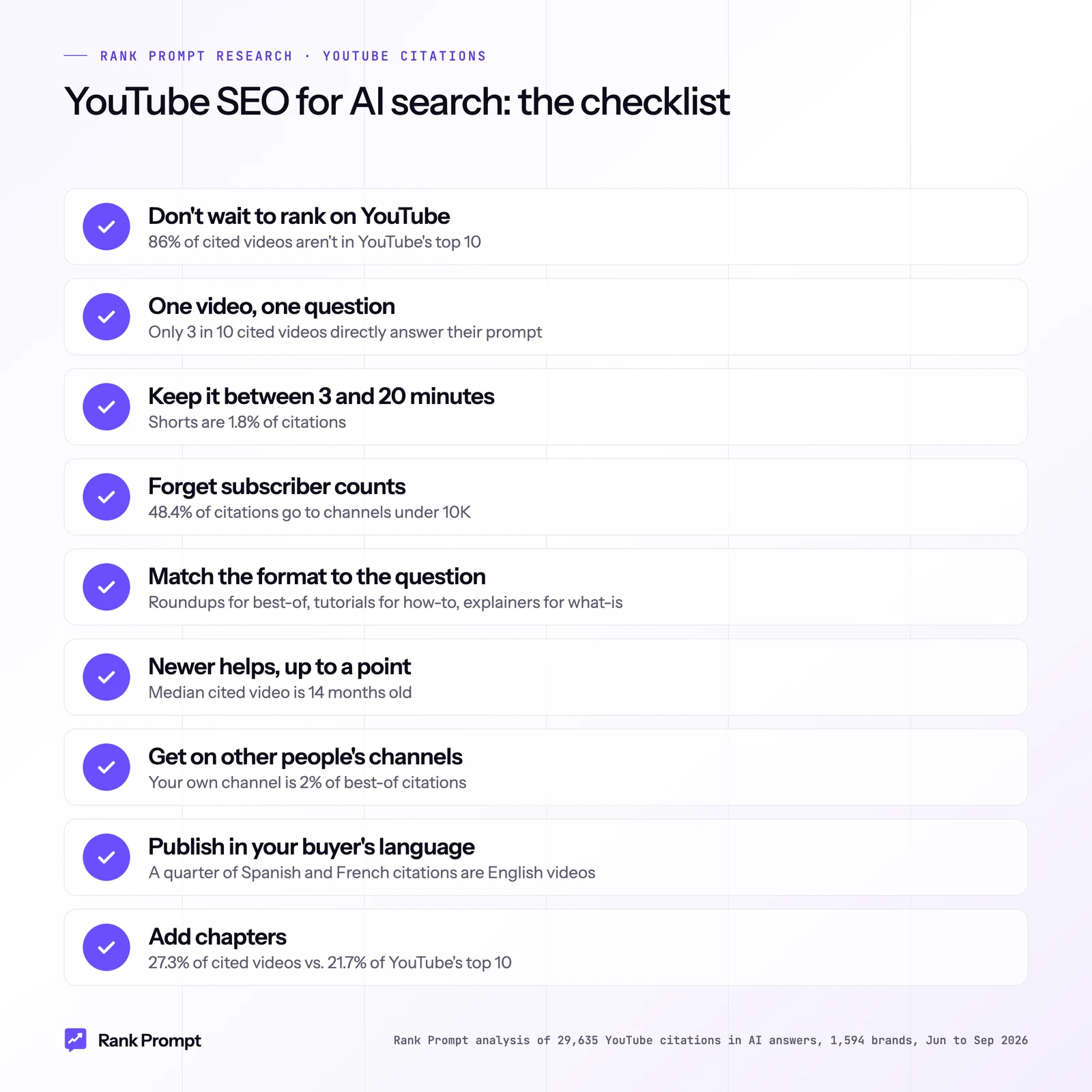
YouTube SEO for AI search: 9 things that get videos cited
Here’s what the data says to do if you want your videos in AI answers, not just YouTube search.
- Don’t wait to rank on YouTube. 86% of cited videos aren’t in YouTube’s top 10 for the question they’re cited on.
- One video, one question. Only 3 in 10 cited videos directly answer their prompt, and those sit higher in the answer.
- Keep it between 3 and 20 minutes. Six in ten cited videos land there, and Shorts are under 2% of citations.
- Forget subscriber counts. Half of citations go to channels under 10K subscribers.
- Match the format to the question. Roundups for best-of, tutorials for how-to, explainers for what-is.
- Newer helps, up to a point. Cited videos are half as old as YouTube’s top results, but the median is still 16 months.
- Get on other people’s channels. For discovery questions, creators’ roundups do the work, not your own channel.
- Publish in your buyer’s language. A quarter of Spanish and French citations still go to English videos.
- Add chapters. 27% of cited videos have them, vs. 22% of YouTube’s top 10, and they take five minutes.
The fastest way to act on this is to see which YouTube videos AI already cites for your own prompts. Rank Prompt’s citation tracking shows every source behind every answer, YouTube included.
Methodology
Data. Every YouTube URL cited in AI answers tracked on Rank Prompt between June 23 and September 23, 2026: 29,635 citations of 16,022 videos from 10,835 channels, across 1,594 brands and 13,788 prompts. Staff, test and sandbox accounts were excluded.
Brand-weighted. One account made up 26.6% of all YouTube citations, so every share is computed per brand first and then averaged. A brand with 2,000 citations counts the same as one with 5.
Video data. Views, duration, upload date, chapters and subscriber counts come from the YouTube Data API. 158 videos had been deleted or made private and were excluded.
Labels. Video type, channel type, question type, industry and relevance were classified with a structured decision model, with a manual check of random samples.
YouTube comparison. All 13,788 prompts were searched on youtube.com on September 23, 2026, from each prompt’s country and in its language, and the top 10 videos were compared with the videos cited for that prompt. Ranges are 95% bootstrap intervals resampling brands. For 53 prompts (0.4%), YouTube returned no videos even though the AI cited one.
Platform reach. The share of brands that get any YouTube citation per platform comes from a separate export covering July 2025 to August 2026.
Limits. These are the brands, industries and countries Rank Prompt customers chose to track, mostly US, so this is not a market sample. Citations span three months while the YouTube search ran once, and YouTube’s results change over time.



 ChatGPT