
Quick answer
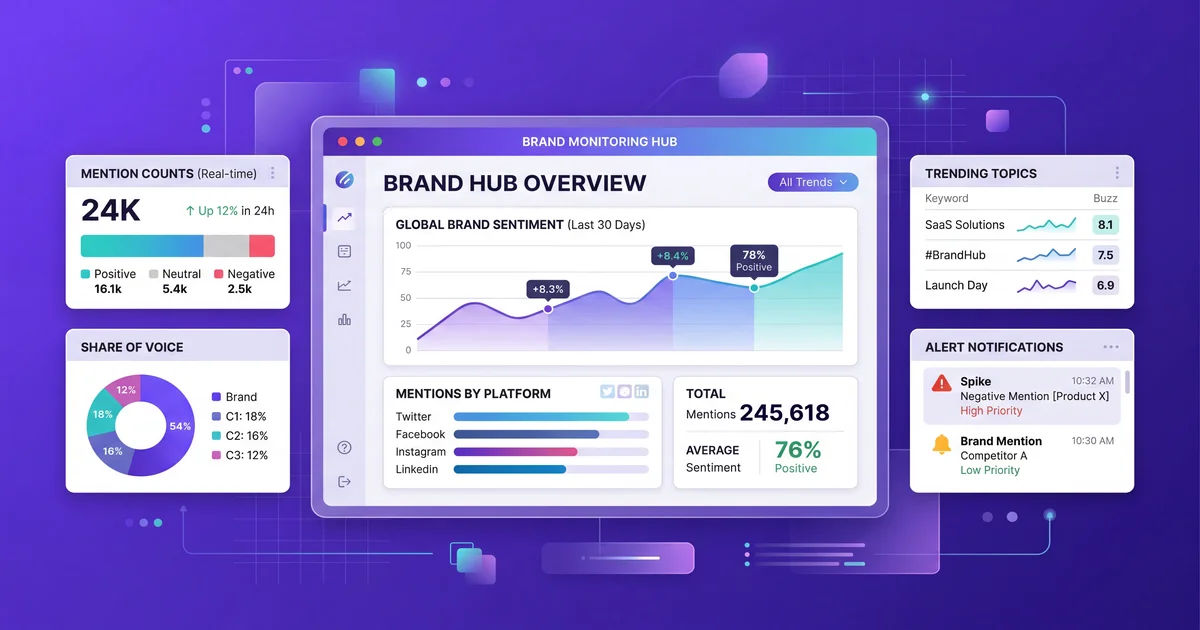
An AI mention tracker is a tool that scans  ChatGPT,
  Gemini,
  Perplexity,
  Grok, and
  Claude to show whether they name your brand. The leading options are Rank Prompt (best all-round, prompt-level and multilingual), Profound (enterprise, national-scale), and Peec AI (competitor benchmarking). Choose one by matching engine coverage, prompt volume, and pricing to your goals.
This is a how-to-choose guide, not a ranked list. If you want the full comparison of every tool on the market, read our best AI search visibility tracking tools roundup. Here we focus on the criteria that separate a strong AI mention tracker from a weak one, plus a step-by-step evaluation workflow you can run before you pay for anything. If one engine matters most to you, start with its own page: ChatGPT mention tracker, Perplexity mention tracker, Gemini mention tracker, AI Mode mention tracker, Claude mention tracker or Grok mention tracker.
AI assistants like ChatGPT, Gemini, Grok, and Perplexity now answer questions instead of returning blue links. They synthesize responses from structured data, citations, and recognized entities, often without sending a click to your site. If your brand isn’t cited in those answers, you’re absent from a discovery layer that keeps growing. That is the problem an AI mention tracker solves, and picking the right one starts with knowing what to measure.
Why an AI Mention Tracker Matters in 2026
Tools like ChatGPT, Gemini, and Perplexity generate answers from structured content and known entities, and those answers shape buyer perception before anyone reaches your site. When Google shows an AI Overview, clicks to the #1 organic result fall by roughly a third (Ahrefs measured 34.5%), so a mention inside the answer is now worth more than a link below it.
Unlike SEO, where ranking is the goal, AI visibility is about being referenced, summarized, and trusted. If you’re not named in the answer, you’re invisible to that buyer. A tracker tells you which engines include you, which sources they cite, and where the gaps are. The rest of this guide covers how to choose one.
The 7 Criteria for Choosing an AI Mention Tracker
Most tools claim to do the same thing. These seven criteria separate a tracker that changes your strategy from one that just produces a dashboard. Score each option against them and weight the ones that match your goals.
- Engine coverage. Confirm it tracks the assistants your buyers actually use: ChatGPT, Gemini, Perplexity, Grok, Claude, and Google AI Overviews. A tool that only reads AI Overviews misses conversational assistants entirely.
- Prompt-level detail. You want to see which specific prompts include or exclude your brand and why, not just an aggregate score. Prompt-level data is what turns tracking into a fix list.
- Citation capture. The best trackers list the exact sources each answer pulls from. That tells you which pages to strengthen and which competitors own the citations you want.
- Competitor benchmarking. Share-of-voice against your top three rivals, by engine and prompt type, tells you whether you’re gaining or losing ground.
- Multilingual and regional support. If you serve multiple markets, confirm the tool runs prompts by location and language. Many enterprise tools track English-only on their base plans.
- Actionable recommendations. Raw data is cheap. Look for schema, citation, and content suggestions tied to specific gaps, so the tool shortens the path from insight to fix.
- Pricing and prompt quotas that fit your scan cadence. Weekly scans across many prompts add up fast. Match the number of prompts a plan covers to how often you plan to run, and check what extra usage costs.
How to Evaluate a Platform: A 5-Step Workflow
Run this before you commit to any annual plan. It takes about a week and surfaces the differences a feature list hides.
- Write down 3 outcomes you need now. For example: measure ChatGPT mention rate, track AI Overviews for 20 keywords daily, and benchmark two competitors. Rank them must-have vs. nice-to-have.
- Build a 50-to-200 prompt test set. Mix branded, category, and competitor prompts across the cities and languages you serve. This is the single best predictor of real-world value.
- Run a 7-day pilot on two tools. Compare mention rate, first-position share, citation quality, and how quickly each surfaces a change after you update a page.
- Check data access and exports. Confirm CSV, API, or webhook support and at least 90 days of history so results flow into your reporting stack.
- Score total cost against must-haves. Add plan price, extra seats, the cost of usage beyond the plan, and setup time, then pick the highest score on must-haves per dollar. Don’t pay for coverage you won’t use.
How the Leading AI Mention Trackers Compare
Using the criteria above, here is how the three platforms most teams shortlist stack up. For the exhaustive list of every tracker on the market, see the full comparison.
Rank Prompt (best all-round). Built specifically for Answer Engine Optimization, it scans across ChatGPT, Claude, Gemini, Perplexity, Grok, and Google AI Mode (AI Overviews), shows prompt-level diagnostics, captures the exact citations behind each answer, and runs multilingual and location-based prompts on every plan. Its schema and citation suggestions tie directly to the gaps it finds, which is why it scores highest on the “actionable recommendations” criterion. Start with a free AI visibility scan to see whether ChatGPT and Gemini name your brand.
Profound (enterprise, national scale). Strong on high-volume, English-language query tracking and analyst-style reporting for CMOs and PR teams, with a dashboard spanning ChatGPT, Gemini, Perplexity, Copilot, and Grok. It raised a $20M Series A led by Kleiner Perkins, with NVIDIA NVentures participating. The tradeoff: base plans skew English-only and prioritize national trends over granular, prompt-specific detail.
Peec AI (competitor benchmarking). Focused dashboards for inclusion, citations, and share-of-voice across ChatGPT, Perplexity, Claude, and Gemini, with unlimited seats and multi-country tracking that make it easy to share results across a team. It leans toward analytics rather than built-in optimization, so pair it with a workflow for acting on the gaps.
Beyond dedicated trackers, two free spot-check tools are worth keeping in the mix. Perplexity shows live citations for every answer, so you can manually verify whether your domain is being pulled. Google Search Console confirms your content is indexed and schema-tagged, which underpins whether Gemini can cite you at all.
A Sample Tracking Workflow for Multi-Location Brands
Once you’ve chosen a tool, here’s how a franchise with locations in Miami, Austin, and Denver puts it to work with Rank Prompt:
- Create location-specific prompt clusters. Run scans for each market (for example, “best tacos in Denver,” “top gyms in Austin”).
- Add multilingual prompts. Include Spanish-language variations if you serve bilingual audiences.
- Use the Brand Tracker. Monitor AI visibility over time for each market or location group.
- Analyze citation influence. See which sources power the answers and where your content is missing.
- Pair with Google Search Console. Track how your structured data and local content perform on the web.
- Compare across LLMs. Evaluate differences between ChatGPT, Claude, Gemini, Perplexity, Grok, and Google AI Mode (AI Overviews).
- Act on AI Suggestions. Use Rank Prompt’s recommendations to boost citations and schema where you underperform.
Pro tip: refresh your About page, FAQ schema, and blog content quarterly so LLMs summarize you with current, geographically relevant information.
Compare the Leading AI Mention Trackers
Use this comparison to match a platform to your needs based on prompt-level depth, regional flexibility, and price. The free options are best as spot-checks alongside a dedicated tracker, not replacements for one.
| Platform | Best For | Regional Tracking | Language Flexibility | AI Assistants | Starting Price |
|---|---|---|---|---|---|
 Rank Prompt Rank Prompt | All-round AEO | Yes (city, zip, neighborhood) | Yes (31 languages) | ChatGPT, Claude, Gemini, Perplexity, Grok, AI Mode | $49/month |
 Profound Profound | Enterprise scale | Limited (national) | One language per plan | ChatGPT, Gemini, Copilot, Grok | $99/month |
 Peec AI Peec AI | Competitor benchmarks | Yes (multi-country) | Yes (add-on engines) | ChatGPT, Perplexity, Claude, Gemini | ~$96/month |
| Perplexity (Manual) | Free citation checks | No | English-only | Perplexity only | Free |
 Google Search Console Google Search Console | Indexation baseline | Some | Yes (if content structured) | Indirect (Gemini) | Free |
Final Thoughts
Choosing an AI mention tracker comes down to matching engine coverage, prompt-level depth, regional flexibility, and price to what you actually need to prove. Score your shortlist against the seven criteria, run a 7-day pilot on your own prompts, and pick the tool that earns the highest score on your must-haves per dollar.
For most teams that balance lands on Rank Prompt: purpose-built for AEO, prompt-level and multilingual on every plan, with citation capture and fix recommendations tied to real gaps. Enterprises focused on national trends often prefer Profound, and teams that live in competitor benchmarking gravitate to Peec AI.
Want to know where you stand today? Run a free AI visibility scan with Rank Prompt and see whether ChatGPT, Gemini, and Perplexity name your brand.



 ChatGPT
  AI Mode