
Quick answer
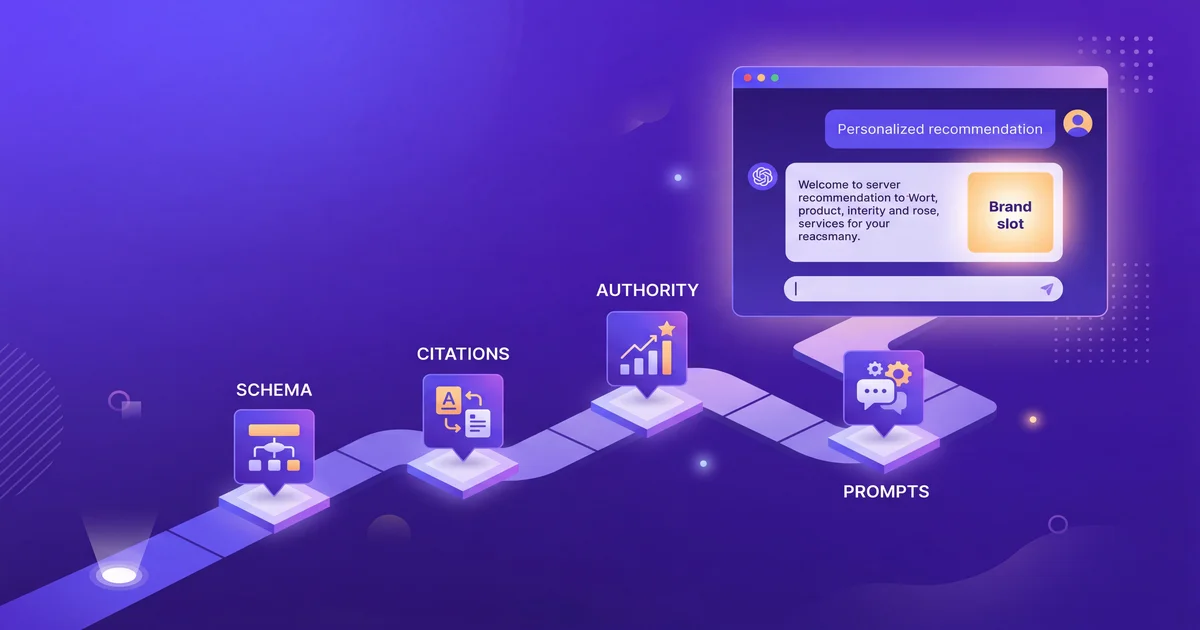
To get  ChatGPT to recommend your business, make your brand an unambiguous entity (consistent profiles plus Organization and FAQ schema), earn mentions on the sources ChatGPT already trusts (G2, Crunchbase, industry roundups, credible press), and publish content that answers your buyers’ questions directly rather than selling at them. Then measure which prompts name you, across every assistant, and close the gaps that show up.
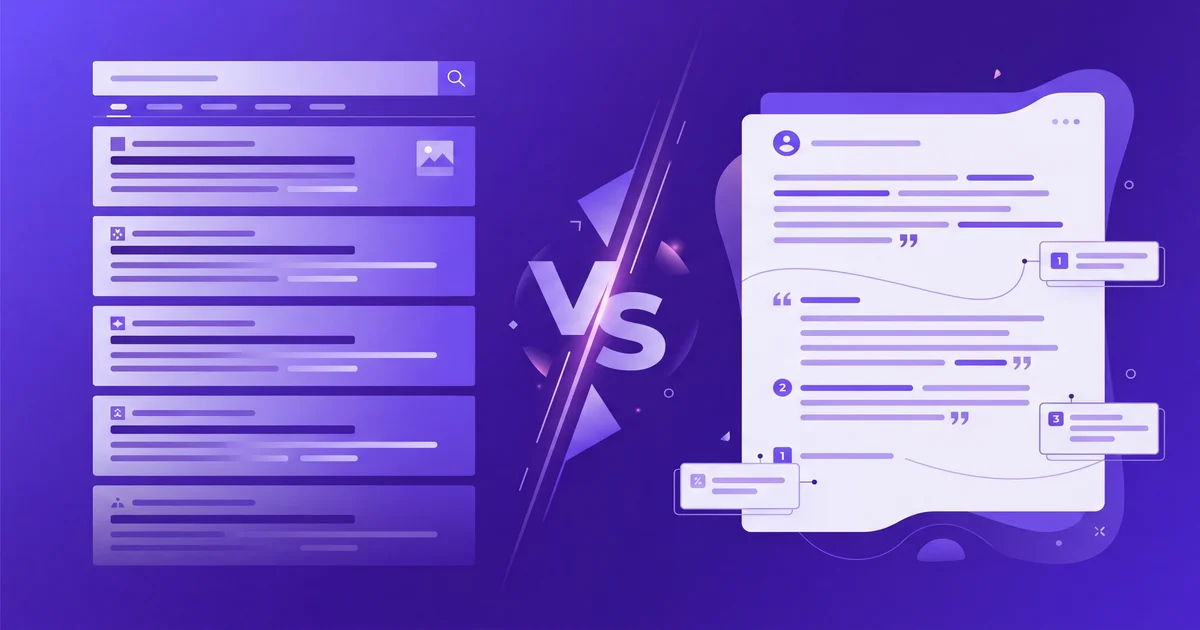
Ranking in ChatGPT is not the same job as ranking on Google. Instead of scrolling ten blue links, people ask a question and get one confident answer naming a handful of brands. If you are not in it, you are invisible, and there is no second page to fall back to.
Why ChatGPT recommendations matter
People now use ChatGPT to research products, compare services and shortlist vendors before they ever reach a search results page. That shift has three consequences for a brand:
- Organic traffic no longer tells the whole story. You can rank on Google and still be absent from the answer that decided the buyer’s shortlist.
- AI mentions are becoming social proof. Being named by an assistant carries the authority a paid ad never will.
- Your competitors are already there. Somebody is being recommended for your category prompts right now.
What ranking in ChatGPT actually means
There is no single “position one”, because every answer is generated in real time and will vary between users and sessions. What does exist is a pattern in what gets pulled into answers. Rather than a rank, you have a mention rate: how often you are named across the prompts that matter, and how prominently.
That is the number to optimise, and the reason a traditional rank tracker cannot see any of this.
How ChatGPT chooses what to recommend
Training data
ChatGPT is trained on a blend of licensed data, publicly available web content and other text up to its training cutoff. Anything the model “knows” about you without searching comes from here, which is why long-standing, consistent third-party coverage compounds.
Live web retrieval
Current ChatGPT ships with web search built in, as do Perplexity and Gemini. When a question needs fresh information, the model retrieves and cites live sources: company sites, review aggregators, Wikipedia, and authoritative media. This is the fastest lever you have, because a page published this week can be cited this week.
Citation and authority signals
Models lean toward sources that are easy to trust and easy to parse: high-authority domains, pages with clean structured data, and content that answers the question directly instead of burying the answer beneath a preamble.
Entity recognition
If the model recognises your brand as a distinct entity, with a clear category, location and description, it is far more likely to surface you. Inconsistent naming across your profiles is one of the most common and most fixable reasons a brand never appears.
The signals, side by side
| Signal | What it means | Why it matters |
|---|---|---|
| Entity recognition | Is your brand a known, distinct entity? | Unrecognised brands are rarely named |
| Schema and structure | Organization, FAQPage, AboutPage, sameAs | Helps the model resolve who you are |
| Content clarity | Question-and-answer formatting, short declaratives | Improves the match to a user’s prompt |
| Citations and mentions | Referenced on reputable third-party sites | Carries the trust the model borrows |
| Prompt alignment | Content maps to how people actually ask | Decides whether you are retrieved at all |
Step by step: how to get ChatGPT to recommend your business
Step 1: Audit where you stand today
Before changing anything, find out which prompts already name you, how you are described, and who is being recommended instead. Run an AI visibility scan with Rank Prompt across ChatGPT, Gemini, Perplexity, Claude and Grok, or start with the free AI visibility checker if you just want a first read.
Without this baseline you cannot tell whether anything you do next worked.
Step 2: Make yourself an unambiguous entity
- Add your brand to structured platforms: Crunchbase, LinkedIn, Product Hunt, G2, Capterra, your Google Business Profile.
- Use the identical name, description, logo, founding year, location and category everywhere. Variants split the entity.
- Link the profiles to each other and to your site, and mirror them in
sameAson your Organization schema.
Step 3: Add the structured data that resolves who you are
- Organization and AboutPage: who you are, what category you belong to, where you operate.
- FAQPage: direct question-and-answer pairs, which is the format assistants quote most readily.
- Product or Service: what you actually sell, in machine-readable terms.
- BreadcrumbList and WebPage: site structure and hierarchy.
Validate with Google’s Rich Results Test. If you are on WordPress, Rank Math and Yoast will emit most of this for you.
Step 4: Write content that answers the question
Assistants extract and summarise. Content that buries its answer under three paragraphs of positioning does not survive that. Publish pages that answer the questions your buyers ask verbatim:
- “What is [your category], and how does it work?”
- “Best [category] tools in 2026”
- “How does [your product] compare to [competitor]?”
- “[Category] for [specific segment], and what it costs”
Keep the answer near the top, use descriptive subheadings, prefer short declarative sentences, and cite your sources. Replace unfalsifiable claims with checkable ones: “used by more than 5,000 SMEs and integrates with 20+ accounting tools” earns a citation in a way “we are the best” never will.
Step 5: Earn mentions on the sources the model trusts
Your own site is not enough. Assistants borrow trust from third parties, so pursue:
- Review platforms: G2, Capterra, Clutch, Trustpilot.
- Structured directories: Crunchbase, Product Hunt, industry-specific listings.
- Wiki-style and reference pages, where you genuinely meet the notability bar.
- Industry roundups and listicles, which assistants quote constantly for “best X” prompts.
- Credible press and podcasts, especially coverage that describes what you do in the words buyers use.
Step 6: Find the prompts that actually matter
You cannot optimise for questions you have not identified. Build the list from several angles:
- Use Rank Prompt’s prompt scanning to see which prompts your competitors appear in and you do not.
- Test manually: ask ChatGPT “best tools for [job]”, “alternatives to [competitor]”, “affordable [category] for small teams”.
- Mine Google’s People Also Ask boxes, which mirror how people phrase things.
- Use AlsoAsked or Answer the Public for real query formats.
Then build content against those prompts specifically, and make sure your brand name appears in the answer you publish.
Step 7: Track, then adjust
Model behaviour shifts without notice, and a mention you earned in March can quietly disappear in May. Check weekly on a rolling average rather than reacting to a single scan, and watch mention rate, first-mention share, and which sources were cited when a competitor beat you.
Common mistakes that keep brands invisible
- No structured data. The model has to guess who you are, and often guesses wrong.
- Inconsistent branding. Different names, descriptions or logos across profiles fragment the entity.
- Only optimising your own site. External credibility is doing most of the work.
- Applying Google-era tactics. Keyword density and thin backlink volume do not move assistants.
- No explainer content. With no clear “what is [category]” page, you cannot be retrieved for the questions that introduce buyers to it.
- Vague, jargon-heavy copy. If a human cannot extract a claim from a sentence, neither can a model.
- Treating it as a one-off. Answers drift. This is a programme, not a project.
How Rank Prompt makes it measurable
Rank Prompt exists for the measurement half of this loop:
- Prompt scanning: which prompts name you, and which name your competitors instead.
- Cross-engine comparison: ChatGPT against Gemini, Perplexity, Claude, Grok and Google AI Mode.
- Citation capture: the exact sources each answer relied on, so you know who to pitch.
- Competitor benchmarking: share of voice by engine and prompt type.
- Schema and content recommendations: what to fix, ranked by likely impact.
The bottom line
Answer Engine Optimization is not a future discipline. Assistants are already deciding which brands enter a buyer’s consideration set, and the mechanics are learnable: be a clear entity, be cited by trusted sources, answer real questions plainly, and measure what changes.
The competition for this is still light. Start with a scan of where you stand, fix the entity and schema gaps it reveals, and work the citation list from there.
Your next customer may not be searching. They may be asking.
 ChatGPT
  AI Mode
  Claude
  Grok
Grok  Perplexity